
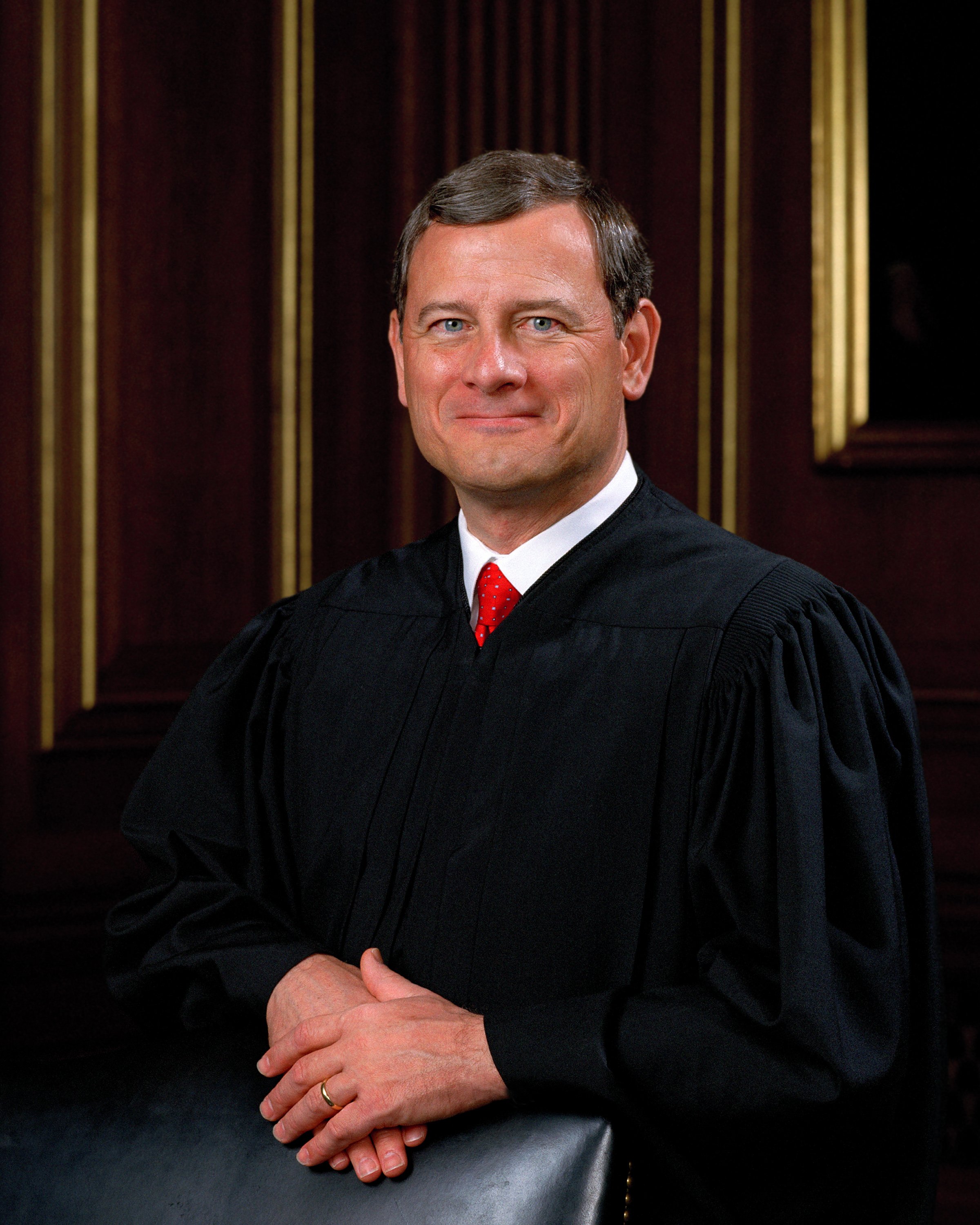
Historical · U.S. Court of Appeals for the District of Columbia Circuit
John Glover Roberts Jr.
Former Circuit Judge · U.S. Court of Appeals for the District of Columbia Circuit · 2003–2005 · Appointed by George W Bush
John Glover Roberts Jr. served as a circuit judge of the U.S. Court of Appeals for the District of Columbia Circuit (2003–2005). Jr. was appointed by George W Bush.
Key facts
- Full name
- John Glover Roberts Jr.
- Court
- U.S. Court of Appeals for the District of Columbia Circuit
- Office
- Circuit Judge (U.S. Court of Appeals)
- Status
- Former circuit judge
- Duty status
- Not serving
- Appointment
- Senate-confirmed
- FJC seat
- CADC0607
- Tenure
- 2003–2005
- Confirmed
- 2003-05-08
- Born
- 1955
- Died
- —
- First year on the bench
- 2003
- Dataset version
- 1.20260711
Appointment & service record
U.S. Court of Appeals for the District of Columbia Circuit · 2003–2005
- Seat
- CADC0607
- Appointment
- Senate-confirmed
- Appointing president
- George W Bush
- Confirmed
- 2003-05-08
- Commissioned
- 2003-06-02
- Senior status
- —
Court, FJC seat, appointment type (Senate-confirmed or recess), appointing president, confirmation and commission dates, and senior-status date are drawn from the Federal Judicial Center Biographical Directory and Wikidata.[1][2][3]
Sources
- [1]https://www.fjc.gov/node/1391841fjc · retrieved 2026-07-11
- [2]https://www.fjc.gov/history/judges/biographical-directory-article-iii-federal-judges-exportfjc-directory · retrieved 2026-07-11
- [3]https://www.wikidata.org/wiki/Q11153Wikidata · retrieved 2026-07-11
Biographical narrative
1,313 words · sourced from the Wikipedia REST extract
John Glover Roberts Jr. is an American jurist who served as a judge on the United States Court of Appeals for the District of Columbia Circuit from 2003 to 2005. Born in 1955, Roberts had a distinguished career as an appellate advocate before his appointment to the federal bench by President George W. Bush, a Republican. His tenure on the D.C. Circuit, though brief, represented a significant milestone in a legal career that had already included extensive experience in both government service and private practice.
Early life and legal career
Roberts was born on January 27, 1955, in Buffalo, New York, to Rosemary Podrasky and John Glover Roberts Sr., both devout Catholics. His father, who had Irish and Welsh ancestry, worked as an electrical engineer for Bethlehem Steel Corporation's factory in Lackawanna, while his mother was descended from Slovak immigrants. Roberts grew up with three sisters and spent his early childhood in Hamburg, New York. When he was ten years old, his family relocated to Long Beach, Indiana, after his father accepted a position managing a new steel plant in nearby Burns Harbor.
Roberts attended La Lumiere School, a Catholic boarding school in La Porte, Indiana, known for its academic rigor. There he distinguished himself both academically and in extracurricular activities, serving as captain of the football team, competing in wrestling at a regional championship level, and participating in track and field. He also engaged in choir and drama and served as co-editor of the school newspaper. In 1973, he graduated as class valedictorian and became the first graduate of La Lumiere School to attend Harvard University.
At Harvard College, Roberts initially pursued his interest in becoming a historian, majoring in history. He entered with sophomore standing due to his exceptional high school academic record. During his undergraduate years, he focused particularly on modern European history while maintaining an interest in politics. Roberts developed a reputation as a serious and formal student who attended Catholic Mass every Sunday at St. Paul Church. He spent his summers working at the steel plant his father managed. His academic excellence earned him the Edwards Whitaker Scholarship for outstanding scholastic achievement in his first year. His essay "Marxism and Bolshevism: Theory and Practice" won the William Scott Ferguson Prize for the most outstanding essay by a sophomore history major. His senior thesis on Daniel Webster, titled "The Utopian Conservative: A Study of Continuity and Change in the Thought of Daniel Webster," won a Bowdoin Prize. Roberts graduated in 1976 with a Bachelor of Arts degree in history, summa cum laude, and was elected to Phi Beta Kappa, completing his undergraduate degree in three years.
Although Roberts had initially intended to pursue a doctorate in history and become a professor, a surplus of history graduate students led him to reconsider his career path. He enrolled at Harvard Law School, where he quickly distinguished himself. His first-year performance placed him among the top students in a class of approximately 550, earning him a position on the Harvard Law Review. He was selected as managing editor of the prestigious journal. Despite the demanding workload—which at one point required him to admit himself to a hospital due to exhaustion—Roberts graduated magna cum laude in 1979 with a Juris Doctor degree, finishing at the top of his class.
Following law school, Roberts served as a law clerk to Judge Henry Friendly of the United States Court of Appeals for the Second Circuit, and subsequently to Justice William Rehnquist of the Supreme Court. These clerkships provided him with invaluable experience in federal appellate practice and judicial reasoning. Roberts then entered government service, holding positions in the Department of Justice during the administrations of Presidents Ronald Reagan and George H. W. Bush, serving from 1989 to 1993 in various capacities within the executive branch.
After his government service, Roberts transitioned to private practice, joining a law firm where he developed one of the nation's leading appellate practices. Over the course of his career in private practice, he argued numerous cases before the Supreme Court, establishing himself as one of the most accomplished appellate advocates in the country. His expertise in Supreme Court litigation and constitutional law made him a prominent figure in the legal community.
In 1992, President George H. W. Bush nominated Roberts to serve on the United States Court of Appeals for the District of Columbia Circuit. However, the Senate did not act on this nomination, and it expired without a confirmation vote taking place.
Federal appellate service
More than a decade after his first nomination, Roberts was again nominated to the D.C. Circuit, this time by President George W. Bush, a Republican. He was confirmed by the Senate on May 8, 2003, and took his seat on the court, which is often considered the second most important federal court in the United States due to its jurisdiction over many cases involving federal agencies and government action.
Roberts served on the D.C. Circuit for approximately two years, from 2003 to 2005. During this period, he participated in the court's work reviewing administrative agency decisions, constitutional questions, and other matters within the circuit's jurisdiction. The D.C. Circuit has historically been a significant stepping stone to the Supreme Court, and several justices have served on this court before their elevation to the nation's highest tribunal.
His service on the circuit court was cut short in 2005 when he was nominated to the Supreme Court. Initially nominated as an associate justice, Roberts was subsequently nominated as Chief Justice following the death of Chief Justice William Rehnquist, for whom Roberts had clerked decades earlier. He was confirmed to that position and departed the D.C. Circuit to assume his new role, ending his brief but notable tenure as a circuit judge.
Jurisprudence and legacy
Roberts's time on the D.C. Circuit, while relatively short, represented an important transition in his career from advocate to jurist. His experience on the court provided him with the opportunity to apply his extensive knowledge of appellate law and constitutional principles from the perspective of a federal judge rather than an advocate. The D.C. Circuit's docket, which frequently involves complex administrative law matters and questions of executive power, offered Roberts exposure to issues that would later prove relevant in his subsequent judicial service.
The brevity of his circuit court tenure means that his judicial record from this period is limited compared to judges who serve for many years on the courts of appeals. Nevertheless, his appointment to and confirmation for the D.C. Circuit demonstrated the legal community's and the Senate's recognition of his qualifications and expertise in federal law. His path from circuit judge to Chief Justice within a span of two years was relatively unusual, reflecting both the timing of vacancies on the Supreme Court and the regard in which he was held.
Roberts's background as an appellate advocate, combined with his clerkship experience and government service, informed his approach to judging during his circuit court service. His academic training in history, particularly his study of figures such as Daniel Webster and his focus on continuity and change in legal and political thought, provided a foundation for understanding constitutional questions in their broader historical context. This scholarly background, combined with his practical experience arguing before the Supreme Court, gave him a unique perspective as a federal appellate judge.
The D.C. Circuit has long been regarded as a training ground for future Supreme Court justices, and Roberts's trajectory followed this pattern. His service on the court, though brief, placed him within an institution known for handling cases of national significance and for the high caliber of its judges. The experience of working collegially with other distinguished jurists and managing a diverse caseload contributed to his development as a judge, even if the short duration of his service limited the extent of his influence on the circuit's jurisprudence during that period.
Sources & provenance
Every quantitative or attributable claim above carries a per-section [N] marker that resolves to the corresponding URL below. Each entry records the upstream provider, the canonical URL, and the timestamp at which the underlying source was retrieved.
Key facts
- https://www.fjc.gov/node/1391841fjc · retrieved 2026-07-11
- https://www.fjc.gov/history/judges/biographical-directory-article-iii-federal-judges-exportfjc-directory · retrieved 2026-07-11
- https://www.wikidata.org/wiki/Q11153Wikidata · retrieved 2026-07-11
Biographical narrative
- https://en.wikipedia.org/wiki/John_RobertsWikipedia · retrieved 2026-07-11
Explore the federal judiciary
The U.S. Courts of Appeals are the intermediate appellate courts of the federal judiciary — thirteen circuits sitting between the district courts and the Supreme Court. Browse the full roster of judges on the U.S. Court of Appeals for the District of Columbia Circuit, or explore how the appointed federal judiciary fits into the federal government.