
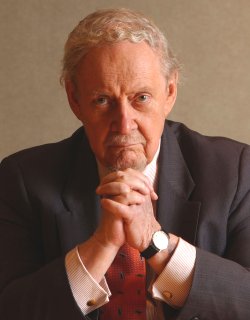
Historical · U.S. Court of Appeals for the District of Columbia Circuit
Robert Heron Bork
Former Circuit Judge · U.S. Court of Appeals for the District of Columbia Circuit · 1982–1988 · Appointed by Ronald Reagan
Robert Heron Bork served as a circuit judge of the U.S. Court of Appeals for the District of Columbia Circuit (1982–1988). Bork was appointed by Ronald Reagan.
Key facts
- Full name
- Robert Heron Bork
- Court
- U.S. Court of Appeals for the District of Columbia Circuit
- Office
- Circuit Judge (U.S. Court of Appeals)
- Status
- Former circuit judge
- Duty status
- Not serving
- Appointment
- Senate-confirmed
- FJC seat
- CADC0504
- Tenure
- 1982–1988
- Confirmed
- 1982-02-08
- Born
- 1927-03-01
- Died
- 2012-12-19
- First year on the bench
- 1982
- Dataset version
- 1.20260711
Appointment & service record
U.S. Court of Appeals for the District of Columbia Circuit · 1982–1988
- Seat
- CADC0504
- Appointment
- Senate-confirmed
- Appointing president
- Ronald Reagan
- Confirmed
- 1982-02-08
- Commissioned
- 1982-02-09
- Senior status
- —
Court, FJC seat, appointment type (Senate-confirmed or recess), appointing president, confirmation and commission dates, and senior-status date are drawn from the Federal Judicial Center Biographical Directory and Wikidata.[1][2][3]
Sources
- [1]https://www.fjc.gov/node/1378046fjc · retrieved 2026-07-11
- [2]https://www.fjc.gov/history/judges/biographical-directory-article-iii-federal-judges-exportfjc-directory · retrieved 2026-07-11
- [3]https://www.wikidata.org/wiki/Q1365780Wikidata · retrieved 2026-07-11
Biographical narrative
1,656 words · sourced from the Wikipedia REST extract
Robert Heron Bork was a judge of the United States Court of Appeals for the District of Columbia Circuit from 1982 to 1988, appointed by President Ronald Reagan, a Republican. Before his appellate service, he was a prominent legal scholar and professor at Yale Law School, served as Solicitor General of the United States from 1973 to 1977, and briefly served as Acting Attorney General during the Watergate crisis. He became widely known for his advocacy of originalist constitutional interpretation and his influential scholarship on antitrust law. In 1987, President Reagan nominated him to the Supreme Court, but the Senate rejected the nomination following an intensely contested confirmation process. After leaving the bench in 1988, he continued his career as an author, scholar, and public intellectual until his death in 2012.
Early life and legal career
Robert Heron Bork was born on March 1, 1927, in Pittsburgh, Pennsylvania. He was the sole child of Harry Philip Bork Jr., who worked as a purchasing agent for a steel company, and Elizabeth Kunkle, who was a schoolteacher. His paternal heritage included German and Irish ancestry, while his mother came from Pennsylvania German background. Bork attended the Hotchkiss School, a preparatory institution in Lakeville, Connecticut, where he later recalled spending much of his time engaged in reading and debate.
He pursued his undergraduate education at the University of Chicago, where he became a member of the Phi Gamma Delta fraternity and earned a Bachelor of Arts degree in 1948. He continued at the same institution for his legal education, enrolling at the University of Chicago Law School. During his time in law school, he served as an editor of the University of Chicago Law Review, demonstrating early academic distinction. His legal studies were interrupted by a two-year leave of absence during which he served in the United States Marine Corps during the Korean War. He completed his legal education in 1953, graduating with a J.D. degree and earning membership in both the Order of the Coif, an honor society recognizing academic excellence in law, and Phi Beta Kappa.
Following law school, Bork spent an additional year fulfilling military service obligations. From 1954 to 1962, he worked in private legal practice at two prominent law firms: Kirkland & Ellis and Willkie Farr & Gallagher. In 1962, he transitioned from private practice to academia, joining the faculty of Yale Law School as a professor. He remained at Yale from 1962 to 1981, though his tenure included a four-year interruption from 1973 to 1977 when he served in the federal government as Solicitor General. During his years teaching at Yale, he instructed numerous students who would go on to prominent careers in law, politics, and public service, including future President Bill Clinton, future Secretary of State Hillary Clinton, civil rights attorney Anita Hill, future Secretary of Labor Robert Reich, California Governor Jerry Brown, journalist Linda Greenhouse, diplomat John Bolton, and legal scholars Samuel Issacharoff and Cynthia Estlund.
As an academic, Bork developed a reputation as an influential scholar in two principal areas: antitrust law and constitutional interpretation. His 1978 book, The Antitrust Paradox, presented arguments that challenged prevailing approaches to antitrust enforcement. He contended that corporate mergers often produced benefits for consumers and that many contemporary interpretations of antitrust statutes were economically unsound and ultimately harmful to consumer interests. He advocated for antitrust law to focus primarily on consumer welfare rather than on preserving competition as an end in itself, arguing that an emphasis on maintaining competition could allow inefficient companies with costly practices to remain in business to the detriment of both consumers and society. His scholarship on antitrust, along with the work of Richard Posner and other scholars associated with law and economics and the Chicago School of economic thought, contributed to a significant shift in how the Supreme Court approached antitrust questions beginning in the 1970s.
Bork also became a prominent advocate of originalism in constitutional interpretation, a judicial philosophy calling for judges to interpret the Constitution according to its original public understanding at the time of ratification. This approach placed him in opposition to many of the doctrinal developments of the Warren and Burger Courts, and his outspoken criticism of those courts' jurisprudence would later become a focal point of controversy.
In March 1973, Bork was appointed Solicitor General of the United States, serving in the Department of Justice under Presidents Richard Nixon and Gerald Ford. In this role, he represented the federal government in arguments before the Supreme Court, handling several significant cases during the 1970s. Chief Justice Warren Burger reportedly characterized Bork as the most effective advocate to appear before the Court during his tenure as Chief Justice. During his time as Solicitor General, Bork hired numerous young attorneys as assistants, several of whom later achieved distinguished careers as judges and legal scholars.
In October 1973, during the Watergate scandal, Bork became Acting Attorney General under extraordinary circumstances known as the Saturday Night Massacre. When President Nixon ordered the dismissal of Special Prosecutor Archibald Cox, who was investigating the Watergate matter, both Attorney General Elliot Richardson and Deputy Attorney General William Ruckelshaus chose to resign rather than carry out the order. As the next-ranking official in the Justice Department, Bork assumed the role of Acting Attorney General and executed the order to dismiss Cox. He served as Acting Attorney General until January 4, 1974, when he was succeeded by William B. Saxbe, a U.S. Senator from Ohio. Bork continued as Solicitor General until 1977, after which he returned to his professorship at Yale Law School.
Federal appellate service
In 1982, President Ronald Reagan, a Republican, appointed Bork to the United States Court of Appeals for the District of Columbia Circuit, often considered the second most important federal court in the nation due to its jurisdiction over many cases involving federal regulatory agencies and government actions. The Senate confirmed his appointment on February 8, 1982, and he took his seat on the court. He served in this capacity for six years, from 1982 until 1988.
The D.C. Circuit during Bork's tenure was widely regarded as one of the most intellectually distinguished federal appellate courts, with a bench that included numerous judges who were considered potential Supreme Court nominees. During his service on the court, Bork participated in the resolution of numerous cases involving administrative law, constitutional questions, and regulatory matters that fell within the circuit's specialized jurisdiction.
In 1987, while still serving as a circuit judge, Bork was nominated by President Reagan to the Supreme Court of the United States to fill the vacancy created by the retirement of Justice Lewis Powell. The nomination generated an unprecedented level of public attention and political mobilization. Various interest groups mounted extensive campaigns both supporting and opposing his confirmation, and the nomination hearings became highly contentious and widely publicized. Opposition to his nomination centered significantly on his judicial philosophy, his extensive record of scholarly writings criticizing certain Supreme Court precedents, and his role in the Saturday Night Massacre during the Watergate era. After extended hearings and debate, the Senate rejected his nomination by a vote of 42 in favor to 58 against. The seat was subsequently filled by Judge Anthony Kennedy.
Following the defeat of his Supreme Court nomination, Bork resigned from his position on the D.C. Circuit in 1988, bringing his federal judicial service to a close after approximately six years on the bench.
Jurisprudence and legacy
During his time on the D.C. Circuit, Bork applied the originalist approach to constitutional interpretation that he had developed and advocated during his academic career. This judicial philosophy held that constitutional provisions should be understood according to their original public meaning at the time they were adopted, rather than interpreted as evolving documents whose meaning changes with contemporary values. His approach to statutory interpretation similarly emphasized textual analysis and adherence to the language chosen by legislative bodies.
Bork's influence on American law extended well beyond his relatively brief tenure as a federal judge. His scholarly work, particularly in the field of antitrust law, had a lasting impact on how courts and enforcement agencies approached questions of market competition and consumer welfare. The framework he articulated in The Antitrust Paradox, emphasizing economic efficiency and consumer welfare as the primary goals of antitrust enforcement, became increasingly influential in judicial decisions and regulatory policy in the decades following the book's publication.
After leaving the bench in 1988, Bork pursued a career as an author, scholar, and public intellectual. He wrote additional books, including Slouching Towards Gomorrah, a work of cultural criticism. He held academic positions at various institutions, including a professorship at George Mason University School of Law. He also became affiliated with conservative think tanks, serving as a fellow at both the American Enterprise Institute and the Hudson Institute. He remained active in public discourse on legal and political matters and served as an advisor to political figures, including presidential candidate Mitt Romney.
The contentious nature of Bork's Supreme Court nomination had significant and lasting effects on the judicial confirmation process. The intense public campaign surrounding his nomination and the ultimate Senate rejection established new precedents for how Supreme Court nominations would be contested in subsequent decades. The nomination battle introduced new levels of media scrutiny, interest-group mobilization, and partisan conflict into what had previously been a less publicly contested process.
Bork continued his scholarly and public activities until late in his life. He died on December 19, 2012, at the age of 85. His career encompassed significant contributions to legal scholarship, particularly in antitrust law and constitutional theory, service in senior positions in the executive branch, and a period of federal judicial service that, though relatively brief, occurred during a formative period in modern administrative and constitutional law. His advocacy of originalism and his critiques of judicial activism influenced subsequent generations of conservative legal thinkers and contributed to ongoing debates about the proper role of courts in American constitutional democracy.
Sources & provenance
Every quantitative or attributable claim above carries a per-section [N] marker that resolves to the corresponding URL below. Each entry records the upstream provider, the canonical URL, and the timestamp at which the underlying source was retrieved.
Key facts
- https://www.fjc.gov/node/1378046fjc · retrieved 2026-07-11
- https://www.fjc.gov/history/judges/biographical-directory-article-iii-federal-judges-exportfjc-directory · retrieved 2026-07-11
- https://www.wikidata.org/wiki/Q1365780Wikidata · retrieved 2026-07-11
Biographical narrative
- https://en.wikipedia.org/wiki/Robert_BorkWikipedia · retrieved 2026-07-11
Explore the federal judiciary
The U.S. Courts of Appeals are the intermediate appellate courts of the federal judiciary — thirteen circuits sitting between the district courts and the Supreme Court. Browse the full roster of judges on the U.S. Court of Appeals for the District of Columbia Circuit, or explore how the appointed federal judiciary fits into the federal government.