
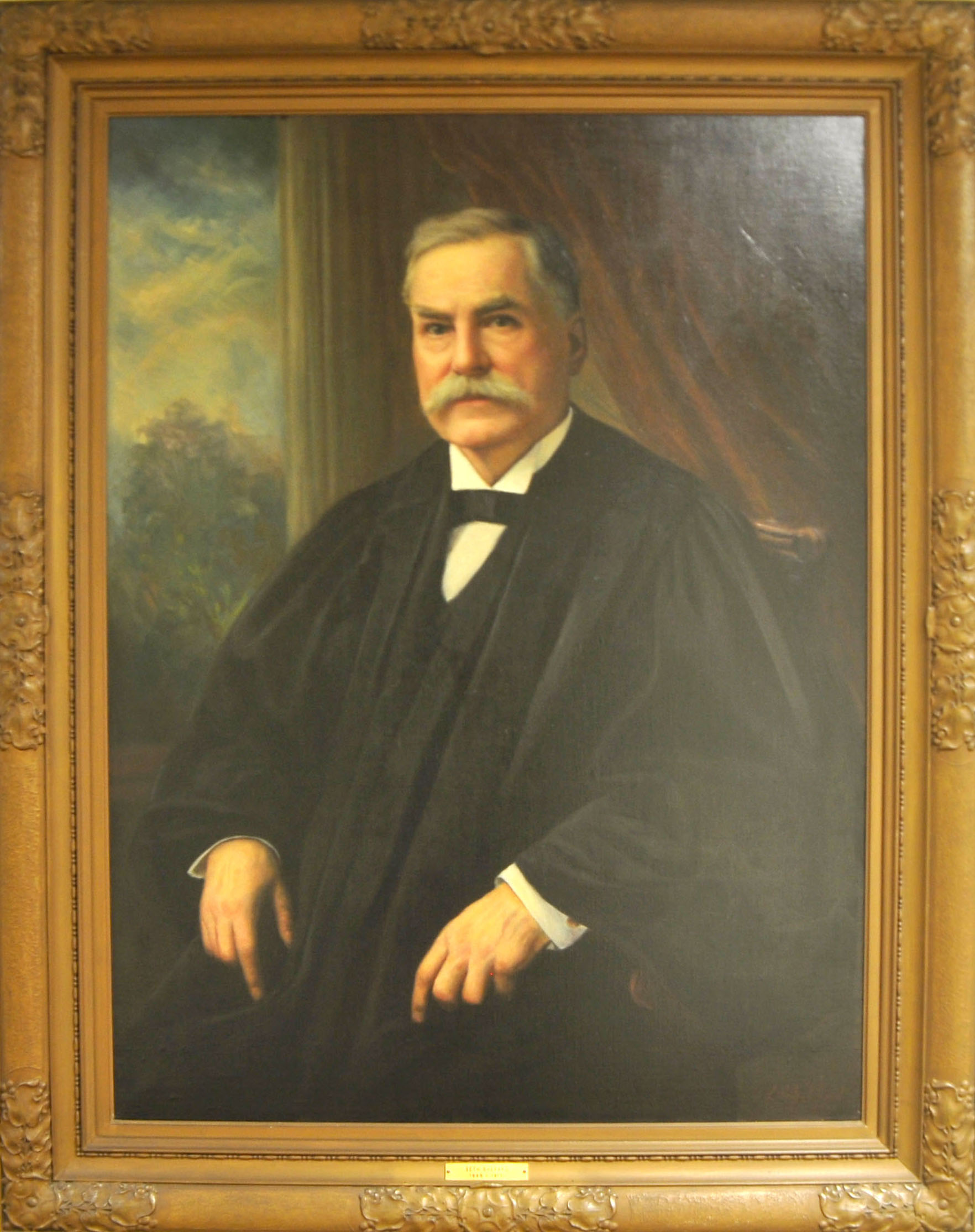
Historical · U.S. Court of Appeals for the District of Columbia Circuit
Seth Shepard
Former Circuit Judge · U.S. Court of Appeals for the District of Columbia Circuit · 1893–1917 · Appointed by Theodore Roosevelt
Seth Shepard served as a circuit judge of the U.S. Court of Appeals for the District of Columbia Circuit (1893–1917). Shepard was appointed by Theodore Roosevelt.
Key facts
- Full name
- Seth Shepard
- Court
- U.S. Court of Appeals for the District of Columbia Circuit
- Office
- Circuit Judge (U.S. Court of Appeals)
- Status
- Former circuit judge
- Duty status
- Not serving
- Appointment
- Senate-confirmed
- FJC seat
- CADC0102
- Tenure
- 1893–1917
- Confirmed
- 1905-01-05
- Born
- 1847-04-23
- Died
- 1917-12-03
- First year on the bench
- 1893
- Dataset version
- 1.20260711
Appointment & service record
U.S. Court of Appeals for the District of Columbia Circuit · 1893–1905
- Seat
- CADC0301
- Appointment
- Senate-confirmed
- Appointing president
- Grover Cleveland
- Confirmed
- 1893-04-15
- Commissioned
- 1893-04-15
- Senior status
- —
U.S. Court of Appeals for the District of Columbia Circuit · 1905–1917
- Seat
- CADC0102
- Appointment
- Senate-confirmed
- Appointing president
- Theodore Roosevelt
- Confirmed
- 1905-01-05
- Commissioned
- 1905-01-05
- Senior status
- —
Court, FJC seat, appointment type (Senate-confirmed or recess), appointing president, confirmation and commission dates, and senior-status date are drawn from the Federal Judicial Center Biographical Directory and Wikidata.[1][2][3]
Sources
- [1]https://www.fjc.gov/node/1387736fjc · retrieved 2026-07-11
- [2]https://www.fjc.gov/history/judges/biographical-directory-article-iii-federal-judges-exportfjc-directory · retrieved 2026-07-11
- [3]https://www.wikidata.org/wiki/Q7456597Wikidata · retrieved 2026-07-11
Biographical narrative
1,078 words · sourced from the Wikipedia REST extract
Seth Shepard was a federal appellate judge who served on the Court of Appeals of the District of Columbia, now known as the United States Court of Appeals for the District of Columbia Circuit, for nearly a quarter century from 1893 until his retirement in 1917. During his tenure on the court, he served first as an associate justice and later as chief justice, receiving appointments from two presidents of different political parties. His judicial career in the nation's capital followed earlier experience in Texas as a state legislator and private practitioner, and he combined his judicial duties with academic work as a law lecturer for fifteen years.
Early life and legal career
Born on April 23, 1847, in Brenham, Texas, Shepard came of age during the tumultuous period of the American Civil War. He served as a private in the Confederate States Army from 1864 to 1865, enlisting during the final years of the conflict while still in his teens. Following the war's conclusion, he pursued legal education and obtained a Bachelor of Laws degree from Washington College in 1868. The institution where he studied would later become known as the Washington and Lee University School of Law.
After completing his legal education, Shepard returned to his birthplace of Brenham, Texas, where he established himself in private legal practice. His professional reputation and community standing led to his entry into public service when he was elected to serve in the Texas Senate, where he held office from 1874 to 1875. This legislative experience provided him with insight into the workings of government and the policy considerations underlying statutory law, experience that would later inform his judicial work.
Following his single term in the state legislature, Shepard resumed private practice, relocating to Galveston, Texas, where he practiced law for a decade until 1886. He then moved his practice to Dallas, Texas, one of the state's growing commercial centers, where he continued to work as a private attorney from 1886 until 1893. This extended period of private practice across multiple Texas cities gave him broad exposure to diverse legal matters and built the professional foundation that would support his subsequent appointment to the federal bench.
Federal appellate service
Shepard's federal judicial career began in 1893 when President Grover Cleveland, a Democrat, nominated him to serve on the Court of Appeals of the District of Columbia. This appointment was to a newly created associate justice position that had been authorized by federal statute. The nomination came on April 14, 1893, and the Senate moved with remarkable speed, confirming Shepard the following day on April 15, 1893. He received his commission on the same day as his confirmation, allowing him to assume his duties without delay.
For nearly twelve years, Shepard served as an associate justice on the District of Columbia appellate court, participating in the resolution of appeals arising from the federal district court and local courts in the nation's capital. The Court of Appeals of the District of Columbia occupied a unique position in the federal judiciary, handling both the typical work of a federal circuit court and matters related to the governance of the District of Columbia itself.
In 1904, the chief justice position on the court became vacant following the departure of Chief Justice Richard H. Alvey. President Theodore Roosevelt, a Republican, nominated Shepard for elevation to the chief justice seat on December 16, 1904. This nomination represented a bipartisan recognition of Shepard's judicial abilities, as Roosevelt was willing to elevate a judge originally appointed by a president of the opposing party. The Senate confirmed the nomination on January 5, 1905, and Shepard received his commission the same day. His service as an associate justice formally concluded on January 19, 1905, when his elevation to chief justice took effect.
As chief justice, Shepard led the Court of Appeals of the District of Columbia for more than twelve years, presiding over the court during a period of significant growth and development in the federal government and the District of Columbia. He continued in this leadership role until September 30, 1917, when his active service terminated due to his retirement at the age of seventy.
Throughout his federal judicial tenure, Shepard also contributed to legal education. He served as a lecturer in law at Georgetown University from 1895 to 1910, a period of fifteen years that overlapped with his judicial service. This academic appointment allowed him to share his legal knowledge and judicial experience with law students in the nation's capital, contributing to the training of future members of the legal profession while continuing his full-time duties on the bench.
Jurisprudence and legacy
Shepard's nearly twenty-four years of service on the Court of Appeals of the District of Columbia spanned a formative period in the development of federal appellate jurisprudence and the governance of the nation's capital. The court on which he served would eventually become the United States Court of Appeals for the District of Columbia Circuit, widely recognized as one of the most important federal appellate courts due to its jurisdiction over challenges to federal agency actions and other matters of national significance.
His career trajectory reflected the respect he commanded across political lines. The fact that he received appointments from presidents of both major political parties—first from Democrat Grover Cleveland and later elevated by Republican Theodore Roosevelt—suggests that his judicial work was regarded as sound and his temperament as appropriate for leadership regardless of partisan considerations. Such bipartisan recognition was particularly notable during an era when political divisions over Reconstruction, economic policy, and America's emerging role on the world stage ran deep.
The combination of Shepard's judicial service with his academic work at Georgetown University demonstrated a commitment to the broader legal community beyond the resolution of individual cases. His fifteen-year tenure as a law lecturer provided an avenue for influencing legal thought and practice through the education of future attorneys and judges, extending his impact beyond the opinions he authored or joined during his time on the bench.
Shepard died on December 3, 1917, in Washington, D.C., just over two months after his retirement from the court and approximately seven months after the United States entered World War I. He was seventy years old at the time of his death, having devoted the final quarter-century of his life to federal judicial service in the nation's capital, far from the Texas communities where he had begun his legal and political career decades earlier.
Sources & provenance
Every quantitative or attributable claim above carries a per-section [N] marker that resolves to the corresponding URL below. Each entry records the upstream provider, the canonical URL, and the timestamp at which the underlying source was retrieved.
Key facts
- https://www.fjc.gov/node/1387736fjc · retrieved 2026-07-11
- https://www.fjc.gov/history/judges/biographical-directory-article-iii-federal-judges-exportfjc-directory · retrieved 2026-07-11
- https://www.wikidata.org/wiki/Q7456597Wikidata · retrieved 2026-07-11
Biographical narrative
- https://en.wikipedia.org/wiki/Seth_ShepardWikipedia · retrieved 2026-07-11
Explore the federal judiciary
The U.S. Courts of Appeals are the intermediate appellate courts of the federal judiciary — thirteen circuits sitting between the district courts and the Supreme Court. Browse the full roster of judges on the U.S. Court of Appeals for the District of Columbia Circuit, or explore how the appointed federal judiciary fits into the federal government.