
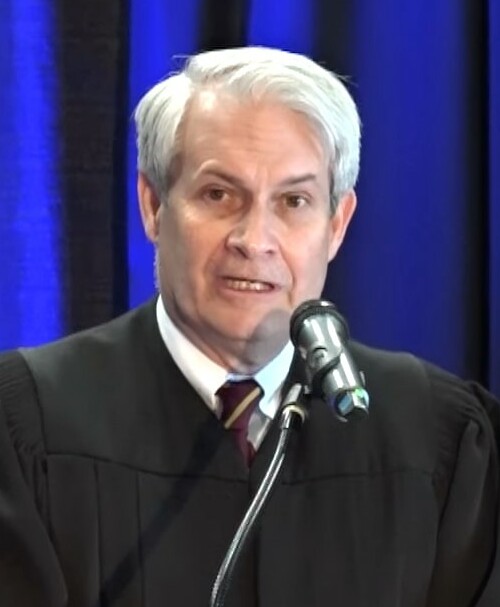
Historical · U.S. Court of Appeals for the District of Columbia Circuit
Thomas Beall Griffith
Former Circuit Judge · U.S. Court of Appeals for the District of Columbia Circuit · 2005–2020 · Appointed by George W Bush
Thomas Beall Griffith served as a circuit judge of the U.S. Court of Appeals for the District of Columbia Circuit (2005–2020). Griffith was appointed by George W Bush.
Key facts
- Full name
- Thomas Beall Griffith
- Court
- U.S. Court of Appeals for the District of Columbia Circuit
- Office
- Circuit Judge (U.S. Court of Appeals)
- Status
- Former circuit judge
- Duty status
- Not serving
- Appointment
- Senate-confirmed
- FJC seat
- CADC1102
- Tenure
- 2005–2020
- Confirmed
- 2005-06-14
- Born
- 1954
- Died
- —
- First year on the bench
- 2005
- Dataset version
- 1.20260711
Appointment & service record
U.S. Court of Appeals for the District of Columbia Circuit · 2005–2020
- Seat
- CADC1102
- Appointment
- Senate-confirmed
- Appointing president
- George W Bush
- Confirmed
- 2005-06-14
- Commissioned
- 2005-06-29
- Senior status
- —
Court, FJC seat, appointment type (Senate-confirmed or recess), appointing president, confirmation and commission dates, and senior-status date are drawn from the Federal Judicial Center Biographical Directory and Wikidata.[1][2][3]
Sources
- [1]https://www.fjc.gov/node/1392286fjc · retrieved 2026-07-11
- [2]https://www.fjc.gov/history/judges/biographical-directory-article-iii-federal-judges-exportfjc-directory · retrieved 2026-07-11
- [3]https://www.wikidata.org/wiki/Q7787246Wikidata · retrieved 2026-07-11
Biographical narrative
1,634 words · sourced from the Wikipedia REST extract
Thomas Beall Griffith is an American lawyer and jurist who served as a circuit judge on the United States Court of Appeals for the District of Columbia Circuit from 2005 until his retirement in 2020. Born in 1954, he was appointed to the federal appellate bench by President George W. Bush, a Republican, and confirmed by the Senate in June 2005. During his fifteen years on one of the nation's most influential federal appeals courts, Griffith participated in numerous cases involving administrative law, constitutional questions, and matters of federal jurisdiction. Since leaving the bench, he has remained active in legal education and the legal profession through academic appointments and service on various commissions and advisory bodies.
Early life and legal career
Thomas Beall Griffith was born on July 5, 1954, in Yokohama, Japan, where his father was stationed with the United States Army at the time. His family later settled in the Washington, D.C. metropolitan area, and Griffith attended Langley High School in McLean, Virginia. During his junior year of high school, he joined the Church of Jesus Christ of Latter-day Saints. He graduated from Langley High School in 1972, having served as student body president during his senior year.
Following high school, Griffith enrolled at Brigham Young University in Utah. He took a two-year leave of absence from his undergraduate studies to serve as a missionary for the LDS Church in South Africa, a common practice among members of that faith. He returned to complete his bachelor's degree, graduating in 1978 with a Bachelor of Arts, summa cum laude, in humanities with an emphasis in comparative literature. His undergraduate education reflected a strong interest in the liberal arts and cross-cultural studies.
In 1982, Griffith entered the University of Virginia School of Law, one of the nation's leading law schools. During his time there, he distinguished himself academically and was selected to serve as an editor of the Virginia Law Review, the school's flagship legal journal. He earned his Juris Doctor degree in 1985 and began his legal career shortly thereafter.
Griffith's early professional experience was in private practice. From 1985 to 1989, he worked as an attorney in Charlotte, North Carolina, gaining experience in various areas of legal practice. In 1989, he moved to Washington, D.C., to join the law firm of Wiley Rein, where he became a litigation partner. Over the course of six years at the firm, from 1989 to 1995, Griffith developed expertise in complex litigation matters and built a reputation as a skilled advocate.
In 1995, Griffith left private practice to accept an appointment as Senate Legal Counsel, the chief legal officer of the United States Senate. This position is nonpartisan by design and requires the counsel to provide legal advice to senators and Senate leadership of both political parties. Griffith served in this role from 1995 to 1999, a period that included the impeachment trial of President Bill Clinton. In that capacity, he provided nonpartisan legal guidance to members of both parties during the proceedings. His work during this sensitive period earned him respect from Democrats and Republicans alike for his professionalism and integrity.
After leaving the Senate Legal Counsel position in 1999, Griffith briefly returned to private practice before accepting another institutional legal role. In 2000, he was appointed General Counsel of Brigham Young University, his undergraduate alma mater. He served in that capacity from 2000 until his appointment to the federal bench in 2005, providing legal advice to the university on a wide range of matters affecting the institution.
Federal appellate service
President George W. Bush first nominated Griffith to the United States Court of Appeals for the District of Columbia Circuit on May 10, 2004. The nomination was for a seat that had been vacated by Judge Patricia M. Wald upon her retirement. Griffith's nomination came after Miguel Estrada, who had been nominated for the same seat, withdrew his nomination following a prolonged filibuster by Senate Democrats that lasted more than two years.
Griffith's nomination encountered some controversy during the confirmation process. One issue that arose concerned his membership in the District of Columbia Bar. It was discovered that his bar membership had lapsed in 1998 due to failure to pay dues. According to reports, Griffith had been unaware of the lapse at the time it occurred. Upon learning of the problem in 2001, he promptly paid the required dues and was reinstated to the bar. When the Washington Post published a story about this issue in June 2004, a number of prominent Democrats came to Griffith's defense with written statements of support.
Among those who wrote letters supporting Griffith was Abner Mikva, a former Democratic congressman who had also served as Chief Judge of the D.C. Circuit. Mikva stated that he had known Griffith both in and out of government service and had never heard any question raised about his integrity or responsibility. Seth Waxman, who had served as Solicitor General during the Clinton administration, wrote that he would stake nearly everything on Griffith's word alone. David Kendall and Lanny Breuer, both of whom had represented President Clinton during the impeachment proceedings, also submitted letters in support of the nomination.
A second issue raised by some Democrats concerned Griffith's practice of law while serving as General Counsel at Brigham Young University. Critics noted that he had practiced law in that capacity for four years without obtaining a Utah law license. Griffith's defenders responded by pointing to the longstanding position of the Utah Bar Association regarding in-house counsel. Five former presidents of the Utah Bar wrote to the Senate Judiciary Committee explaining that the bar's position had long been that in-house counsel in Utah were not required to be licensed in the state provided they worked closely with Utah bar members when providing legal advice. Griffith stated that he had carefully followed this practice throughout his tenure at the university.
The Senate did not act on Griffith's initial nomination before the end of the congressional session in 2004, and the nomination lapsed. President Bush resubmitted the nomination on February 14, 2005, again for the same seat on the D.C. Circuit. On June 14, 2005, the Senate confirmed Griffith by a vote of 73 to 24. Twenty Democrats joined fifty-three Republicans in voting to confirm him, while two Republicans and one Independent did not vote. Notable Democrats who voted in favor of confirmation included Barack Obama, Joe Biden, Senate Minority Leader Harry Reid, and Senate Minority Whip Dick Durbin. Despite the earlier controversies surrounding the nomination, the Washington Post editorial board endorsed Griffith, describing him as widely respected by people in both parties and as a sober lawyer with an open mind. Griffith received his commission on June 29, 2005, and took his seat on the court.
During his time on the D.C. Circuit, Griffith served on a court often described as second in importance only to the Supreme Court due to its jurisdiction over many federal administrative agencies and its role in reviewing significant regulatory and constitutional questions. In 2011, The New Republic included Griffith on a list of Washington's most powerful but least famous people, reflecting his influence despite operating largely outside the public spotlight.
On March 5, 2020, Griffith announced his intention to retire from the federal bench in September of that year. He officially retired on September 1, 2020, after fifteen years of service on the D.C. Circuit.
Jurisprudence and legacy
Following his retirement from the bench, Griffith has remained active in the legal community and has taken on several significant roles. In April 2021, President Joe Biden, a Democrat, appointed Griffith to serve on the Presidential Commission on the Supreme Court of the United States, a body created to study potential reforms to the nation's highest court. His appointment to this commission reflected the bipartisan respect he had earned during his career.
In September 2022, Griffith was proposed by the government as one of two candidates to serve as a special master to review documents that had been seized during a Federal Bureau of Investigation search at Mar-a-Lago. In July 2023, Judge Christopher Cooper of the United States District Court for the District of Columbia designated Griffith to serve as mediator in a dispute between the United States Court of Appeals for the Federal Circuit and one of its judges, Pauline Newman, demonstrating continued confidence in his judgment and diplomatic skills.
Griffith has received recognition for his contributions to the legal profession and to democratic institutions. In December 2022, he was elected to membership in the American Law Institute, a prestigious organization of lawyers, judges, and legal scholars. That same year, he received a Lifetime Achievement Award from The National Law Journal and a Defender of Democracy Award from the Center for Election Innovation & Research.
Since leaving the bench, Griffith has also taken on academic and professional roles. He serves as a lecturer on law at Harvard Law School, where he contributes to the education of future lawyers. He is a fellow at the Wheatley Institute at Brigham Young University and serves as special counsel in the Washington, D.C. office of the law firm Hunton Andrews Kurth. He is a member of the Federalist Society, a conservative and libertarian legal organization. Additionally, reflecting his longstanding interest in international rule-of-law development, Griffith serves on the international advisory board of the CEELI Institute in Prague, an organization focused on legal reform in former communist nations.
Throughout his career, Griffith has been characterized by colleagues from across the political spectrum as a lawyer of integrity, professionalism, and intellectual rigor. His service as Senate Legal Counsel during a highly partisan period, his confirmation with substantial bipartisan support, and his post-retirement appointments by both Republican and Democratic administrations reflect a reputation for fairness and nonpartisan judgment that has defined his professional life.
Sources & provenance
Every quantitative or attributable claim above carries a per-section [N] marker that resolves to the corresponding URL below. Each entry records the upstream provider, the canonical URL, and the timestamp at which the underlying source was retrieved.
Key facts
- https://www.fjc.gov/node/1392286fjc · retrieved 2026-07-11
- https://www.fjc.gov/history/judges/biographical-directory-article-iii-federal-judges-exportfjc-directory · retrieved 2026-07-11
- https://www.wikidata.org/wiki/Q7787246Wikidata · retrieved 2026-07-11
Biographical narrative
- https://en.wikipedia.org/wiki/Thomas_B._GriffithWikipedia · retrieved 2026-07-11
Explore the federal judiciary
The U.S. Courts of Appeals are the intermediate appellate courts of the federal judiciary — thirteen circuits sitting between the district courts and the Supreme Court. Browse the full roster of judges on the U.S. Court of Appeals for the District of Columbia Circuit, or explore how the appointed federal judiciary fits into the federal government.