
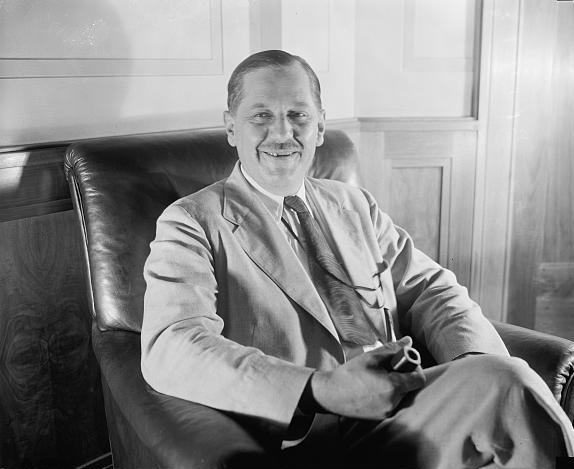
Historical · U.S. Court of Appeals for the District of Columbia Circuit
Thurman Wesley Arnold
Former Circuit Judge · U.S. Court of Appeals for the District of Columbia Circuit · 1943–1945 · Appointed by Franklin D Roosevelt
Thurman Wesley Arnold served as a circuit judge of the U.S. Court of Appeals for the District of Columbia Circuit (1943–1945). Arnold was appointed by Franklin D Roosevelt.
Key facts
- Full name
- Thurman Wesley Arnold
- Court
- U.S. Court of Appeals for the District of Columbia Circuit
- Office
- Circuit Judge (U.S. Court of Appeals)
- Status
- Former circuit judge
- Duty status
- Not serving
- Appointment
- Senate-confirmed
- FJC seat
- CADC0602
- Tenure
- 1943–1945
- Confirmed
- 1943-03-09
- Born
- 1891-06-02
- Died
- 1969
- First year on the bench
- 1943
- Dataset version
- 1.20260711
Appointment & service record
U.S. Court of Appeals for the District of Columbia Circuit · 1943–1945
- Seat
- CADC0602
- Appointment
- Senate-confirmed
- Appointing president
- Franklin D Roosevelt
- Confirmed
- 1943-03-09
- Commissioned
- 1943-03-11
- Senior status
- —
Court, FJC seat, appointment type (Senate-confirmed or recess), appointing president, confirmation and commission dates, and senior-status date are drawn from the Federal Judicial Center Biographical Directory and Wikidata.[1][2][3]
Sources
- [1]https://www.fjc.gov/node/1377276fjc · retrieved 2026-07-11
- [2]https://www.fjc.gov/history/judges/biographical-directory-article-iii-federal-judges-exportfjc-directory · retrieved 2026-07-11
- [3]https://www.wikidata.org/wiki/Q7799336Wikidata · retrieved 2026-07-11
Biographical narrative
1,244 words · sourced from the Wikipedia REST extract
Thurman Wesley Arnold was a United States Circuit Judge who served on the U.S. Court of Appeals for the District of Columbia Circuit from 1943 to 1945. Born on June 2, 1891, in Laramie, Wyoming, Arnold had a multifaceted career that encompassed legal scholarship, public service, and antitrust enforcement before his brief tenure on the federal bench. He is perhaps best remembered for his vigorous antitrust work as Assistant Attorney General in the late 1930s and early 1940s, and for co-founding what became one of Washington's most prominent law firms after leaving the judiciary. His contributions to legal thought, particularly through his participation in the legal realism movement and his published works, marked him as an influential figure in American legal history during the mid-twentieth century.
Early life and legal career
Arnold was born in the frontier ranch town of Laramie, Wyoming, to Annie Brockway and Constantine Peter Arnold. Laramie, which would grow from a frontier settlement into a small city and home to the University of Wyoming, provided the backdrop for his early years. He began his undergraduate education at Wabash College before transferring to Princeton University, where he earned his Bachelor of Arts degree in 1911. He continued his legal education at Harvard Law School, receiving his Bachelor of Laws in 1914.
Following his legal education, Arnold's early career was interrupted by World War I, during which he served in the United States Army Field Artillery, rising to the rank of lieutenant. After the war, he worked briefly in Chicago, Illinois, before returning to his hometown of Laramie. There he established himself as a lawyer with a reputation for maverick approaches to legal practice. His involvement in public life began early: he served as a member of the Wyoming House of Representatives in 1921 and subsequently as mayor of Laramie from 1923 to 1924. During this same period, from 1921 to 1926, he served as a lecturer at the University of Wyoming, beginning what would become a significant academic career alongside his legal practice.
Arnold's academic trajectory advanced when he became Dean of the West Virginia University College of Law, serving in that capacity from 1927 to 1930. His scholarly reputation grew, leading to an appointment as a visiting professor at Yale University from 1930 to 1931. This visiting position became permanent, and he served as a professor of law at Yale from 1931 to 1938. During his time at Yale, Arnold became an important participant in the legal realism movement, which sought to examine law as it functioned in practice rather than as an abstract system of rules. He published two influential books during this period: "The Symbols of Government" in 1935 and "The Folklore of Capitalism" in 1937, both of which reflected his realist approach to understanding legal and economic institutions.
Arnold's transition to federal service began in 1933 when he served as a special assistant to the general counsel of the Agricultural Adjustment Administration, one of the New Deal agencies created during President Franklin D. Roosevelt's first term. This experience in the Roosevelt administration led to his appointment as Assistant Attorney General of the United States Department of Justice in 1938, a position he would hold until 1943. In this role, Arnold took charge of the Antitrust Division and became known for launching an aggressive trust-busting campaign. As the chief competition lawyer for the federal government, he initiated numerous studies to support antitrust enforcement efforts in the late 1930s. Among his notable targets was the American Medical Association, which he pursued for anti-competitive practices against health plans. He also published "The Bottlenecks of Business" in 1940, further developing his economic and legal theories. However, the Roosevelt administration eventually de-emphasized antitrust enforcement, with the stated rationale that corporations needed to concentrate their efforts on contributing to the Allied victory in World War II rather than defending against antitrust actions.
Federal appellate service
President Franklin D. Roosevelt, a Democrat, nominated Arnold to the United States Court of Appeals for the District of Columbia on February 11, 1943. The nomination was to fill a seat that had been vacated by Wiley Blount Rutledge, who had been elevated to the Supreme Court. The Senate confirmed Arnold on March 9, 1943, and he received his commission two days later, on March 11, 1943. The appointment has been characterized as Roosevelt "kicking upstairs" his aggressive antitrust chief, effectively removing him from the Antitrust Division by promoting him to the federal bench.
Arnold's tenure on the Court of Appeals for the District of Columbia Circuit proved to be brief and, by his own account, unsatisfying. During the period of his service, the court's docket consisted primarily of reviewing decisions from local trial courts in the District of Columbia involving routine civil and criminal matters, though the court also had some responsibility for reviewing decisions made by federal administrative agencies. This work was far removed from the policy-oriented antitrust enforcement and academic scholarship that had characterized Arnold's earlier career.
Arnold found the judicial role ill-suited to his temperament and interests. He resigned from the bench on July 9, 1945, after serving only approximately two years as a circuit judge. In explaining his decision to leave the federal judiciary, he reportedly told observers that he "would rather be speaking to damn fools than listening to damn fools," a characteristically blunt assessment that reflected his dissatisfaction with the passive role of a judge compared to the active advocacy he preferred.
Jurisprudence and legacy
Following his resignation from the bench, Arnold returned to private legal practice in Washington, D.C., where he embarked on what would become perhaps his most enduring institutional contribution to American law. Together with Paul A. Porter and Abe Fortas, he co-founded a law firm that is known today as Arnold & Porter, which grew to become one of the most prominent and influential law firms in the nation's capital. This venture allowed Arnold to return to active legal advocacy and policy engagement, roles that better suited his skills and temperament than judicial service had.
Arnold's personal life was marked by a long marriage to Frances Longan Arnold, whom he married on September 4, 1917. The couple had two children, both sons: Thurman Arnold Jr. and George Arnold, both of whom pursued successful legal careers of their own. Thurman Arnold Jr. established a law practice in Palm Springs, California in 1953, creating a legal legacy that extended to a third generation when his son, Thurman Arnold III, joined the firm. George Arnold married Ellen Cameron Pearson, the daughter of columnist Drew Pearson and granddaughter of Cissy Patterson, who owned the Washington Times-Herald, connecting the Arnold family to prominent figures in American journalism and media.
Arnold died on November 7, 1969, at his home in Alexandria, Virginia. His legacy rests less on his brief judicial service than on his broader contributions to American legal thought and antitrust policy. His work in the legal realism movement helped reshape how scholars and practitioners understood the relationship between law and society, while his aggressive antitrust enforcement during the late New Deal period represented one of the most sustained efforts to use competition law to address economic concentration. His writings, particularly "The Folklore of Capitalism," continued to influence legal and economic thinking long after their publication. The law firm he co-founded remains a testament to his vision of engaged, policy-oriented legal practice, carrying his name into the twenty-first century as a major force in American law and public policy.
Sources & provenance
Every quantitative or attributable claim above carries a per-section [N] marker that resolves to the corresponding URL below. Each entry records the upstream provider, the canonical URL, and the timestamp at which the underlying source was retrieved.
Key facts
- https://www.fjc.gov/node/1377276fjc · retrieved 2026-07-11
- https://www.fjc.gov/history/judges/biographical-directory-article-iii-federal-judges-exportfjc-directory · retrieved 2026-07-11
- https://www.wikidata.org/wiki/Q7799336Wikidata · retrieved 2026-07-11
Biographical narrative
- https://en.wikipedia.org/wiki/Thurman_ArnoldWikipedia · retrieved 2026-07-11
Explore the federal judiciary
The U.S. Courts of Appeals are the intermediate appellate courts of the federal judiciary — thirteen circuits sitting between the district courts and the Supreme Court. Browse the full roster of judges on the U.S. Court of Appeals for the District of Columbia Circuit, or explore how the appointed federal judiciary fits into the federal government.