
Historical · U.S. Court of Appeals for the Eighth Circuit
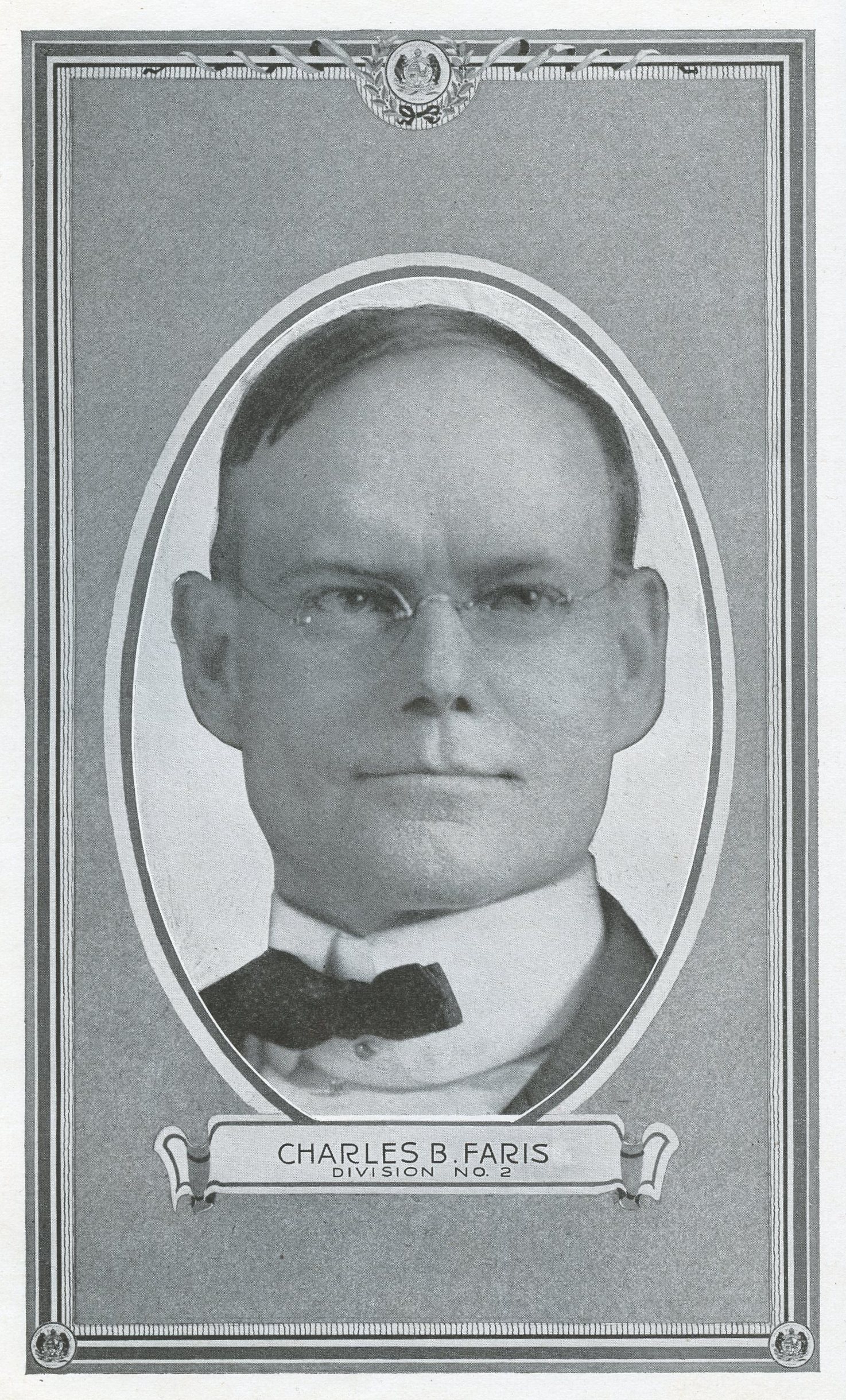
Charles Breckenridge Faris
Former Circuit Judge · U.S. Court of Appeals for the Eighth Circuit · 1935–1938 · Appointed by Franklin D Roosevelt
Charles Breckenridge Faris served as a circuit judge of the U.S. Court of Appeals for the Eighth Circuit (1935–1938). Faris was appointed by Franklin D Roosevelt.
Key facts
- Full name
- Charles Breckenridge Faris
- Court
- U.S. Court of Appeals for the Eighth Circuit
- Office
- Circuit Judge (U.S. Court of Appeals)
- Status
- Former circuit judge
- Duty status
- Not serving
- Appointment
- Senate-confirmed
- FJC seat
- CA80404
- Tenure
- 1935–1938
- Confirmed
- 1935-01-25
- Born
- 1864-10-03
- Died
- 1938-12-18
- First year on the bench
- 1935
- Dataset version
- 1.20260711
Appointment & service record
U.S. Court of Appeals for the Eighth Circuit · 1935–1935
- Seat
- CA80404
- Appointment
- Senate-confirmed
- Appointing president
- Franklin D Roosevelt
- Confirmed
- 1935-01-25
- Commissioned
- 1935-01-31
- Senior status
- 1935-11-30
Court, FJC seat, appointment type (Senate-confirmed or recess), appointing president, confirmation and commission dates, and senior-status date are drawn from the Federal Judicial Center Biographical Directory and Wikidata.[1][2][3]
Sources
- [1]https://www.fjc.gov/node/1380621fjc · retrieved 2026-07-11
- [2]https://www.fjc.gov/history/judges/biographical-directory-article-iii-federal-judges-exportfjc-directory · retrieved 2026-07-11
- [3]https://www.wikidata.org/wiki/Q5075756Wikidata · retrieved 2026-07-11
Biographical narrative
1,148 words · sourced from the Wikipedia REST extract
Charles Breckenridge Faris was a federal appellate judge who served on the United States Court of Appeals for the Eighth Circuit in 1935. Born in Missouri in 1864, he pursued a lengthy legal career that spanned private practice, local prosecution, state banking leadership, service in the Missouri legislature, and positions on both the Missouri state judiciary and the federal bench. Appointed to the Eighth Circuit by President Franklin D. Roosevelt, a Democrat, Faris served only briefly on the appellate court before assuming senior status and passing away in 1938. His judicial career at the federal level encompassed more than fifteen years on the district court before his elevation to the circuit bench.
Early life and legal career
Charles Breckenridge Faris was born on October 3, 1864, in the vicinity of Charleston, Missouri, a small community in the southeastern portion of the state. He pursued his legal education at two institutions: he attended the Washington University School of Law and subsequently enrolled at the University of Missouri, where he earned both a Bachelor of Laws degree and a Bachelor of Pedagogy degree in 1889. This dual focus on law and education reflected the breadth of professional training available to aspiring attorneys in the late nineteenth century.
Following his admission to the bar, Faris established a private law practice in Caruthersville, Missouri, where he worked from 1891 to 1892. Caruthersville, the county seat of Pemiscot County in the Missouri Bootheel region, provided the setting for the early stages of his professional life. His transition into public service came quickly: he served as city attorney of Caruthersville from 1892 to 1893, gaining experience in municipal legal matters. He then assumed the role of prosecuting attorney for Pemiscot County, a position he held from 1893 to 1899. This six-year tenure as a county prosecutor gave him substantial experience in criminal law and courtroom advocacy during a formative period of his career.
Beyond his legal work, Faris became involved in the banking sector. He served as President of the Bank of Caruthersville from 1898 to 1910, a role that placed him at the intersection of law, business, and community leadership during a period of economic development in southeastern Missouri. His civic engagement extended to elected office: he served as a member of the Missouri House of Representatives during the 36th Missouri General Assembly, representing his constituents in the state legislature and gaining experience in the legislative process.
Faris's career then shifted to the state judiciary. He was elected or appointed as a judge of the 28th Judicial Circuit, serving from 1910 to 1912. This circuit court position involved presiding over trial-level proceedings in state court. His judicial abilities and reputation led to his elevation to the Supreme Court of Missouri, where he served as a justice from 1912 to 1919. During these seven years on Missouri's highest court, he participated in the resolution of significant questions of state law and gained experience in appellate decision-making that would later inform his work on the federal bench.
Federal appellate service
Faris's entry into the federal judiciary came in 1919, when President Woodrow Wilson, a Democrat, nominated him to serve as a United States district judge for the United States District Court for the Eastern District of Missouri. The nomination, submitted on October 11, 1919, was to fill a vacancy created by the departure of Judge David Patterson Dyer. The United States Senate acted with remarkable speed, confirming Faris on October 13, 1919, just two days after the nomination. He received his commission on the same day as his confirmation and began his service on the district court.
Faris served as a district judge for more than fifteen years, presiding over federal trial proceedings in the Eastern District of Missouri, which encompasses the St. Louis metropolitan area and surrounding counties. During this extended tenure on the trial bench, he would have handled a wide variety of federal matters, including civil disputes involving federal law and diversity jurisdiction, criminal prosecutions for violations of federal statutes, and other matters within the district court's jurisdiction. His service in this capacity continued until February 6, 1935, when it was terminated due to his elevation to a higher court.
President Franklin D. Roosevelt, also a Democrat, nominated Faris to the United States Court of Appeals for the Eighth Circuit on January 14, 1935. This nomination was to fill a seat that had been vacated by Judge William S. Kenyon. The Senate confirmed the nomination on January 25, 1935, and Faris received his commission on January 31, 1935. The Eighth Circuit, which at that time heard appeals from federal district courts across a multi-state region including Missouri, Arkansas, Iowa, Minnesota, Nebraska, North Dakota, and South Dakota, represented a significant expansion of Faris's judicial responsibilities.
Faris's active service on the Eighth Circuit proved to be brief. He assumed senior status on November 30, 1935, less than a year after receiving his commission. Senior status is a form of semi-retirement that allows federal judges to continue hearing cases on a reduced schedule while creating a vacancy for a new active judge to be appointed. Faris continued in senior status until his death on December 18, 1938, which terminated his federal judicial service. He was seventy-four years old at the time of his passing.
Jurisprudence and legacy
The brevity of Faris's active service on the Eighth Circuit—approximately ten months before assuming senior status—limits the available record of his contributions to federal appellate jurisprudence. His time on the circuit court came during the mid-1930s, a period of significant legal and constitutional development as the federal courts grappled with New Deal legislation and the expanding role of federal regulatory authority. However, specific details regarding the number of opinions he authored, the particular cases in which he participated, or the distinctive elements of his judicial philosophy are not available in the historical record.
Faris's longer tenure on the district court, spanning more than fifteen years, would have provided him with extensive experience in applying federal law at the trial level. His background on the Supreme Court of Missouri before joining the federal bench gave him a foundation in appellate reasoning and legal analysis that he brought to his work as a circuit judge. The combination of state supreme court experience, federal trial court service, and federal appellate appointment represented an unusual breadth of judicial experience across different levels and systems of American jurisprudence.
His career trajectory from local prosecutor to state legislator, from state trial judge to state supreme court justice, and finally to the federal bench, illustrates a pattern of progressive advancement through the legal profession that was characteristic of many federal judges appointed during the early twentieth century. Faris's service spanned a transformative period in American law, from the late nineteenth century through the New Deal era, though the specific contours of his judicial legacy remain largely undocumented in readily available historical sources.
Sources & provenance
Every quantitative or attributable claim above carries a per-section [N] marker that resolves to the corresponding URL below. Each entry records the upstream provider, the canonical URL, and the timestamp at which the underlying source was retrieved.
Key facts
- https://www.fjc.gov/node/1380621fjc · retrieved 2026-07-11
- https://www.fjc.gov/history/judges/biographical-directory-article-iii-federal-judges-exportfjc-directory · retrieved 2026-07-11
- https://www.wikidata.org/wiki/Q5075756Wikidata · retrieved 2026-07-11
Biographical narrative
- https://en.wikipedia.org/wiki/Charles_Breckenridge_FarisWikipedia · retrieved 2026-07-11
Explore the federal judiciary
The U.S. Courts of Appeals are the intermediate appellate courts of the federal judiciary — thirteen circuits sitting between the district courts and the Supreme Court. Browse the full roster of judges on the U.S. Court of Appeals for the Eighth Circuit, or explore how the appointed federal judiciary fits into the federal government.