
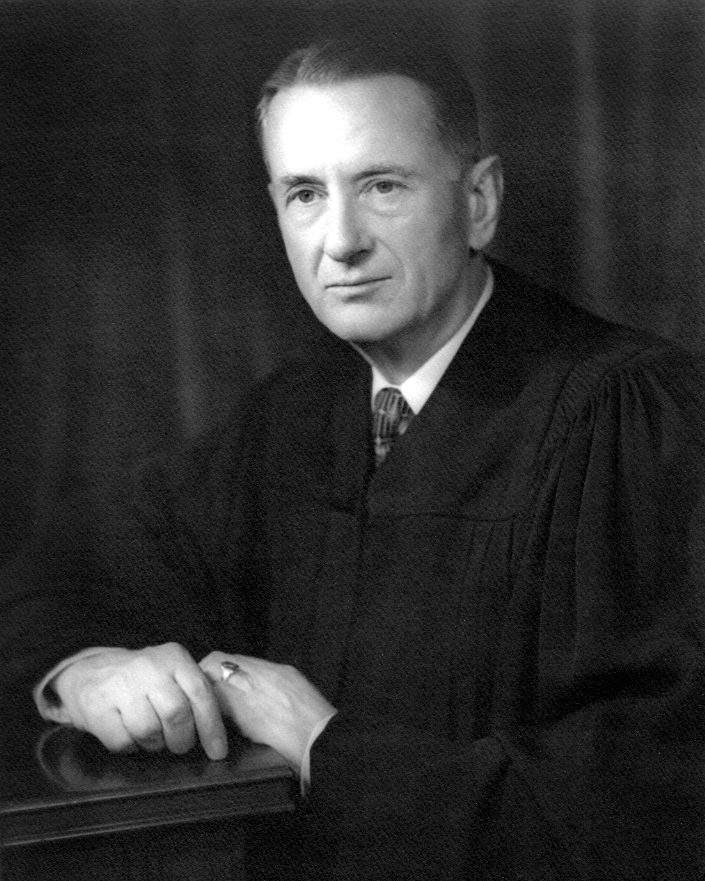
Historical · U.S. Court of Appeals for the Eighth Circuit
Charles Evans Whittaker
Former Circuit Judge · U.S. Court of Appeals for the Eighth Circuit · 1956–1957 · Appointed by Dwight D Eisenhower
Charles Evans Whittaker served as a circuit judge of the U.S. Court of Appeals for the Eighth Circuit (1956–1957). Whittaker was appointed by Dwight D Eisenhower.
Key facts
- Full name
- Charles Evans Whittaker
- Court
- U.S. Court of Appeals for the Eighth Circuit
- Office
- Circuit Judge (U.S. Court of Appeals)
- Status
- Former circuit judge
- Duty status
- Not serving
- Appointment
- Senate-confirmed
- FJC seat
- CA80305
- Tenure
- 1956–1957
- Confirmed
- 1956-06-04
- Born
- 1901-02-22
- Died
- 1973-11-26
- First year on the bench
- 1956
- Dataset version
- 1.20260711
Appointment & service record
U.S. Court of Appeals for the Eighth Circuit · 1956–1957
- Seat
- CA80305
- Appointment
- Senate-confirmed
- Appointing president
- Dwight D Eisenhower
- Confirmed
- 1956-06-04
- Commissioned
- 1956-06-05
- Senior status
- —
Court, FJC seat, appointment type (Senate-confirmed or recess), appointing president, confirmation and commission dates, and senior-status date are drawn from the Federal Judicial Center Biographical Directory and Wikidata.[1][2][3]
Sources
- [1]https://www.fjc.gov/node/1389716fjc · retrieved 2026-07-11
- [2]https://www.fjc.gov/history/judges/biographical-directory-article-iii-federal-judges-exportfjc-directory · retrieved 2026-07-11
- [3]https://www.wikidata.org/wiki/Q1064300Wikidata · retrieved 2026-07-11
Biographical narrative
1,414 words · sourced from the Wikipedia REST extract
Charles Evans Whittaker was a federal appellate judge who served on the United States Court of Appeals for the Eighth Circuit from 1956 to 1957. Born in Kansas in 1901, he rose from humble rural origins to become a prominent figure in the federal judiciary during the mid-twentieth century. Appointed by President Dwight D. Eisenhower, a Republican, Whittaker's tenure on the Eighth Circuit was brief, as he was elevated to the Supreme Court of the United States in 1957, making him the first person to serve consecutively on all three levels of the Article III federal court system. He passed away in 1973 in Kansas City, Missouri.
Early life and legal career
Charles Evans Whittaker was born on February 22, 1901, on a farm in the vicinity of Troy, Kansas. His father, Charles Edward Whittaker, worked as a farmer, while his mother, Ida Eve Miller, had been a schoolteacher originally from Hagerstown, Maryland. Whittaker's early education took place at the Brush Creek School, a one-room schoolhouse that served the rural community near his family's farm. He subsequently attended Troy High School but did not complete his secondary education there. When his mother died on his sixteenth birthday, Whittaker left school in the ninth grade and returned to work on the family farm for the next three years. During this period, he engaged in agricultural labor as well as hunting and trapping to support himself and his family.
Despite the interruption in his formal education, Whittaker developed an interest in the legal profession through reading newspaper accounts of criminal trials. This self-directed study inspired him to pursue legal training. In the summer of 1920, he sought admission to the Kansas City School of Law, which operated a part-time evening program and is known today as the University of Missouri–Kansas City School of Law. The institution granted him conditional admission after he personally appealed to Oliver Dean, who served as president of the law school. The condition required that Whittaker complete his high school education concurrently with his legal studies.
Demonstrating remarkable determination, Whittaker enrolled at Manual High School in Kansas City, Missouri, and embarked on an intensive four-year period during which he worked full-time during the day to support himself financially while attending both high school and law school classes in the evenings. This demanding schedule reflected both his commitment to legal education and the economic necessities of his situation. Among his classmates at the Kansas City School of Law was Harry S. Truman, who would later become President of the United States. Whittaker was admitted to the Missouri bar during his final year of legal studies and graduated in 1924 with a Bachelor of Laws degree.
Following his admission to the bar, Whittaker joined the Kansas City law firm of Watson, Ess, Marshall & Enggas, where he had previously been employed full-time as an office boy. At this firm, he developed a practice focused on corporate law, building a client base that included significant business entities and institutions. Among his notable clients were the Union Pacific Railroad, the retail company Montgomery Ward, and the City National Bank and Trust Company. His legal work in these areas established his reputation as a capable attorney in commercial matters. During this period, Whittaker became a member of the Tau Kappa Epsilon fraternity and cultivated connections with the Republican Party, relationships that would prove significant in his later career. In 1928, he married Winifred R. Pugh, and the couple would go on to have three sons.
Federal appellate service
Whittaker's career in the federal judiciary began when President Dwight D. Eisenhower nominated him to serve on the United States District Court for the Western District of Missouri in May 1954. This nomination was to fill a vacancy created by the departure of Judge Albert L. Reeves. The United States Senate confirmed the nomination in July 1954, and Whittaker received his commission shortly thereafter. He served in this trial court capacity for approximately two years, presiding over cases in the federal district that encompassed much of western Missouri.
His service on the district court was relatively brief, as President Eisenhower nominated him for elevation to the United States Court of Appeals for the Eighth Circuit on March 16, 1956. This nomination was to fill a seat that had been vacated by Judge John Caskie Collet. The Eighth Circuit at that time had jurisdiction over appeals from federal district courts in a multi-state region of the upper Midwest and Great Plains. The Senate confirmed Whittaker's appointment to the circuit court on June 4, 1956, and he received his commission the following day, assuming his duties as a federal appellate judge.
Whittaker's tenure on the Eighth Circuit proved even shorter than his district court service. He served on the appellate court for less than one year, as his service terminated on March 24, 1957. This termination occurred because President Eisenhower nominated him to the Supreme Court of the United States in early March 1957 to fill the vacancy created by the retirement of Associate Justice Stanley Forman Reed. The Senate confirmed this nomination on March 19, 1957, and Whittaker took the judicial oath of office as an Associate Justice on March 25, 1957. Through this rapid progression through the federal court system, Whittaker achieved the distinction of becoming the first individual to serve consecutively as a judge on a United States District Court, a United States Court of Appeals, and the Supreme Court of the United States, having held all three positions within a span of less than three years.
Jurisprudence and legacy
While Whittaker's service on the Eighth Circuit was too brief to establish an extensive record of appellate opinions or a distinctive judicial philosophy at that level, his subsequent service on the Supreme Court provides insight into his approach to legal questions. During his tenure on the nation's highest court, which lasted from 1957 to 1962, Whittaker served as Circuit Justice for both the Eighth Circuit and the Tenth Circuit, maintaining a connection to the appellate courts in those regions.
On the Supreme Court during the era of Chief Justice Earl Warren, Whittaker found himself on a closely divided tribunal where ideological disagreements among the justices were frequent. Scholarly assessments indicate that he functioned as a swing vote between competing factions on the Court. According to academic analysis, Whittaker struggled to develop a consistent judicial philosophy and reportedly harbored doubts about his qualifications relative to his colleagues on the bench. His voting patterns suggested difficulty in resolving the complex constitutional questions that came before the Court, and he appeared susceptible to persuasion by whichever group of justices presented arguments to him most recently.
The pressures of Supreme Court service took a significant toll on Whittaker. After spending months deliberating over his position in a major case concerning legislative reapportionment, he suffered a nervous breakdown in the spring of 1962. At the recommendation of Chief Justice Warren, he recused himself from that case and retired from the Court effective March 31, 1962, citing a certified disability related to exhaustion from the workload and the stress of judicial decision-making. His departure from the Court after only five years of service was unusual and reflected the personal difficulties he experienced in that role.
Following his retirement from the Supreme Court, Whittaker resigned his status as a retired justice in September 1965 in order to accept a position as chief counsel to General Motors, one of the nation's largest corporations. In this capacity and in his public statements during the 1960s, he became an outspoken critic of both the Warren Court and the Civil Rights Movement. He characterized certain forms of civil disobedience, including tactics employed by civil rights activists, as lawless behavior. In writings for law enforcement publications, he advocated that those seeking social change should pursue their objectives through the court system rather than through public demonstrations and street protests.
Whittaker holds several distinctions in the history of the federal judiciary. He remains the only Supreme Court Justice appointed from Missouri. Additionally, he is the most recently appointed Justice to have received his legal education from a public law school. His rapid ascent through all three levels of the federal court system within three years represents an unusual trajectory in American judicial history. Whittaker died on November 26, 1973, at St. Luke's Hospital in Kansas City, Missouri, from a ruptured abdominal aneurysm, bringing to a close a judicial career marked by both notable achievements and significant personal challenges.
Sources & provenance
Every quantitative or attributable claim above carries a per-section [N] marker that resolves to the corresponding URL below. Each entry records the upstream provider, the canonical URL, and the timestamp at which the underlying source was retrieved.
Key facts
- https://www.fjc.gov/node/1389716fjc · retrieved 2026-07-11
- https://www.fjc.gov/history/judges/biographical-directory-article-iii-federal-judges-exportfjc-directory · retrieved 2026-07-11
- https://www.wikidata.org/wiki/Q1064300Wikidata · retrieved 2026-07-11
Biographical narrative
- https://en.wikipedia.org/wiki/Charles_Evans_WhittakerWikipedia · retrieved 2026-07-11
Explore the federal judiciary
The U.S. Courts of Appeals are the intermediate appellate courts of the federal judiciary — thirteen circuits sitting between the district courts and the Supreme Court. Browse the full roster of judges on the U.S. Court of Appeals for the Eighth Circuit, or explore how the appointed federal judiciary fits into the federal government.