
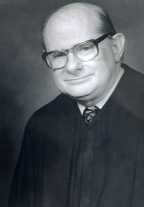
Historical · U.S. Court of Appeals for the Eighth Circuit
Donald Pomery Lay
Former Circuit Judge · U.S. Court of Appeals for the Eighth Circuit · 1966–2007 · Appointed by Lyndon B Johnson
Donald Pomery Lay served as a circuit judge of the U.S. Court of Appeals for the Eighth Circuit (1966–2007). Lay was appointed by Lyndon B Johnson.
Key facts
- Full name
- Donald Pomery Lay
- Court
- U.S. Court of Appeals for the Eighth Circuit
- Office
- Circuit Judge (U.S. Court of Appeals)
- Status
- Former circuit judge
- Duty status
- Not serving
- Appointment
- Senate-confirmed
- FJC seat
- CA80902
- Tenure
- 1966–2007
- Confirmed
- 1966-07-22
- Born
- 1926-08-24
- Died
- 2007-04-29
- First year on the bench
- 1966
- Dataset version
- 1.20260711
Appointment & service record
U.S. Court of Appeals for the Eighth Circuit · 1966–1992
- Seat
- CA80902
- Appointment
- Senate-confirmed
- Appointing president
- Lyndon B Johnson
- Confirmed
- 1966-07-22
- Commissioned
- 1966-07-22
- Senior status
- 1992-01-07
- Chief Judge
- 1979–1992
Court, FJC seat, appointment type (Senate-confirmed or recess), appointing president, confirmation and commission dates, and senior-status date are drawn from the Federal Judicial Center Biographical Directory and Wikidata.[1][2][3]
Sources
- [1]https://www.fjc.gov/node/1383701fjc · retrieved 2026-07-11
- [2]https://www.fjc.gov/history/judges/biographical-directory-article-iii-federal-judges-exportfjc-directory · retrieved 2026-07-11
- [3]https://www.wikidata.org/wiki/Q5294970Wikidata · retrieved 2026-07-11
Biographical narrative
962 words · sourced from the Wikipedia REST extract
Donald Pomery Lay was a United States circuit judge who served on the United States Court of Appeals for the Eighth Circuit from 1966 until his death in 2007. Appointed by President Lyndon B. Johnson, a Democrat, he served as Chief Judge of the circuit from 1979 to 1992 and was a member of the Judicial Conference of the United States during that period. Throughout his four decades on the federal bench, he maintained a concurrent academic career, teaching at multiple law schools. His judicial work included participation in several cases that reached national prominence, and he continued to serve in senior status for fifteen years before his death in Minnesota.
Early life and legal career
Donald Pomery Lay was born on August 24, 1926, in Princeton, Illinois. During World War II, he served in the United States Navy as a seaman from 1944 to 1945. Following his military service, he pursued higher education at the University of Iowa, where he earned a Bachelor of Arts degree in 1949. He continued his studies at the University of Iowa College of Law, receiving his Juris Doctor in 1951.
After completing his legal education, Lay entered private practice, beginning his career in Omaha, Nebraska, from 1951 to 1953. He then briefly relocated to Milwaukee, Wisconsin, where he practiced law from 1953 to 1954, before returning to Omaha. He maintained a private practice in Omaha for the next twelve years, from 1954 until his appointment to the federal bench in 1966. During this period, he also engaged in legal education, serving as an instructor at the Omaha University School of Law from 1956 to 1957. This early teaching experience foreshadowed what would become a lifelong commitment to legal education alongside his judicial duties.
Federal appellate service
President Lyndon B. Johnson nominated Lay to the United States Court of Appeals for the Eighth Circuit on July 11, 1966. The nomination was to fill a seat that had been vacated by Judge Harvey M. Johnsen. The United States Senate confirmed the nomination on July 22, 1966, and Lay received his commission on the same day, beginning what would become more than four decades of federal judicial service.
Lay served as an active circuit judge for twenty-six years. In 1979, he was elevated to the position of Chief Judge of the Eighth Circuit, a role he held for thirteen years until 1992. As Chief Judge, he also served as a member of the Judicial Conference of the United States, the national policy-making body for the federal courts, from 1979 to 1992. On January 7, 1992, he assumed senior status, a form of semi-retirement that allows federal judges to continue hearing cases with a reduced caseload. He remained active in this capacity for an additional fifteen years.
Throughout his tenure on the bench, Lay was involved in numerous cases across the wide geographic jurisdiction of the Eighth Circuit, which encompasses multiple states in the Midwest and Great Plains regions. His service on the court spanned significant periods of legal development in American jurisprudence, from the civil rights era of the 1960s through the early twenty-first century.
Remarkably, Lay maintained a substantial commitment to legal education concurrent with his full-time judicial responsibilities. He served as an instructor at William Mitchell College of Law in 1983 and became a professor at the University of Minnesota Law School in 1983, a position he held until his death in 2007. This dual role as both federal appellate judge and law professor was unusual and demonstrated his dedication to training future generations of lawyers while actively shaping the law through his judicial opinions.
His service on the Eighth Circuit was terminated on April 29, 2007, when he died at his home in North Oaks, Minnesota, at the age of eighty.
Jurisprudence and legacy
Lay's judicial work included participation in several cases that gained national attention and had lasting impact on American law. Among the most prominent was his involvement in a landmark sexual harassment case, Jenson v. Eveleth Taconite Co., which addressed workplace harassment in the mining industry. The case later became the basis for a major motion picture released in 2005 titled North Country, bringing wider public attention to the legal issues involved.
In some instances, Lay's dissenting opinions proved prescient, later being vindicated by the Supreme Court of the United States. In 1971, he wrote a dissent on behalf of two Iowa convicts whose parole had been revoked without trial. The Supreme Court subsequently agreed with his position in Morrissey v. Brewer, affirming the procedural protections he had advocated. Similarly, his dissent in a case involving the Jaycees organization, Jaycees v. McClure, which argued that the organization should be compelled to admit women, was later adopted by higher authority, reflecting his forward-thinking approach to civil rights and equal protection issues.
Not all of his dissents prevailed, however. In United States v. $124,700 in U.S. Currency, Lay dissented from a decision upholding the civil forfeiture of properties possibly connected to drugs. That ruling has remained standing precedent, illustrating the range of perspectives he brought to the bench across different areas of law.
His long tenure, particularly his thirteen years as Chief Judge, allowed him to shape the administration and direction of the Eighth Circuit during a formative period. His simultaneous work as a law professor at the University of Minnesota for nearly a quarter century enabled him to influence legal education and mentor students while drawing on his extensive practical experience on the federal bench. This combination of judicial service and academic engagement represented a distinctive contribution to both the federal judiciary and legal education in the upper Midwest. His service concluded only with his death in 2007, marking the end of a forty-one-year career in the federal appellate judiciary.
Sources & provenance
Every quantitative or attributable claim above carries a per-section [N] marker that resolves to the corresponding URL below. Each entry records the upstream provider, the canonical URL, and the timestamp at which the underlying source was retrieved.
Key facts
- https://www.fjc.gov/node/1383701fjc · retrieved 2026-07-11
- https://www.fjc.gov/history/judges/biographical-directory-article-iii-federal-judges-exportfjc-directory · retrieved 2026-07-11
- https://www.wikidata.org/wiki/Q5294970Wikidata · retrieved 2026-07-11
Biographical narrative
- https://en.wikipedia.org/wiki/Donald_P._LayWikipedia · retrieved 2026-07-11
Explore the federal judiciary
The U.S. Courts of Appeals are the intermediate appellate courts of the federal judiciary — thirteen circuits sitting between the district courts and the Supreme Court. Browse the full roster of judges on the U.S. Court of Appeals for the Eighth Circuit, or explore how the appointed federal judiciary fits into the federal government.