
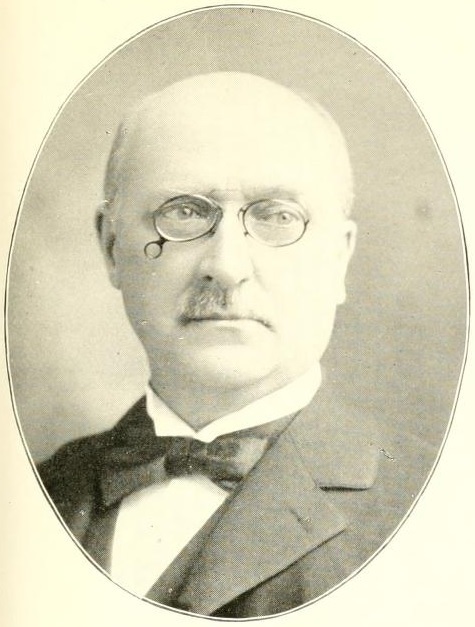
Historical · U.S. Court of Appeals for the Eighth Circuit
Elmer Bragg Adams
Former Circuit Judge · U.S. Court of Appeals for the Eighth Circuit · 1905–1916 · Appointed by Theodore Roosevelt
Elmer Bragg Adams served as a circuit judge of the U.S. Court of Appeals for the Eighth Circuit (1905–1916). Adams was appointed by Theodore Roosevelt.
Key facts
- Full name
- Elmer Bragg Adams
- Court
- U.S. Court of Appeals for the Eighth Circuit
- Office
- Circuit Judge (U.S. Court of Appeals)
- Status
- Former circuit judge
- Duty status
- Not serving
- Appointment
- Senate-confirmed
- FJC seat
- CA80302
- Tenure
- 1905–1916
- Confirmed
- 1905-12-12
- Born
- 1842-10-27
- Died
- 1916-10-24
- First year on the bench
- 1905
- Dataset version
- 1.20260711
Appointment & service record
U.S. Court of Appeals for the Eighth Circuit · 1905–1916
- Seat
- CA80302
- Appointment
- Senate-confirmed
- Appointing president
- Theodore Roosevelt
- Confirmed
- 1905-12-12
- Commissioned
- 1905-12-12
- Senior status
- —
Court, FJC seat, appointment type (Senate-confirmed or recess), appointing president, confirmation and commission dates, and senior-status date are drawn from the Federal Judicial Center Biographical Directory and Wikidata.[1][2][3]
Sources
- [1]https://www.fjc.gov/node/1377016fjc · retrieved 2026-07-11
- [2]https://www.fjc.gov/history/judges/biographical-directory-article-iii-federal-judges-exportfjc-directory · retrieved 2026-07-11
- [3]https://www.wikidata.org/wiki/Q5366494Wikidata · retrieved 2026-07-11
Biographical narrative
1,099 words · sourced from the Wikipedia REST extract
Elmer Bragg Adams was a United States circuit judge who served on the United States Court of Appeals for the Eighth Circuit from 1905 until his death in 1916. Born in Vermont in 1842, he pursued legal education at Harvard Law School following his undergraduate studies at Yale University, then established himself as a lawyer and jurist in Missouri. Before his elevation to the federal appellate bench, Adams served as both a state circuit court judge and a United States district judge for the Eastern District of Missouri. He was appointed to the Eighth Circuit by President Theodore Roosevelt, a Republican, and served in that capacity for more than a decade during a formative period in American federal jurisprudence.
Early life and legal career
Elmer Bragg Adams was born on October 27, 1842, in Pomfret, Vermont. He came from a family with deep roots in early American history, being a lineal descendant of Henry Adams of Braintree, Massachusetts. Adams pursued his higher education at Yale University, where he earned a Bachelor of Arts degree in 1865, graduating in the immediate aftermath of the Civil War. Following his undergraduate studies, he continued his education at Harvard Law School, completing his legal training and graduating in 1868.
Between his undergraduate and law school years, Adams devoted time to educational work in the Reconstruction South. From 1865 to 1866, he served as a teacher for the American Union Commission in Georgia, contributing to efforts to provide education during the tumultuous period following the Civil War. After completing his legal education, Adams relocated to St. Louis, Missouri, where he would spend the remainder of his professional life. He entered private practice in St. Louis beginning in 1866, establishing himself in the legal community of what was then one of the major cities of the American West and a crucial commercial center on the Mississippi River.
Adams practiced law privately in St. Louis for more than a decade, building a reputation that led to his appointment to the state judiciary. In 1879, he was appointed as a judge of the St. Louis Circuit Court, a position he held for five years. His service on the state bench lasted until 1884, after which he returned to private practice in St. Louis. He continued in private practice for another eleven years, maintaining his standing in the Missouri legal community. During this period, he also received academic recognition for his legal work when the University of Missouri conferred upon him an honorary Doctor of Laws degree in 1896. Adams married Emma Richmond of Woodstock, Vermont, in 1870, establishing a family life that would continue throughout his judicial career.
Federal appellate service
Adams's federal judicial career began with his appointment to the district court. President Grover Cleveland, a Democrat, gave Adams a recess appointment on May 17, 1895, to a seat on the United States District Court for the Eastern District of Missouri. This seat had been vacated by Judge Henry Samuel Priest. President Cleveland formally nominated Adams to the same position on December 4, 1895, and the United States Senate confirmed the nomination on December 9, 1895. Adams received his commission the same day and began his service as a federal district judge.
Adams served on the district court for a decade, presiding over cases in the Eastern District of Missouri, which encompassed St. Louis and the surrounding region. His tenure on the district bench came to an end when he was elevated to the circuit court. On May 20, 1905, President Theodore Roosevelt gave Adams a recess appointment to a joint seat on the United States Court of Appeals for the Eighth Circuit and the United States Circuit Courts for the Eighth Circuit. This seat had been vacated by Judge Amos Madden Thayer. President Roosevelt formally nominated Adams to this position on December 5, 1905, and the Senate confirmed him on December 12, 1905, with Adams receiving his commission the same day.
At the time of Adams's appointment to the Eighth Circuit, the federal court system still maintained the old circuit courts, which were distinct from the courts of appeals created in 1891. Adams therefore held a joint appointment to both tribunals. However, this dual structure was short-lived. On December 31, 1911, Congress abolished the circuit courts as part of judicial reform efforts, and thereafter Adams served exclusively on the Court of Appeals for the Eighth Circuit. The Eighth Circuit during Adams's tenure had jurisdiction over appeals from federal district courts in a large swath of the central United States, handling cases involving federal law, diversity jurisdiction, and other matters within federal court authority.
Adams continued his service on the Eighth Circuit until his death. He died in St. Louis on October 24, 1916, just three days before what would have been his seventy-fourth birthday. His death terminated his judicial service after more than eleven years on the circuit court and more than twenty-one years total on the federal bench.
Jurisprudence and legacy
Adams served on the federal appellate bench during a significant period in American legal history, spanning the Progressive Era and the early years of the twentieth century. His tenure on the Eighth Circuit coincided with important developments in federal law, including cases involving interstate commerce, federal regulatory authority, and the interpretation of constitutional provisions during a time of rapid economic and social change. The Eighth Circuit during this era heard appeals from a geographically vast region that included both agricultural states and growing industrial centers, presenting a diverse array of legal questions.
As a circuit judge appointed during the Theodore Roosevelt administration, Adams was part of a federal judiciary grappling with the expansion of federal power and the relationship between state and federal authority. The period of his service saw the federal courts addressing questions arising from new federal legislation, including antitrust laws and railroad regulation, as well as traditional areas of federal jurisdiction. His background as both a state court judge and a federal district judge provided him with experience in multiple levels of the American judicial system, which informed his work on the appellate bench.
Adams's career reflected the typical path of federal judges of his era, many of whom combined private practice, state judicial service, and federal appointments. His more than two decades of federal judicial service, split between the trial and appellate levels, represented a substantial contribution to the administration of federal justice in Missouri and the broader Eighth Circuit region. His service ended only with his death in 1916, after having witnessed significant transformations in American law and society during his years on the bench.
Sources & provenance
Every quantitative or attributable claim above carries a per-section [N] marker that resolves to the corresponding URL below. Each entry records the upstream provider, the canonical URL, and the timestamp at which the underlying source was retrieved.
Key facts
- https://www.fjc.gov/node/1377016fjc · retrieved 2026-07-11
- https://www.fjc.gov/history/judges/biographical-directory-article-iii-federal-judges-exportfjc-directory · retrieved 2026-07-11
- https://www.wikidata.org/wiki/Q5366494Wikidata · retrieved 2026-07-11
Biographical narrative
- https://en.wikipedia.org/wiki/Elmer_B._AdamsWikipedia · retrieved 2026-07-11
Explore the federal judiciary
The U.S. Courts of Appeals are the intermediate appellate courts of the federal judiciary — thirteen circuits sitting between the district courts and the Supreme Court. Browse the full roster of judges on the U.S. Court of Appeals for the Eighth Circuit, or explore how the appointed federal judiciary fits into the federal government.