
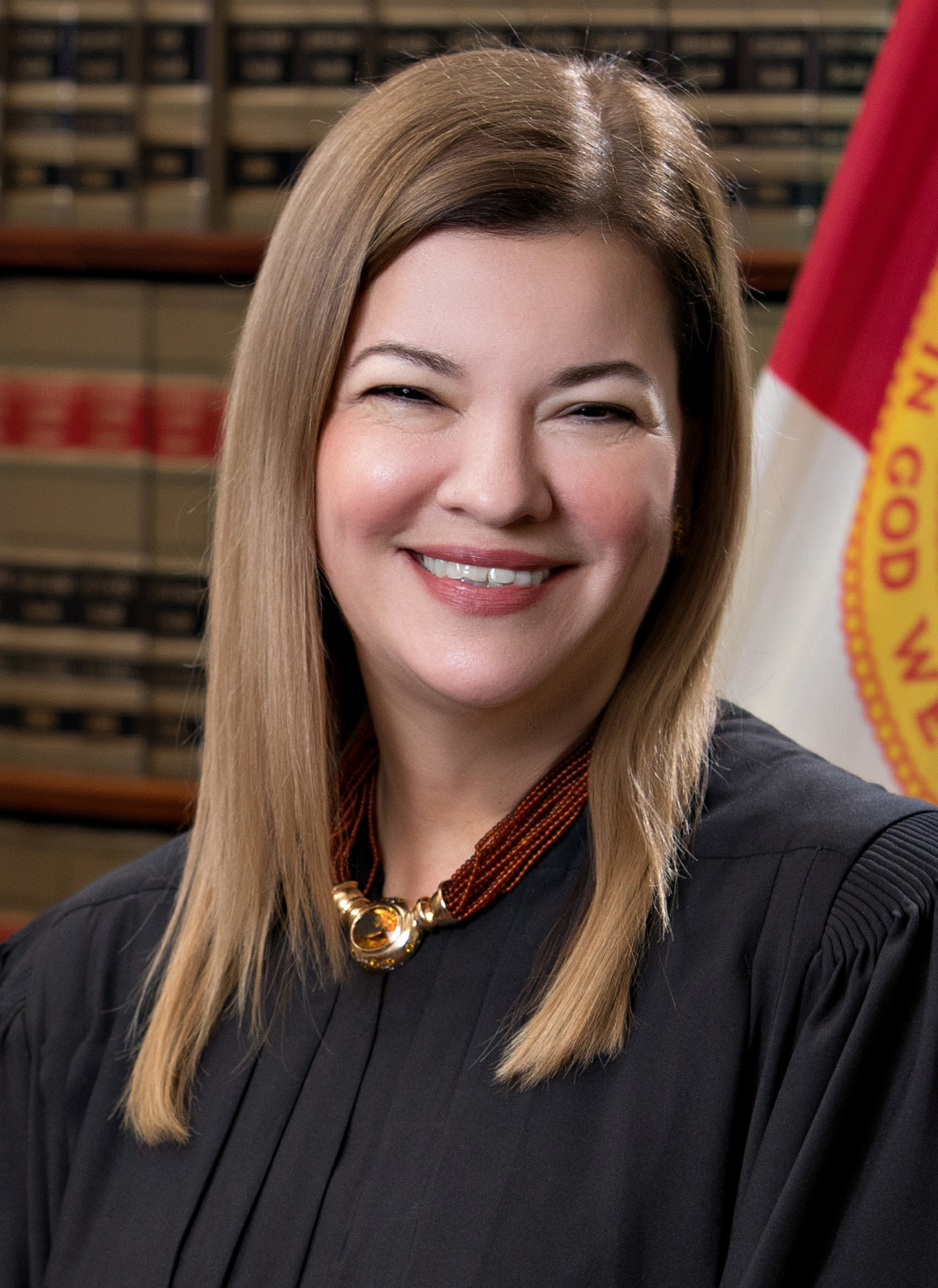
Currently serving · U.S. Court of Appeals for the Eleventh Circuit
Barbara Lagoa
Currently serving
Circuit Judge · U.S. Court of Appeals for the Eleventh Circuit · 2019–present · Appointed by Donald Trump
Barbara Lagoa serves as a circuit judge of the U.S. Court of Appeals for the Eleventh Circuit (2019–present). Lagoa was appointed by Donald Trump.
Key facts
- Full name
- Barbara Lagoa
- Court
- U.S. Court of Appeals for the Eleventh Circuit
- Office
- Circuit Judge (U.S. Court of Appeals)
- Status
- Active circuit judge
- Duty status
- Active
- Appointment
- Senate-confirmed
- FJC seat
- CA110503
- Tenure
- 2019–present
- Confirmed
- 2019-11-20
- Born
- 1967
- Died
- —
- First year on the bench
- 2019
- Dataset version
- 1.20260705
Appointment & service record
U.S. Court of Appeals for the Eleventh Circuit · 2019–present
- Seat
- CA110503
- Appointment
- Senate-confirmed
- Appointing president
- Donald Trump
- Confirmed
- 2019-11-20
- Commissioned
- 2019-12-06
- Senior status
- —
Court, FJC seat, appointment type (Senate-confirmed or recess), appointing president, confirmation and commission dates, and senior-status date are drawn from the Federal Judicial Center Biographical Directory and Wikidata.[1][2][3]
Sources
- [1]https://www.fjc.gov/node/7395471fjc · retrieved 2026-07-05
- [2]https://www.fjc.gov/history/judges/biographical-directory-article-iii-federal-judges-exportfjc-directory · retrieved 2026-07-05
- [3]https://www.wikidata.org/wiki/Q4859076Wikidata · retrieved 2026-07-05
Biographical narrative
1,320 words · sourced from the Wikipedia REST extract
Barbara Lagoa is an American attorney and jurist who serves as a United States circuit judge on the Eleventh Circuit Court of Appeals. Appointed to the federal bench in 2019 by President Donald J. Trump, she previously held positions on Florida’s intermediate appellate court, its supreme court, and worked as a federal prosecutor. Her career has been marked by several historic firsts for Hispanic and Cuban‑American women within the state judiciary, and she has participated in notable appellate decisions involving voting rights, gender‑based school policies, and state regulation of medical treatment for minors.
Early life and legal career
Barbara Lagoa was born on November 2, 1967, in Miami, Florida, to Antonio and Araceli Lagoa, who emigrated from Cuba after the Cuban Revolution. Raised in Hialeah, a city with a large Cuban‑American population, she grew up bilingual in English and Spanish. She pursued undergraduate studies at Florida International University, earning a Bachelor of Arts in English literature in 1989; her academic record was recognized with cum laude honors and membership in Phi Kappa Phi. Continuing to law school, Lagoa attended Columbia Law School, where she contributed as an associate editor to the Columbia Law Review and received her Juris Doctor in 1992.
Following graduation, Lagoa returned to Miami and entered private practice. She first joined the firm Morgan, Lewis & Bockius before moving to Greenberg Traurig, where she worked as an associate from 1998 until 2003. During this period, she participated in pro bono representation of the family of Elián González, a high‑profile immigration case that attracted national attention in 2000.
In 2003 Lagoa transitioned to public service as an Assistant United States Attorney for the Southern District of Florida. Within that office she served in multiple sections, including civil litigation, major crimes, and appellate work, gaining experience across a broad spectrum of federal legal matters.
Lagoa’s judicial career began with her appointment to the Third District Court of Appeal by Governor Jeb Bush in June 2006. She later became chief judge of that court on January 1, 2019. Shortly thereafter, Governor Ron DeSantis appointed her to the Florida Supreme Court on January 9, 2019, making her the first Hispanic woman and the first Cuban‑American woman to sit on that high court. While on the state supreme court, Lagoa authored a unanimous opinion upholding the governor’s authority to suspend Sheriff Scott Israel in the aftermath of the Stoneman Douglas High School shooting. She also participated in oral arguments concerning an advisory question about whether Florida could require felons who had been re‑enfranchised under the 2018 amendment to pay outstanding fines before voting.
Lagoa resigned from the Florida Supreme Court after her federal appointment, concluding a state judicial tenure that combined appellate leadership with historic representation for Hispanic women in Florida’s highest courts.
Federal appellate service
President Donald J. Trump announced his intent to nominate Lagoa to the United States Court of Appeals for the Eleventh Circuit on September 12, 2019, filling the vacancy left by Judge Stanley Marcus. The formal nomination was transmitted to the Senate on October 15, 2019, and a confirmation hearing before the Senate Judiciary Committee took place on October 16. The committee reported her nomination favorably with an 18–4 vote on November 7.
The full Senate invoked cloture on Lagoa’s nomination on November 19 by an 80‑15 vote and confirmed her the following day with the same margin. She received her judicial commission on December 6, 2019, and has served as an active circuit judge since that time.
During her tenure on the Eleventh Circuit, Judge Lagoa has been involved in several high‑profile en banc decisions. In July 2020, Democratic members of the Senate Judiciary Committee wrote to request her recusal from a case challenging Florida’s felon disenfranchisement law, citing her prior participation in related state‑court proceedings. Together with Judge Robert Luck, she declined to step aside, reasoning that differences in court, procedural posture, and constitutional issues mitigated any appearance of bias.
Later that year, the en banc Eleventh Circuit affirmed the constitutionality of Florida’s requirement that individuals whose voting rights had been restored must satisfy all financial obligations—including fines, fees, and restitution—before casting a ballot. Judge Lagoa joined the majority opinion authored by Chief Judge William H. Pryor Jr., also signing an additional concurrence.
In December 2022, she wrote the majority opinion for an en banc panel that held a high school’s bathroom policy, which separated facilities based on biological sex, did not violate the Equal Protection Clause of the Fourteenth Amendment or Title IX. In a separate special concurrence, Lagoa discussed how redefining “sex” under Title IX to align with gender identity could affect the rights of girls and women, particularly in athletics.
More recently, on August 21, 2023, Judge Lagoa authored an opinion that vacated a district‑court preliminary injunction and permitted Alabama’s Vulnerable Child Compassion and Protection Act to take effect. The statute criminalizes the prescription or administration of puberty blockers or cross‑sex hormones to minors for the purpose of affirming gender identity inconsistent with the minor’s biological sex. In her analysis, Lagoa concluded that the Constitution does not protect an unenumerated parental right to provide such transitioning medications and that the law did not constitute impermissible sex discrimination.
Throughout her federal service, Judge Lagoa has been listed among potential nominees for the United States Supreme Court. President Trump included her on a shortlist of candidates in September 2020, and she was later identified as one of the finalists considered to replace Justice Ruth Bader Ginsburg, although the appointment ultimately went to another nominee.
Jurisprudence and legacy
Judge Barbara Lagoa’s body of work reflects engagement with issues that intersect constitutional interpretation, state regulatory authority, and evolving social policy. Her opinions on voting‑rights matters demonstrate a willingness to uphold state legislative frameworks governing electoral qualifications, emphasizing procedural regularity over expansive readings of individual rights. In the Florida felon‑disenfranchisement case, her support for the majority underscored deference to state determinations about the conditions attached to restored suffrage.
On gender‑related education policy, Lagoa’s 2022 opinion affirmed a school’s ability to base restroom access on biological sex, interpreting both the Equal Protection Clause and Title IX in a manner that preserves traditional sex classifications. Her accompanying special concurrence articulated concerns about how expanding the definition of “sex” could affect existing protections for women and girls, particularly in competitive sports contexts.
The 2023 Alabama case illustrates her approach to state regulation of medical treatment for minors. By rejecting an argument for a constitutional right to gender‑affirming medication, she aligned with a view that such matters fall within the purview of legislative judgment rather than protected individual liberties, while also finding no violation of sex‑based discrimination prohibitions.
Beyond specific rulings, Judge Lagoa’s career carries symbolic significance. As the first Latina and Cuban‑American woman to serve on Florida’s supreme court, she broke ethnic and gender barriers in a state judiciary historically dominated by other demographics. Her subsequent elevation to the federal appellate bench continued that pattern of representation at the national level. While her judicial philosophy is reflected through case outcomes rather than overt statements, the decisions she has joined or authored reveal an inclination toward interpreting constitutional provisions with respect for established statutory schemes and a measured view of expanding rights beyond explicit textual guarantees.
Potential future service on the nation’s highest court has been publicly discussed, indicating that her professional profile resonates within broader considerations of judicial diversity and ideological balance. Whether or not such elevation occurs, Judge Lagoa’s contributions to both state and federal jurisprudence have already left an imprint on legal discourse surrounding electoral law, gender identity, and parental authority in medical decisions.
In sum, Barbara Lagoa’s trajectory from a Miami upbringing to the Eleventh Circuit exemplifies a blend of historic firsts, extensive appellate experience, and participation in consequential constitutional debates. Her ongoing service continues to shape the interpretation of federal law within her circuit while reflecting the evolving composition of the American judiciary.
Sources & provenance
Every quantitative or attributable claim above carries a per-section [N] marker that resolves to the corresponding URL below. Each entry records the upstream provider, the canonical URL, and the timestamp at which the underlying source was retrieved.
Key facts
- https://www.fjc.gov/node/7395471fjc · retrieved 2026-07-05
- https://www.fjc.gov/history/judges/biographical-directory-article-iii-federal-judges-exportfjc-directory · retrieved 2026-07-05
- https://www.wikidata.org/wiki/Q4859076Wikidata · retrieved 2026-07-05
Biographical narrative
- https://en.wikipedia.org/wiki/Barbara_LagoaWikipedia · retrieved 2026-07-05
Explore the federal judiciary
The U.S. Courts of Appeals are the intermediate appellate courts of the federal judiciary — thirteen circuits sitting between the district courts and the Supreme Court. Browse the full roster of judges on the U.S. Court of Appeals for the Eleventh Circuit, or explore how the appointed federal judiciary fits into the federal government.