
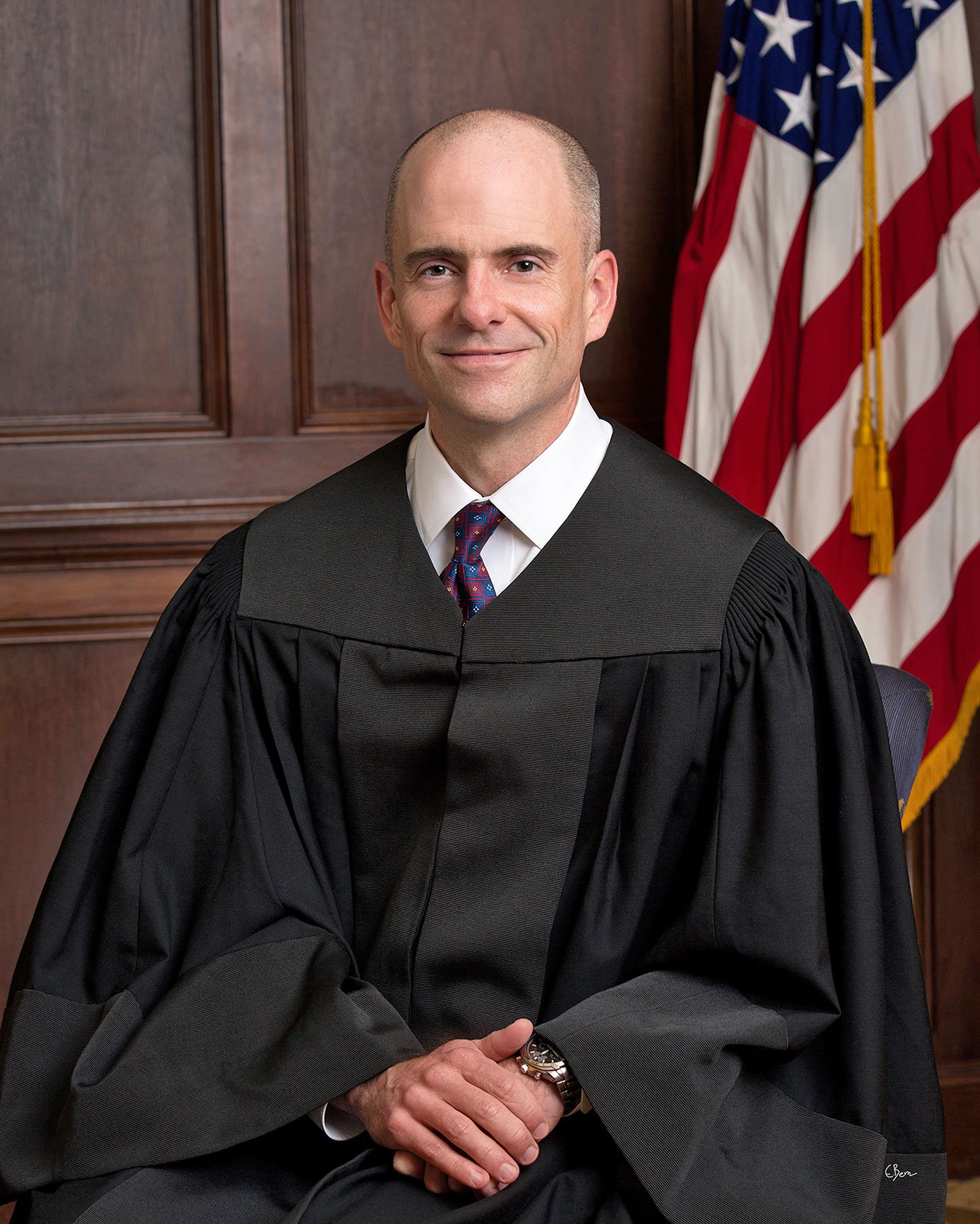
Currently serving · U.S. Court of Appeals for the Eleventh Circuit
Kevin Christopher Newsom
Currently serving
Circuit Judge · U.S. Court of Appeals for the Eleventh Circuit · 2017–present · Appointed by Donald Trump
Kevin Christopher Newsom serves as a circuit judge of the U.S. Court of Appeals for the Eleventh Circuit (2017–present). Newsom was appointed by Donald Trump.
Key facts
- Full name
- Kevin Christopher Newsom
- Court
- U.S. Court of Appeals for the Eleventh Circuit
- Office
- Circuit Judge (U.S. Court of Appeals)
- Status
- Active circuit judge
- Duty status
- Active
- Appointment
- Senate-confirmed
- FJC seat
- CA110603
- Tenure
- 2017–present
- Confirmed
- 2017-08-01
- Born
- 1972
- Died
- —
- First year on the bench
- 2017
- Dataset version
- 1.20260705
Appointment & service record
U.S. Court of Appeals for the Eleventh Circuit · 2017–present
- Seat
- CA110603
- Appointment
- Senate-confirmed
- Appointing president
- Donald Trump
- Confirmed
- 2017-08-01
- Commissioned
- 2017-08-02
- Senior status
- —
Court, FJC seat, appointment type (Senate-confirmed or recess), appointing president, confirmation and commission dates, and senior-status date are drawn from the Federal Judicial Center Biographical Directory and Wikidata.[1][2][3]
Sources
- [1]https://www.fjc.gov/node/3267886fjc · retrieved 2026-07-05
- [2]https://www.fjc.gov/history/judges/biographical-directory-article-iii-federal-judges-exportfjc-directory · retrieved 2026-07-05
- [3]https://www.wikidata.org/wiki/Q29867685Wikidata · retrieved 2026-07-05
Biographical narrative
1,142 words · sourced from the Wikipedia REST extract
Kevin Christopher Newsom (born September 22, 1972) is an American attorney and jurist who has served as a United States circuit judge on the Eleventh Circuit Court of Appeals since 2017. Appointed by President Donald J. Trump, he occupies an active seat on a federal appellate court that hears cases from Alabama, Florida, and Georgia. His career spans clerkships at both the appellate and Supreme Court levels, service as Alabama’s solicitor general, private‑practice appellate work, and participation in academic and professional organizations.
Early life and legal career
Kevin Newsom was born in Birmingham, Alabama, to Susan and Michael Alan Newsom. His father practiced law, providing an early exposure to the legal profession. Both parents struggled with alcoholism, a circumstance noted in biographical accounts of his upbringing. Newsom attended Homewood High School in Birmingham before pursuing higher education at Samford University, where he earned a Bachelor of Arts degree summa cum laude in 1994 and graduated first in his class.
Following his undergraduate studies, Newsom enrolled at Harvard Law School. He completed his Juris Doctor there in 1997, graduating magna cum laude. While at Harvard, he contributed to the Harvard Law Review as an articles editor, a role that involved overseeing scholarly submissions and editing legal scholarship for publication.
After law school, Newsom entered the federal judiciary as a clerk for Judge Diarmuid O’Scannlain of the United States Court of Appeals for the Ninth Circuit, serving from 1997 to 1998. He subsequently secured a prestigious clerkship with Justice David Souter of the Supreme Court of the United States, where he worked from 1998 to 1999. These clerkships provided him with direct experience in appellate and constitutional adjudication at the highest levels.
Upon completing his clerkships, Newsom joined the Washington, D.C., law firm Covington & Burling, where he practiced for several years. In December 2003, he returned to Alabama when Governor Bob Riley appointed him as the state’s second solicitor general, succeeding Nathan A. Forrester. In that capacity, Newsom served under two state attorneys general—William H. Pryor Jr. and Troy King—for three and a half years. As solicitor general, he represented Alabama in appellate matters, arguing eighteen cases before various courts, including three appearances before the United States Supreme Court.
After his tenure as solicitor general, Newsom entered private practice as a partner at Bradley Arant Boult Cummings LLP in Birmingham. His practice focused on appellate litigation, allowing him to continue shaping legal arguments before state and federal appellate courts. In addition to his professional work, Newsom has maintained ties to academia and the broader legal community. He serves on the Board of Overseers of Samford University, contributing to governance and strategic planning for his alma mater. His affiliations also include membership in the Federalist Society, a network of conservative and libertarian lawyers and scholars, and participation in the American Law Institute, an organization dedicated to clarifying and improving the law.
Newsom’s personal life includes his marriage in 1994 to Deborah E. Wilgus, who is also a Samford University alumna. The couple has two children.
Federal appellate service
President Donald J. Trump nominated Kevin Newsom to the United States Court of Appeals for the Eleventh Circuit on May 8, 2017. The nomination filled the vacancy created when Judge Joel Fredrick Dubina assumed senior status on October 26, 2013. Newsom’s confirmation process began with a hearing before the Senate Judiciary Committee on June 14, 2017. Following deliberation, the committee reported his nomination favorably by an 18–2 vote on July 13, 2017.
The full United States Senate considered the nomination in late July. On July 31, 2017, the Senate invoked cloture on Newsom’s appointment with a 68–26 vote, limiting further debate and moving toward a final confirmation vote. The subsequent confirmation vote took place on August 1, 2017, resulting in a 66–31 affirmation of his nomination. He received his judicial commission the following day, August 2, 2017, officially becoming an active circuit judge on the Eleventh Circuit.
Newsom occupies seat CA110603 on the Eleventh Circuit, a court that reviews decisions from federal district courts within its three‑state jurisdiction and addresses significant questions of federal law. As an active judge, he participates in panels that hear oral arguments, draft opinions, and contribute to the development of precedent across a wide range of legal issues, including civil rights, criminal procedure, administrative law, and constitutional interpretation.
Jurisprudence and legacy
Since joining the Eleventh Circuit bench, Judge Newsom has authored opinions on matters of both procedural and substantive significance. In June 2020, amid the COVID‑19 pandemic, he wrote for a divided panel that vacated an injunction issued by a lower court requiring the Miami‑Dade County Corrections and Rehabilitation Department to implement social‑distancing protocols and other preventive measures for incarcerated individuals. The decision reflected the panel’s assessment of the appropriate scope of judicial intervention in prison health policies during an unprecedented public health crisis.
Another notable opinion authored by Newsom appeared on May 23, 2022, in the case *Moody v. NetChoice*. Sitting with Judges Tjoflat and Ed Carnes, he concluded that several provisions of Florida’s social‑media moderation law were unconstitutional, while affirming the constitutionality of other sections. The panel’s split analysis highlighted complex tensions between state regulatory authority over digital platforms and First Amendment protections. The United States Supreme Court later remanded the case in July 2024 for further consideration, underscoring the ongoing relevance of the issues addressed in Newsom’s opinion.
Beyond his judicial work, Newsom has contributed to legal scholarship. In January 2000, he published an article titled “Setting Incorporationism Straight: A Reinterpretation of the Slaughter‑House Cases” in *The Yale Law Journal*. The piece examined historical interpretations of the Fourteenth Amendment’s incorporation doctrine, offering a nuanced perspective on how certain rights become applicable to the states through the Due Process Clause.
Judge Newsom’s involvement with professional organizations such as the Federalist Society and the American Law Institute reflects his engagement with broader debates about legal theory and practice. His service on Samford University’s Board of Overseers demonstrates an ongoing commitment to higher education and mentorship within the legal community.
While still in active service, Judge Newsom’s jurisprudence continues to shape the Eleventh Circuit’s body of law. His opinions illustrate a careful approach to constitutional analysis, often balancing deference to legislative intent with scrutiny of governmental authority. As a former solicitor general and appellate practitioner, he brings extensive experience in oral advocacy and brief writing to his judicial role, influencing both the procedural conduct of cases and substantive outcomes.
Overall, Kevin Christopher Newsom’s career trajectory—from clerkships at the Ninth Circuit and the United States Supreme Court, through state‑level appellate leadership as Alabama’s solicitor general, to private‑practice appellate work and ultimately a federal appellate judgeship—exemplifies a blend of academic achievement, public service, and professional dedication. His contributions on the Eleventh Circuit bench, combined with his scholarly output and civic involvement, constitute a notable presence within the contemporary federal judiciary.
Sources & provenance
Every quantitative or attributable claim above carries a per-section [N] marker that resolves to the corresponding URL below. Each entry records the upstream provider, the canonical URL, and the timestamp at which the underlying source was retrieved.
Key facts
- https://www.fjc.gov/node/3267886fjc · retrieved 2026-07-05
- https://www.fjc.gov/history/judges/biographical-directory-article-iii-federal-judges-exportfjc-directory · retrieved 2026-07-05
- https://www.wikidata.org/wiki/Q29867685Wikidata · retrieved 2026-07-05
Biographical narrative
- https://en.wikipedia.org/wiki/Kevin_NewsomWikipedia · retrieved 2026-07-05
Explore the federal judiciary
The U.S. Courts of Appeals are the intermediate appellate courts of the federal judiciary — thirteen circuits sitting between the district courts and the Supreme Court. Browse the full roster of judges on the U.S. Court of Appeals for the Eleventh Circuit, or explore how the appointed federal judiciary fits into the federal government.