
Historical · U.S. Court of Appeals for the Federal Circuit
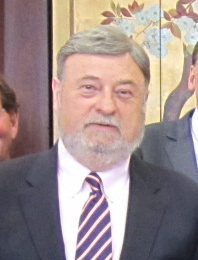
Arthur J. Gajarsa
Former Circuit Judge · U.S. Court of Appeals for the Federal Circuit · 1997–2012 · Appointed by Bill Clinton
Arthur J. Gajarsa served as a circuit judge of the U.S. Court of Appeals for the Federal Circuit (1997–2012). Gajarsa was appointed by Bill Clinton.
Key facts
- Full name
- Arthur J. Gajarsa
- Court
- U.S. Court of Appeals for the Federal Circuit
- Office
- Circuit Judge (U.S. Court of Appeals)
- Status
- Former circuit judge
- Duty status
- Not serving
- Appointment
- Senate-confirmed
- FJC seat
- CAFC0302
- Tenure
- 1997–2012
- Confirmed
- 1997-07-31
- Born
- 1941
- Died
- —
- First year on the bench
- 1997
- Dataset version
- 1.20260711
Appointment & service record
U.S. Court of Appeals for the Federal Circuit · 1997–2011
- Seat
- CAFC0302
- Appointment
- Senate-confirmed
- Appointing president
- Bill Clinton
- Confirmed
- 1997-07-31
- Commissioned
- 1997-08-01
- Senior status
- 2011-07-31
Court, FJC seat, appointment type (Senate-confirmed or recess), appointing president, confirmation and commission dates, and senior-status date are drawn from the Federal Judicial Center Biographical Directory and Wikidata.[1][2][3]
Sources
- [1]https://www.fjc.gov/node/1390476fjc · retrieved 2026-07-11
- [2]https://www.fjc.gov/history/judges/biographical-directory-article-iii-federal-judges-exportfjc-directory · retrieved 2026-07-11
- [3]https://www.wikidata.org/wiki/Q4799190Wikidata · retrieved 2026-07-11
Biographical narrative
1,313 words · sourced from the Wikipedia REST extract
Arthur Joseph Gajarsa is a former United States circuit judge who served on the United States Court of Appeals for the Federal Circuit from 1997 to 2012. Born in Italy in 1941 and raised in Massachusetts, he brought an unusual combination of technical training in electrical engineering, graduate education in economics, and legal expertise to the federal bench. Appointed by President William J. Clinton, a Democrat, and confirmed by the Senate in 1997, Gajarsa served as an active judge until assuming senior status in 2011 and retiring the following year. His career before ascending to the federal appellate bench included work as a patent examiner, private practice focused on intellectual property and related fields, and service in various government positions.
Early life and legal career
Gajarsa was born on March 1, 1941, in Norcia, a town in the province of Perugia in Italy. His family later relocated to the United States, where he attended Boston Technical High School in Massachusetts. He distinguished himself academically, graduating as the top-ranked student in his class in 1958. That same year, he received both the Bausch and Lomb Medal and the Benjamin Franklin Award from his high school, recognizing his academic achievements.
Following high school, Gajarsa enrolled at Rensselaer Polytechnic Institute in Troy, New York, where he pursued studies in electrical engineering. During his time at Rensselaer, he was admitted to the Zeta Psi fraternity. He completed his undergraduate education in 1962, earning a Bachelor of Science degree in electrical engineering. This technical foundation would prove significant throughout his subsequent career, particularly given the specialized nature of patent law and the Federal Circuit's jurisdiction over intellectual property matters.
After completing his engineering degree, Gajarsa began working in the patent field while continuing his education. From 1962 to 1963, he served as a patent examiner with the United States Patent and Trademark Office, gaining firsthand experience with the patent system. He then transitioned to serving as a patent adviser to the United States Air Force from 1963 to 1964. During this period, he pursued graduate studies in economics at the Catholic University of America, earning a Master of Arts degree in 1964. From 1964 to 1967, he worked as a patent adviser to the law firm of Cushman, Darby and Cushman while simultaneously attending law school.
Gajarsa obtained his Juris Doctor from Georgetown University Law Center in 1967. Following law school, he served as a law clerk to Judge Joseph Charles McGarraghy of the United States District Court for the District of Columbia from 1967 to 1968. This clerkship provided him with valuable exposure to federal judicial proceedings and legal reasoning. After his clerkship, Gajarsa worked as an attorney with Aetna Life and Casualty, Inc. from 1968 to 1969, then served as special counsel for the Commissioner of Indian Affairs at the United States Department of Interior from 1969 to 1970.
Beginning in 1971, Gajarsa entered private practice in Washington, D.C., where he remained for more than two decades until his appointment to the federal bench. During this period, he developed expertise in various areas of law and maintained an active presence in legal scholarship. He authored publications on antitrust law for the American Bar Association from 1967 to 1969 and wrote on European Common Market antitrust laws for Catholic University in 1967. Throughout his career in private practice, he published numerous articles addressing topics in both economics and law, drawing on his interdisciplinary educational background.
Federal appellate service
President William J. Clinton, a Democrat, nominated Gajarsa to the United States Court of Appeals for the Federal Circuit on January 7, 1997. The nomination was to fill a seat that had been vacated by Judge Helen W. Nies. The United States Senate confirmed the nomination on July 31, 1997, and Gajarsa received his commission the following day, on August 1, 1997. He officially entered service as a circuit judge on September 12, 1997, taking his place on a court with specialized jurisdiction over patent appeals, certain claims against the federal government, and other matters of national importance.
The Federal Circuit, established in 1982, occupies a unique position in the federal judiciary. Unlike the geographically defined regional circuits, it has nationwide jurisdiction over specific subject matters, most notably patent law. The court hears appeals from all federal district courts in patent cases, as well as appeals from the United States Patent and Trademark Office and the United States Court of International Trade. This specialized jurisdiction meant that Gajarsa's technical background in electrical engineering and his early career experience in patent examination were particularly relevant to his judicial work.
Gajarsa served as an active judge on the Federal Circuit for fourteen years. During this time, he participated in the court's work addressing complex questions of patent law, intellectual property, government contracts, and other matters within the court's jurisdiction. His tenure on the court spanned a period of significant development in patent law and technology policy, as the Federal Circuit's decisions shaped the landscape for innovation and intellectual property protection across the United States.
On July 31, 2011, Gajarsa assumed senior status, a form of semi-retirement that allows federal judges to continue hearing cases on a reduced schedule while creating a vacancy for a new active judge to be appointed. He continued in senior status until June 30, 2012, when his service terminated due to retirement. His federal appellate service thus spanned approximately fifteen years in total, from 1997 to 2012.
Jurisprudence and legacy
Following his retirement from the federal bench, Gajarsa remained active in legal education and institutional leadership. In November 2010, while still serving as a judge, Rensselaer Polytechnic Institute announced that he would succeed Samuel F. Heffner as Chairman of the Board, a position he assumed at the start of 2011. This role represented a return to his alma mater in a leadership capacity, allowing him to contribute to the governance of the institution where he had earned his engineering degree decades earlier.
In the fall of 2012, shortly after his retirement from the bench, Gajarsa joined the University of New Hampshire School of Law as its first Distinguished Jurist-in-Residence at the Franklin Pierce Center for Intellectual Property. This position allowed him to share his extensive experience in intellectual property law with the next generation of attorneys. The Franklin Pierce Center is recognized as a leading institution for the study of intellectual property law, making it a natural fit for a former Federal Circuit judge with Gajarsa's background. In recognition of his contributions to the field and his association with the law school, UNH Law co-founded the Arthur J. Gajarsa American Inn of Court, which became a member of the national Linn IP Inn Alliance. The Inn was formally launched in Concord, New Hampshire, on September 13, 2012.
Throughout his career, Gajarsa received numerous awards and honors recognizing his professional achievements and service. Beyond his early academic honors, he received the JFK Award for Public Service in 1974. His alma mater, Rensselaer Polytechnic Institute, recognized him with the Sun and Balance Medal in 1990, the Rensselaer Key Alumni Award in 1992, the Alumni Fellow Award from the Rensselaer Alumni Association in 1996, and the Albert Fox DeMers Medal in 1999. Georgetown University Law Center honored him with its 125th Anniversary Medal in 1995 and the Paul R. Dean Award in 1999. He received the Order of Commendatore from the Republic of Italy in 1995, acknowledging his Italian heritage and accomplishments. The Camp Hale Association in Boston presented him with the Gigi Pieri Award in 1992. In 2009, the Order Sons of Italy in America recognized him with an award for Lifetime Achievement in Jurisprudence and Italian American Leadership.
Gajarsa and his wife, Melanie, have five children. His career trajectory from immigrant origins to the federal appellate bench, combined with his interdisciplinary education spanning engineering, economics, and law, represents a distinctive path in the federal judiciary.
Sources & provenance
Every quantitative or attributable claim above carries a per-section [N] marker that resolves to the corresponding URL below. Each entry records the upstream provider, the canonical URL, and the timestamp at which the underlying source was retrieved.
Key facts
- https://www.fjc.gov/node/1390476fjc · retrieved 2026-07-11
- https://www.fjc.gov/history/judges/biographical-directory-article-iii-federal-judges-exportfjc-directory · retrieved 2026-07-11
- https://www.wikidata.org/wiki/Q4799190Wikidata · retrieved 2026-07-11
Biographical narrative
- https://en.wikipedia.org/wiki/Arthur_J._GajarsaWikipedia · retrieved 2026-07-11
Explore the federal judiciary
The U.S. Courts of Appeals are the intermediate appellate courts of the federal judiciary — thirteen circuits sitting between the district courts and the Supreme Court. Browse the full roster of judges on the U.S. Court of Appeals for the Federal Circuit, or explore how the appointed federal judiciary fits into the federal government.