
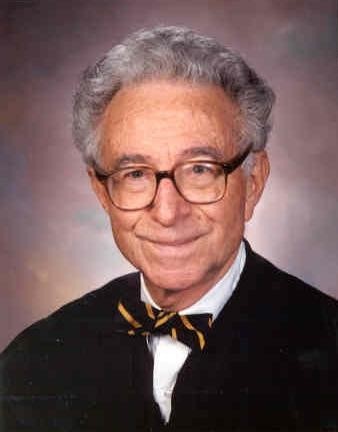
Historical · U.S. Court of Appeals for the Federal Circuit
Daniel Mortimer Friedman
Former Circuit Judge · U.S. Court of Appeals for the Federal Circuit · 1982–2011 · Appointed by None Reassignment
Daniel Mortimer Friedman served as a circuit judge of the U.S. Court of Appeals for the Federal Circuit (1982–2011). Friedman was appointed by None Reassignment.
Key facts
- Full name
- Daniel Mortimer Friedman
- Court
- U.S. Court of Appeals for the Federal Circuit
- Office
- Circuit Judge (U.S. Court of Appeals)
- Status
- Former circuit judge
- Duty status
- Not serving
- Appointment
- Recess appointment
- FJC seat
- CAFC0601
- Tenure
- 1982–2011
- Confirmed
- —
- Born
- 1916-02-08
- Died
- 2011-07-06
- First year on the bench
- 1982
- Dataset version
- 1.20260711
Appointment & service record
U.S. Court of Appeals for the Federal Circuit · 1982–1989
- Seat
- CAFC0601
- Appointment
- Recess appointment
- Appointing president
- None Reassignment
- Confirmed
- Recess appointment
- Commissioned
- 1982-10-01
- Senior status
- 1989-11-01
Court, FJC seat, appointment type (Senate-confirmed or recess), appointing president, confirmation and commission dates, and senior-status date are drawn from the Federal Judicial Center Biographical Directory and Wikidata.[1][2][3]
Sources
- [1]https://www.fjc.gov/node/1390371fjc · retrieved 2026-07-11
- [2]https://www.fjc.gov/history/judges/biographical-directory-article-iii-federal-judges-exportfjc-directory · retrieved 2026-07-11
- [3]https://www.wikidata.org/wiki/Q5218197Wikidata · retrieved 2026-07-11
Biographical narrative
1,264 words · sourced from the Wikipedia REST extract
Daniel Mortimer Friedman was a United States circuit judge who served on the United States Court of Appeals for the Federal Circuit from 1982 to 1989, and continued in senior status until his death in 2011. Before his appellate service, he served as chief judge of the United States Court of Claims beginning in 1978. His judicial career followed an extensive tenure in the federal government, including nearly two decades in the Office of the Solicitor General, where he rose to the position of first deputy solicitor general and briefly served as acting solicitor general. His career spanned significant developments in federal law, from post-World War II administrative regulation through the creation of the Federal Circuit in the early 1980s.
Early life and legal career
Daniel Mortimer Friedman was born on February 8, 1916, in New York City, New York. He pursued his undergraduate education at Columbia University, where he earned an Artium Baccalaureus degree in 1937. Continuing his studies at Columbia Law School, he received his Bachelor of Laws degree in 1940, completing his legal education at one of the nation's leading law schools during a period of significant change in American legal practice and theory.
Following his admission to the bar, Friedman entered private legal practice in New York City, where he worked until 1942. His private practice career was brief, as he soon transitioned to government service. In 1942, he joined the Securities and Exchange Commission as an attorney, working in both Philadelphia, Pennsylvania, and Washington, D.C. This position gave him early exposure to federal regulatory law and administrative practice during the wartime expansion of government activity.
His civilian government service was interrupted by World War II. Friedman joined the United States Army in September 1942 and served in the Quartermaster Corps, the branch responsible for supply operations and logistics. His military service included deployment to Europe during the war. He remained in the Army until February 1946, when he was discharged with the rank of master sergeant, having served through the conclusion of the European theater and the immediate postwar period.
After his discharge from military service, Friedman returned to the Securities and Exchange Commission, where he continued his work in federal securities regulation until 1951. That year marked a significant transition in his career when he joined the Antitrust Division of the United States Department of Justice in Washington, D.C., serving as assistant chief of the appellate section. This role placed him at the center of federal antitrust enforcement during a period of active government litigation against monopolistic practices and anticompetitive conduct.
In 1959, Friedman moved to the Office of the United States Solicitor General, beginning what would become a distinguished nineteen-year tenure representing the federal government before the Supreme Court of the United States. He initially served as an assistant to the solicitor general from 1959 to 1962, gaining experience in Supreme Court advocacy and the preparation of briefs on behalf of the United States. From 1962 to 1968, he was promoted to second assistant to the solicitor general, taking on greater responsibility for the government's appellate litigation strategy. In 1968, he advanced to the position of first deputy solicitor general, the second-ranking position in the office, where he served until 1978. During his time as first deputy, he supervised the office's work and participated in decisions about which cases the government would appeal and what positions it would take before the high court. In 1977, he served as acting United States Solicitor General, temporarily leading the office during a transitional period.
Federal appellate service
On March 22, 1978, President Jimmy Carter, a Democrat, nominated Friedman to serve as chief judge of the United States Court of Claims, filling the seat that had been vacated by Chief Judge Arnold Wilson Cowen. The United States Senate confirmed his nomination on May 17, 1978, and he received his commission two days later, on May 19, 1978. The Court of Claims was a specialized Article I court with jurisdiction over most claims against the United States government, handling disputes involving government contracts, tax refunds, and various other monetary claims against the federal government.
Friedman's tenure as chief judge of the Court of Claims coincided with a period of significant institutional change in the federal judiciary. During the Reagan Administration, Congress enacted the Federal Courts Improvement Act of 1982, a major reorganization of the federal appellate system for specialized cases. This legislation, codified at 96 Stat. 25, abolished the Court of Claims as it had existed and created the United States Court of Appeals for the Federal Circuit, a new Article III appellate court with nationwide jurisdiction over appeals in specialized areas including patent law, international trade, government contracts, and certain claims against the federal government.
By operation of the Federal Courts Improvement Act, Friedman was reassigned on October 1, 1982, to serve as a United States circuit judge of the newly created Court of Appeals for the Federal Circuit. This reassignment was automatic for judges of the former Court of Claims, reflecting Congress's intent to preserve judicial continuity while restructuring the court system. Friedman thus became one of the founding judges of the Federal Circuit, participating in the establishment of its procedures and jurisprudence during its formative years. He served in active status on the Federal Circuit until November 1, 1989, when he assumed senior status, a form of semi-retirement that allowed him to continue hearing cases on a reduced schedule while creating a vacancy for a new active judge.
Friedman remained in senior status for more than two decades, continuing to contribute to the work of the Federal Circuit until his death on July 6, 2011, in Washington, D.C. He was ninety-five years old at the time of his death, having served the federal judiciary for more than three decades.
Jurisprudence and legacy
Following Friedman's death, the legal community moved to honor his contributions to federal appellate practice and the development of the Federal Circuit. In 2012, working in cooperation with Friedman's former law clerks, the Federal Circuit Bar Association established the Friedman Memorial Committee. This committee was created specifically to honor Friedman's memory, spirit, and accomplishments, recognizing his role in shaping the specialized appellate practice before the Federal Circuit and his earlier contributions to federal litigation.
The Friedman Memorial Committee organizes an annual lecture series designed to advance the field of appellate advocacy. The Judge Daniel M. Friedman Appellate Lecture has become a prestigious event in the Federal Circuit legal community, bringing prominent jurists and advocates to address issues of appellate practice, procedure, and substantive law. The inaugural lecture took place on November 16, 2012, and featured Chief Judge Frank H. Easterbrook of the United States Court of Appeals for the Seventh Circuit, himself a distinguished jurist known for his contributions to appellate jurisprudence. The establishment of this lecture series reflects the esteem in which Friedman was held by practitioners and his lasting influence on the specialized bar that practices before the Federal Circuit.
Friedman's career trajectory from government attorney to solicitor general's office advocate to federal judge exemplified a traditional path of public service in the federal legal system. His extensive experience in the solicitor general's office, where he spent nearly two decades arguing and supervising cases before the Supreme Court, provided him with deep knowledge of appellate practice and federal law that informed his subsequent judicial service. His role as one of the founding judges of the Federal Circuit placed him in a position to help shape the jurisprudence of a new court with a unique and important mission in the federal judicial system.
Sources & provenance
Every quantitative or attributable claim above carries a per-section [N] marker that resolves to the corresponding URL below. Each entry records the upstream provider, the canonical URL, and the timestamp at which the underlying source was retrieved.
Key facts
- https://www.fjc.gov/node/1390371fjc · retrieved 2026-07-11
- https://www.fjc.gov/history/judges/biographical-directory-article-iii-federal-judges-exportfjc-directory · retrieved 2026-07-11
- https://www.wikidata.org/wiki/Q5218197Wikidata · retrieved 2026-07-11
Biographical narrative
- https://en.wikipedia.org/wiki/Daniel_Mortimer_FriedmanWikipedia · retrieved 2026-07-11
Explore the federal judiciary
The U.S. Courts of Appeals are the intermediate appellate courts of the federal judiciary — thirteen circuits sitting between the district courts and the Supreme Court. Browse the full roster of judges on the U.S. Court of Appeals for the Federal Circuit, or explore how the appointed federal judiciary fits into the federal government.