
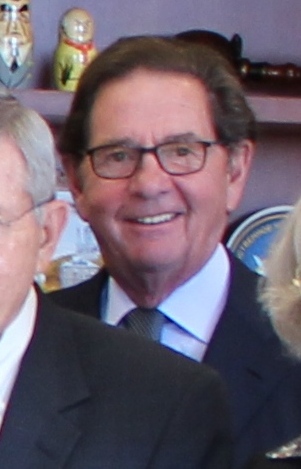
Currently serving · U.S. Court of Appeals for the Federal Circuit
Raymond Charles Clevenger III
Currently servingSenior status
Senior Circuit Judge · U.S. Court of Appeals for the Federal Circuit · 1990–present · Appointed by George H W Bush
Raymond Charles Clevenger III serves as a senior circuit judge of the U.S. Court of Appeals for the Federal Circuit (1990–present). III was appointed by George H W Bush. III assumed senior status in 2006 and continues to hear cases.
Key facts
- Full name
- Raymond Charles Clevenger III
- Court
- U.S. Court of Appeals for the Federal Circuit
- Office
- Circuit Judge (U.S. Court of Appeals)
- Status
- Senior circuit judge (still serving)
- Duty status
- Senior
- Appointment
- Senate-confirmed
- FJC seat
- CAFC1102
- Tenure
- 1990–present
- Confirmed
- 1990-04-27
- Born
- 1937
- Died
- —
- First year on the bench
- 1990
- Dataset version
- 1.20260705
Appointment & service record
U.S. Court of Appeals for the Federal Circuit · 1990–present
- Seat
- CAFC1102
- Appointment
- Senate-confirmed
- Appointing president
- George H W Bush
- Confirmed
- 1990-04-27
- Commissioned
- 1990-04-30
- Senior status
- 2006-02-01 (still serving)
Court, FJC seat, appointment type (Senate-confirmed or recess), appointing president, confirmation and commission dates, and senior-status date are drawn from the Federal Judicial Center Biographical Directory and Wikidata.[1][2][3]
Sources
- [1]https://www.fjc.gov/node/1379236fjc · retrieved 2026-07-05
- [2]https://www.fjc.gov/history/judges/biographical-directory-article-iii-federal-judges-exportfjc-directory · retrieved 2026-07-05
- [3]https://www.wikidata.org/wiki/Q7298633Wikidata · retrieved 2026-07-05
Biographical narrative
962 words · sourced from the Wikipedia REST extract
Raymond Charles Clevenger III (born August 27, 1937) is a senior United States circuit judge of the Court of Appeals for the Federal Circuit. Appointed by President George H. W. Bush in 1990, he served as an active‑service judge until assuming senior status in early 2006 and continues to sit on panels hearing appeals from federal district courts and specialized tribunals.
Early life and legal career
Clevenger was born in Topeka, Kansas, where he attended the local public schools before moving east for secondary education. He completed his high‑school studies at Phillips Academy in Andover, Massachusetts, a preparatory institution known for its rigorous academic program. Following graduation, Clevenger enrolled at Yale University, earning a Bachelor of Arts degree in 1959 with magna cum laude honors, reflecting distinguished undergraduate performance.
After completing his undergraduate work, Clevenger entered the financial sector, taking a position with Morgan Guaranty Trust Company. This early professional experience provided exposure to corporate finance and banking operations before he turned toward a legal career. He returned to Yale for graduate studies in law, receiving a Bachelor of Laws from Yale Law School in 1966. At Yale Law, Clevenger again graduated magna cum laude and was elected to the Order of the Coif, an honor society recognizing high academic achievement among law students.
The year following his graduation, Clevenger served as a law clerk for Justice Byron White of the United States Supreme Court during the October term of 1966. This clerkship placed him at the nation’s highest court, where he assisted in researching legal issues, drafting bench memoranda, and observing the deliberative process of the justices.
Upon completing his clerkship, Clevenger entered private practice with the Washington, D.C.,‑based firm Wilmer, Cutler & Pickering. He practiced law there for more than two decades, from 1967 until his judicial appointment in 1990. His tenure at the firm included work both in the nation’s capital and in London, indicating involvement in transatlantic legal matters and exposure to a broad range of commercial and regulatory issues. The experience he accumulated during this period—spanning corporate law, litigation, and international practice—formed the professional foundation for his later service on the federal appellate bench.
Federal appellate service
President George H. W. Bush nominated Clevenger to the United States Court of Appeals for the Federal Circuit on January 24, 1990, filling the vacancy created by Judge Oscar Hirsh Davis. The nomination proceeded through the Senate confirmation process and culminated in a vote confirming his appointment on April 27, 1990. He received his judicial commission three days later, on April 30, and formally assumed his duties as an active circuit judge on May 3, 1990.
During his sixteen years of active service, Judge Clevenger participated in the adjudication of appeals arising under the Federal Circuit’s specialized jurisdiction, which includes patent law, international trade, government contracts, and certain claims against the United States. The court’s unique docket required judges to possess a deep understanding of technical subject matter as well as complex statutory schemes. Throughout his tenure, Clevenger contributed to the development of the court’s jurisprudence across these areas, authoring opinions, joining panels, and engaging in the collegial processes that shape appellate precedent.
On February 1, 2006, Judge Clevenger elected to take senior status, a form of semi‑retirement that permits continued judicial service while allowing for reduced caseloads. Senior judges on the Federal Circuit remain integral to its functioning, often handling substantial portions of the court’s docket and providing mentorship to newer members of the bench. Since assuming senior status, Clevenger has continued to hear cases, maintaining an active role in the appellate process and ensuring continuity within the court’s institutional memory.
Jurisprudence and legacy
Judge Clevenger’s career on the Federal Circuit spans a period marked by significant evolution in areas such as patent law, where legislative reforms and shifting policy priorities have reshaped the landscape of intellectual property protection. While specific case holdings are not detailed here, his long service places him among the cohort of jurists who have contributed to the court’s reputation for technical expertise and consistency in interpreting statutes that affect national commerce and innovation.
His background—combining elite academic credentials, Supreme Court clerkship experience, and extensive private‑practice work both domestically and abroad—provided a foundation for addressing the complex legal questions presented before the Federal Circuit. The breadth of his pre‑judicial practice, particularly his involvement with an international law firm, equipped him to navigate cross‑border issues that frequently arise in patent disputes and trade matters.
Through participation in numerous panels and opinion authorship, Judge Clevenger helped shape the body of precedent that lower courts rely upon when applying federal statutes within the court’s jurisdiction. Senior judges often play a pivotal role in maintaining the efficiency of appellate review by handling cases that might otherwise delay resolution for litigants. In this capacity, Clevenger’s continued service after 2006 has contributed to the court’s ability to manage its docket and uphold the timely administration of justice.
Beyond his judicial duties, Judge Clevenger’s career reflects a trajectory common among Federal Circuit judges: distinguished academic achievement, clerkship at the nation’s highest court, and substantial experience in private practice before appointment. This pathway underscores the importance placed on both scholarly rigor and practical legal expertise within the federal appellate system. His tenure exemplifies the continuity of institutional knowledge that senior judges bring to the bench, fostering stability and mentorship within the judiciary.
In sum, Raymond Charles Clevenger III’s professional life encompasses a blend of academic distinction, high‑level clerkship experience, extensive private practice, and over three decades of service on one of the nation’s most specialized appellate courts. His contributions—both as an active judge and later as a senior jurist—have supported the Federal Circuit’s mission to provide uniform interpretation of federal statutes in areas critical to commerce, technology, and government operations.
Sources & provenance
Every quantitative or attributable claim above carries a per-section [N] marker that resolves to the corresponding URL below. Each entry records the upstream provider, the canonical URL, and the timestamp at which the underlying source was retrieved.
Key facts
- https://www.fjc.gov/node/1379236fjc · retrieved 2026-07-05
- https://www.fjc.gov/history/judges/biographical-directory-article-iii-federal-judges-exportfjc-directory · retrieved 2026-07-05
- https://www.wikidata.org/wiki/Q7298633Wikidata · retrieved 2026-07-05
Biographical narrative
- https://en.wikipedia.org/wiki/Raymond_C._ClevengerWikipedia · retrieved 2026-07-05
Explore the federal judiciary
The U.S. Courts of Appeals are the intermediate appellate courts of the federal judiciary — thirteen circuits sitting between the district courts and the Supreme Court. Browse the full roster of judges on the U.S. Court of Appeals for the Federal Circuit, or explore how the appointed federal judiciary fits into the federal government.