
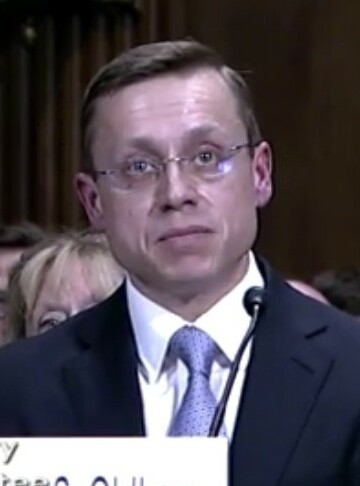
Currently serving · U.S. Court of Appeals for the Fifth Circuit
Andrew Stephen Oldham
Currently serving
Circuit Judge · U.S. Court of Appeals for the Fifth Circuit · 2018–present · Appointed by Donald Trump
Andrew Stephen Oldham serves as a circuit judge of the U.S. Court of Appeals for the Fifth Circuit (2018–present). Oldham was appointed by Donald Trump.
Key facts
- Full name
- Andrew Stephen Oldham
- Court
- U.S. Court of Appeals for the Fifth Circuit
- Office
- Circuit Judge (U.S. Court of Appeals)
- Status
- Active circuit judge
- Duty status
- Active
- Appointment
- Senate-confirmed
- FJC seat
- CA52404
- Tenure
- 2018–present
- Confirmed
- 2018-07-18
- Born
- 1978
- Died
- —
- First year on the bench
- 2018
- Dataset version
- 1.20260705
Appointment & service record
U.S. Court of Appeals for the Fifth Circuit · 2018–present
- Seat
- CA52404
- Appointment
- Senate-confirmed
- Appointing president
- Donald Trump
- Confirmed
- 2018-07-18
- Commissioned
- 2018-07-19
- Senior status
- —
Court, FJC seat, appointment type (Senate-confirmed or recess), appointing president, confirmation and commission dates, and senior-status date are drawn from the Federal Judicial Center Biographical Directory and Wikidata.[1][2][3]
Sources
- [1]https://www.fjc.gov/node/4947641fjc · retrieved 2026-07-05
- [2]https://www.fjc.gov/history/judges/biographical-directory-article-iii-federal-judges-exportfjc-directory · retrieved 2026-07-05
- [3]https://www.wikidata.org/wiki/Q48570490Wikidata · retrieved 2026-07-05
Biographical narrative
1,081 words · sourced from the Wikipedia REST extract
Andrew Stephen Oldham (born 1978) is an American attorney who has served as a United States circuit judge on the Fifth Circuit since 2018. Appointed by President Donald J. Trump, he previously held senior legal positions in both federal and state government, worked in private appellate practice, and taught law as an adjunct professor. His judicial work includes authorship of opinions that have addressed issues ranging from administrative delegation to criminal sentencing.
Early life and legal career
Andrew Stephen Oldham was born in 1978 in Richmond, Virginia. He pursued undergraduate studies at the University of Virginia, graduating in 2001 with a Bachelor of Arts earned with highest honors. Following his time in Charlottesville, he attended the University of Cambridge on a Harry S. Truman Scholarship, where he completed a Master of Philosophy in 2002 and received first‑class honours. Oldham then enrolled at Harvard Law School. While there he served as an editor of the Harvard Journal of Law and Public Policy and reached the semi‑final round of the Ames Moot Court Competition; he earned his Juris Doctor magna cum laude in 2005.
After law school, Oldham began a series of clerkships that placed him at the center of federal appellate work. From 2005 to 2006 he served as a law clerk for Judge David B. Sentelle of the United States Court of Appeals for the District of Columbia Circuit. He then spent two years (2006‑2008) as an attorney‑adviser in the Office of Legal Counsel within the U.S. Department of Justice, contributing to legal opinions during the administration of President George W. Bush. A subsequent clerkship with Justice Samuel Alito of the United States Supreme Court lasted from 2008 to 2009; his co‑clerk on that term was future federal judge Michael H. Park.
In 2009 Oldham entered private practice at Kellogg, Hansen, Todd, Figel & Frederick in Washington, D.C., focusing on appellate litigation before the United States courts of appeals nationwide. He later moved to Texas, where he joined the Office of the Solicitor General as Deputy Solicitor General and represented the state in federal appellate matters. While serving in that capacity, Oldham authored an amicus curiae brief supporting Governor Greg Abbott’s successful challenge to the Deferred Action for Childhood Arrivals (DACA) executive order issued by President Barack Obama.
Oldham’s career shifted again in 2015 when he was appointed general counsel to Texas Governor Greg Abbott. In that role he advised the governor on a broad spectrum of legal issues under both federal and state law, and oversaw litigation in which the governor had a direct interest. The appointment followed the departure of former chief counsel Jimmy Blacklock, who left for a seat on the Supreme Court of Texas.
In addition to his governmental work, Oldham has been involved in legal education. Since 2019 he has served as an adjunct professor at the University of Texas School of Law, teaching courses that draw upon his appellate experience. He has also maintained long‑standing membership in the Federalist Society, joining the organization in 2002.
Federal appellate service
President Donald J. Trump announced his intent to nominate Oldham to the United States Court of Appeals for the Fifth Circuit on February 12, 2018. The formal nomination was transmitted to the Senate three days later, designating Oldham as the successor to Judge Edward C. Prado, who had been appointed U.S. ambassador to Argentina. A hearing before the Senate Judiciary Committee took place on April 25, 2018, and the committee reported the nomination favorably by a narrow margin of 11–10 on May 24, 2018.
The full Senate considered Oldham’s confirmation in July 2018. Cloture was invoked on July 17 with a vote of 50‑49, and the following day the Senate confirmed his appointment by the same tally. He received his judicial commission on July 19, 2018 and has served continuously as an active circuit judge for the Fifth Circuit since that time.
During his tenure on the bench Oldham has participated in both panel and en banc proceedings, contributing to the development of federal law across a range of subjects. His service includes authoring majority opinions, concurring opinions, and participating in the court’s internal administration. As an active member of the Fifth Circuit, he sits regularly with judges covering districts in Texas, Louisiana, and Mississippi.
Jurisprudence and legacy
Judge Oldham’s written opinions have addressed significant constitutional and statutory questions. In July 2024, sitting en banc on the Fifth Circuit, he authored the majority opinion in *Consumers’ Research v. FCC*. The decision held that the funding mechanism for the Universal Service Fund violated the nondelegation doctrine because Congress had delegated taxing authority to the Federal Communications Commission, which then further delegated it to a private nonprofit administrator. This ruling created a circuit split with the Sixth and Eleventh Circuits, which had previously rejected similar challenges. The Supreme Court later reversed the Fifth Circuit’s analysis in *FCC v. Consumers’ Research* (June 27, 2025), upholding the funding mechanism by a 6‑3 vote.
In March 2025, Judge Oldham wrote a concurring opinion in *United States v. Sanders*, a criminal appeal concerning the death penalty imposed on Thomas Sanders. While the majority vacated one of two death sentences on double‑jeopardy grounds, Oldham’s concurrence raised historical and procedural questions about presidential clemency. He noted concerns regarding last‑minute pardons issued by the Biden administration, referenced William Blackstone’s commentary on voided pardons obtained under deception, and examined whether the Federal Death Penalty Act permits a presidential commutation from death to life without parole. The concurrence attracted attention for its discussion of autopen signatures and executive competence in clemency decisions.
Beyond specific cases, Judge Oldham’s broader impact includes his continued involvement in legal education through his adjunct professorship at the University of Texas School of Law. His experience spanning federal clerkships, Department of Justice service, private appellate practice, and high‑level state counsel informs his approach to judicial decision‑making on the Fifth Circuit. While still early in a career that began with his 2018 appointment, Oldham’s contributions reflect an engagement with complex constitutional doctrines and an awareness of the interplay between federal authority and state interests.
Overall, Andrew Stephen Oldham’s professional trajectory—from distinguished academic achievements and clerkships at both appellate and Supreme Court levels to significant roles within the executive branch of Texas—culminated in his service on one of the nation’s most influential intermediate appellate courts. His written opinions and participation in circuit jurisprudence continue to shape legal discourse within the Fifth Circuit and, through subsequent review by higher courts, influence broader federal law.
Sources & provenance
Every quantitative or attributable claim above carries a per-section [N] marker that resolves to the corresponding URL below. Each entry records the upstream provider, the canonical URL, and the timestamp at which the underlying source was retrieved.
Key facts
- https://www.fjc.gov/node/4947641fjc · retrieved 2026-07-05
- https://www.fjc.gov/history/judges/biographical-directory-article-iii-federal-judges-exportfjc-directory · retrieved 2026-07-05
- https://www.wikidata.org/wiki/Q48570490Wikidata · retrieved 2026-07-05
Biographical narrative
- https://en.wikipedia.org/wiki/Andrew_OldhamWikipedia · retrieved 2026-07-05
Explore the federal judiciary
The U.S. Courts of Appeals are the intermediate appellate courts of the federal judiciary — thirteen circuits sitting between the district courts and the Supreme Court. Browse the full roster of judges on the U.S. Court of Appeals for the Fifth Circuit, or explore how the appointed federal judiciary fits into the federal government.