
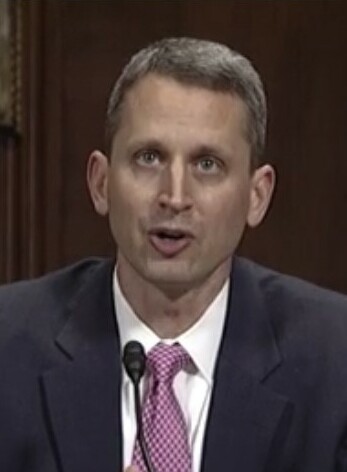
Currently serving · U.S. Court of Appeals for the Fifth Circuit
Stuart Kyle Duncan
Currently serving
Circuit Judge · U.S. Court of Appeals for the Fifth Circuit · 2018–present · Appointed by Donald Trump
Stuart Kyle Duncan serves as a circuit judge of the U.S. Court of Appeals for the Fifth Circuit (2018–present). Duncan was appointed by Donald Trump.
Key facts
- Full name
- Stuart Kyle Duncan
- Court
- U.S. Court of Appeals for the Fifth Circuit
- Office
- Circuit Judge (U.S. Court of Appeals)
- Status
- Active circuit judge
- Duty status
- Active
- Appointment
- Senate-confirmed
- FJC seat
- CA51103
- Tenure
- 2018–present
- Confirmed
- 2018-04-24
- Born
- 1972
- Died
- —
- First year on the bench
- 2018
- Dataset version
- 1.20260705
Appointment & service record
U.S. Court of Appeals for the Fifth Circuit · 2018–present
- Seat
- CA51103
- Appointment
- Senate-confirmed
- Appointing president
- Donald Trump
- Confirmed
- 2018-04-24
- Commissioned
- 2018-05-01
- Senior status
- —
Court, FJC seat, appointment type (Senate-confirmed or recess), appointing president, confirmation and commission dates, and senior-status date are drawn from the Federal Judicial Center Biographical Directory and Wikidata.[1][2][3]
Sources
- [1]https://www.fjc.gov/node/4517676fjc · retrieved 2026-07-05
- [2]https://www.fjc.gov/history/judges/biographical-directory-article-iii-federal-judges-exportfjc-directory · retrieved 2026-07-05
- [3]https://www.wikidata.org/wiki/Q41516812Wikidata · retrieved 2026-07-05
Biographical narrative
1,319 words · sourced from the Wikipedia REST extract
Stuart Kyle Duncan is a United States circuit judge serving on the Fifth Circuit Court of Appeals. Appointed by President Donald J. Trump and confirmed in 2018, he has been an active member of the federal appellate bench since that time. Prior to his judicial service, Duncan built a career that combined private practice, government work, academic teaching, and advocacy on religious‑liberty and other issues that have drawn considerable public attention.
Early life and legal career
Born in 1972, Stuart Kyle Duncan pursued an extensive legal education before entering the profession. He earned his undergraduate degree at Louisiana State University, graduating summa cum laude with a Bachelor of Arts. Continuing at LSU’s Paul M. Hebert Law Center, he obtained a Juris Doctor, where his academic performance placed him in the Order of the Coif and led to an editorial role as executive senior editor of the Louisiana Law Review. He later added a Master of Laws from Columbia Law School, further broadening his legal training.
Following law school, Duncan began his career with a clerkship for Judge John M. Duhé Jr., then serving on the United States Court of Appeals for the Fifth Circuit and based in Louisiana. This early exposure to appellate work preceded a series of positions that spanned both public service and private practice.
From 2008 through 2012, Duncan served as appellate chief within the office of the Attorney General of Louisiana. Although some media reports have mistakenly referred to him as having held the title of Solicitor General during this period, the position did not exist at that time; his responsibilities nonetheless involved overseeing appellate litigation for the state. After leaving the attorney general’s office, he joined the Becket Fund for Religious Liberty, a nonprofit organization dedicated to defending religious freedom in the United States. As general counsel from 2012 to 2014, Duncan managed nationwide public‑interest litigation on behalf of the fund.
Duncan’s professional experience also includes time in academia and additional legal practice. He spent four years as an assistant professor of law at the University of Mississippi Law School, where he taught courses and contributed to scholarly discourse. Prior to that appointment, he held a two‑year associate‑in‑law position at Columbia University Law School. In Texas, he worked for three years as an Assistant Solicitor General in the Office of the Solicitor General of the Texas Attorney General’s Office, handling appellate matters on behalf of the state. He also practiced briefly with Vinson & Elkins LLP in its appellate practice group.
In addition to his employment history, Duncan has been a member of the Federalist Society since 2012, reflecting an ongoing engagement with conservative legal thought. His litigation record includes arguing two cases before the United States Supreme Court and serving as lead counsel in several others. Notably, he represented Hobby Lobby Stores, Inc. in *Burwell v. Hobby Lobby Stores, Inc.*, a case that challenged the Affordable Care Act’s contraceptive mandate on religious‑freedom grounds and resulted in a favorable ruling for his client.
Federal appellate service
President Donald J. Trump announced his intent to nominate Duncan to the United States Court of Appeals for the Fifth Circuit on September 28, 2017. The nomination targeted the seat previously occupied by Judge W. Eugene Davis, who had taken senior status at the end of 2016. Formal submission of the nomination occurred on October 2, 2017.
The Senate Judiciary Committee held a hearing on Duncan’s nomination on November 29, 2017. During the confirmation process, Louisiana Senator John Kennedy initially withheld support but later announced his backing after the hearing, praising Duncan’s performance. The nomination was returned to the President under Senate Rule XXXI, Paragraph 6, on January 3, 2018, and President Trump promptly renominated him on January 5, 2018. The renomination was transmitted to the Senate on January 8, 2018.
On January 18, 2018, the Judiciary Committee reported Duncan’s nomination out of committee by a vote of 11–10. The subsequent cloture vote in the full Senate took place on April 23, 2018, with a tally of 50–44, allowing the confirmation process to proceed. The final confirmation vote occurred on April 24, 2018, resulting in a 50–47 affirmation of his appointment. Duncan received his judicial commission on May 1, 2018 and has served as an active circuit judge on the Fifth Circuit ever since.
Jurisprudence and legacy
Since joining the Fifth Circuit, Judge Duncan has participated in numerous appellate decisions that reflect his legal background and viewpoints. One published opinion authored by him is *In re Larry Swearingen*, No. 19‑20565, a habeas corpus case in which the court denied relief to the petitioner. While the specifics of the ruling are not detailed here, the decision illustrates his role in shaping federal appellate jurisprudence.
Judge Duncan’s pre‑judicial advocacy on issues related to LGBT rights has continued to inform public perception of his judicial work. During his time in private practice and as a government attorney, he was involved in litigation opposing same‑sex marriage and other LGBT protections. In 2015, he argued before the Supreme Court against the constitutionality of same‑sex marriage, and after the Court’s decision in *Obergefell v. Hodges*, he publicly described that ruling as an “abject failure” that raised questions about the legitimacy of the Court.
His representation of parties in high‑profile disputes has included defending a birth mother who sought to limit visitation rights for her former same‑sex spouse, representing a school board in *G.G. v. Gloucester County School Board* concerning a transgender student’s bathroom access, and supporting North Carolina’s “bathroom bill” that restricted restroom use based on biological sex. While serving as an appellate judge, Duncan has expressed the view that Congress does not prohibit courts from referring to litigants according to their biological sex rather than gender identity, a stance he articulated in response to a transgender defendant’s preferred name and pronouns.
Judge Duncan’s public engagements have occasionally intersected with campus activism. On March 9, 2023, he traveled to Stanford Law School for a discussion organized by the university’s Federalist Society chapter on topics including firearms, COVID‑19, and social media. The event was met with protests led by the student coalition Identity and Rights Affirmers for Trans Equality (IRATE), who sought its cancellation. According to contemporary reports, protesters repeatedly interrupted Duncan’s remarks, resulting in a contentious atmosphere. After approximately ten minutes of disruption, Duncan deviated from his prepared remarks and responded directly to the hecklers. The incident prompted an apology from Stanford University’s president and law school dean, affirming students’ right to protest while emphasizing that such protests should not disrupt scheduled proceedings.
Throughout his career, Judge Duncan has been associated with organizations focused on religious liberty, notably serving as general counsel for the Becket Fund. His involvement in *Burwell v. Hobby Lobby Stores, Inc.* contributed to a landmark Supreme Court decision affirming certain religious‑freedom claims against federal regulations. Additionally, his membership in the Federalist Society since 2012 aligns him with a network of legal professionals who advocate for an originalist and textualist approach to constitutional interpretation.
Judge Duncan’s legacy on the Fifth Circuit is still unfolding. His judicial opinions, combined with his prior advocacy, have placed him at the center of ongoing debates over religious liberty, LGBT rights, and procedural matters in federal courts. As a sitting appellate judge, he continues to hear cases that shape the law within the Fifth Circuit’s jurisdiction, which includes Texas, Louisiana, and Mississippi. Observers note that his background in both government service and private litigation provides him with a perspective grounded in extensive appellate experience.
In sum, Stuart Kyle Duncan’s professional trajectory—from academic achievement at LSU and Columbia Law School through varied roles in state attorney general offices, nonprofit advocacy, academia, and private practice—culminated in his appointment to the federal bench. His tenure on the Fifth Circuit reflects both his legal expertise and the contentious issues that have marked his public profile, contributing to a nuanced record of service within the United States judiciary.
Sources & provenance
Every quantitative or attributable claim above carries a per-section [N] marker that resolves to the corresponding URL below. Each entry records the upstream provider, the canonical URL, and the timestamp at which the underlying source was retrieved.
Key facts
- https://www.fjc.gov/node/4517676fjc · retrieved 2026-07-05
- https://www.fjc.gov/history/judges/biographical-directory-article-iii-federal-judges-exportfjc-directory · retrieved 2026-07-05
- https://www.wikidata.org/wiki/Q41516812Wikidata · retrieved 2026-07-05
Biographical narrative
- https://en.wikipedia.org/wiki/Kyle_Duncan_(judge)Wikipedia · retrieved 2026-07-05
Explore the federal judiciary
The U.S. Courts of Appeals are the intermediate appellate courts of the federal judiciary — thirteen circuits sitting between the district courts and the Supreme Court. Browse the full roster of judges on the U.S. Court of Appeals for the Fifth Circuit, or explore how the appointed federal judiciary fits into the federal government.