
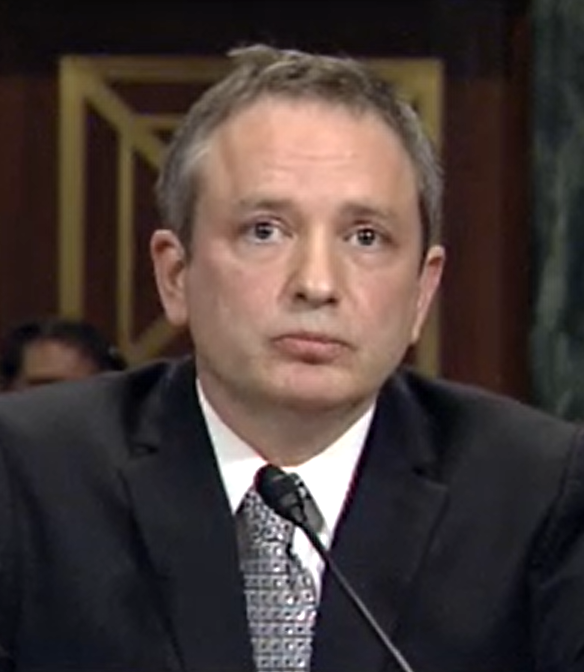
Currently serving · U.S. Court of Appeals for the First Circuit
David Jeremiah Barron
Currently serving
Circuit Judge · U.S. Court of Appeals for the First Circuit · 2014–present · Appointed by Barack Obama
David Jeremiah Barron serves as a circuit judge of the U.S. Court of Appeals for the First Circuit (2014–present). Barron was appointed by Barack Obama.
Key facts
- Full name
- David Jeremiah Barron
- Court
- U.S. Court of Appeals for the First Circuit
- Office
- Circuit Judge (U.S. Court of Appeals)
- Status
- Active circuit judge
- Duty status
- Active
- Appointment
- Senate-confirmed
- FJC seat
- CA10107
- Tenure
- 2014–present
- Confirmed
- 2014-05-22
- Born
- 1967
- Died
- —
- First year on the bench
- 2014
- Dataset version
- 1.20260705
Appointment & service record
U.S. Court of Appeals for the First Circuit · 2014–present
- Seat
- CA10107
- Appointment
- Senate-confirmed
- Appointing president
- Barack Obama
- Confirmed
- 2014-05-22
- Commissioned
- 2014-05-23
- Senior status
- —
- Chief Judge
- 2022–present
Court, FJC seat, appointment type (Senate-confirmed or recess), appointing president, confirmation and commission dates, and senior-status date are drawn from the Federal Judicial Center Biographical Directory and Wikidata.[1][2][3]
Sources
- [1]https://www.fjc.gov/node/1394531fjc · retrieved 2026-07-05
- [2]https://www.fjc.gov/history/judges/biographical-directory-article-iii-federal-judges-exportfjc-directory · retrieved 2026-07-05
- [3]https://www.wikidata.org/wiki/Q14944939Wikidata · retrieved 2026-07-05
Biographical narrative
986 words · sourced from the Wikipedia REST extract
David Jeremiah Barron (born 1967) is an American jurist who serves as the chief judge of the United States Court of Appeals for the First Circuit. Prior to his appointment to the federal bench, he held academic positions at Harvard Law School, served in senior roles within the Department of Justice’s Office of Legal Counsel, and contributed to scholarly work on executive power and war powers. His career spans journalism, legal practice, government service, and scholarship, culminating in a leadership role on one of the nation’s appellate courts.
Early life and legal career
Barron was born in Washington, D.C., in 1967, the son of Jerome A. Barron, a professor and former dean at George Washington University Law School. He pursued his undergraduate education at Harvard College, graduating magna cum laude in 1989. While at Harvard, he held the presidency of *The Harvard Crimson*, the university’s daily newspaper. Following graduation, Barron worked as a reporter for *The News & Observer* in Raleigh, North Carolina, from 1989 to 1991.
Returning to academia for legal studies, Barron earned his Juris Doctor magna cum laude from Harvard Law School in 1994, where he was a member of the *Harvard Law Review*. He then entered the federal judiciary as a law clerk, first for Judge Stephen Reinhardt of the United States Court of Appeals for the Ninth Circuit (1994‑1995) and subsequently for Justice John Paul Stevens of the United States Supreme Court (1995‑1996). After completing his clerkships, Barron joined the Department of Justice’s Office of Legal Counsel as an attorney‑advisor from 1996 to 1999.
In 1999 Barron began a faculty career at Harvard Law School as an assistant professor. He was promoted to full professor in 2004 and later received the title of S. William Green Professor of Public Law in 2011. During a leave from academia, he returned to the Office of Legal Counsel in 2009 as Acting Assistant Attorney General. In that capacity, Barron authored a classified memorandum in 2010 that provided legal justification for a presidential decision to conduct a drone strike against Anwar al‑Awlaki, an American citizen identified as a militant operative abroad. The memo later attracted public scrutiny and commentary regarding its reliance on foreign legal authorities.
For his service related to the memo and broader national security work, Barron was awarded the National Intelligence Exceptional Achievement Medal by the Office of the Director of National Intelligence and the Secretary of Defense Medal for Outstanding Public Service. After completing his tenure at the Justice Department, he returned to Harvard Law School in 2010, continuing his scholarly focus on constitutional law and executive authority.
In addition to his academic responsibilities, Barron was appointed in 2012 by Massachusetts Governor Deval Patrick to serve on the Massachusetts Board of Higher Education and the Massachusetts State College Building Authority. His contributions to public service were recognized further when he was elected a fellow of the American Academy of Arts and Sciences in 2020.
Federal appellate service
President Barack Obama nominated Barron to the United States Court of Appeals for the First Circuit on September 24, 2013, filling the vacancy created by Judge Michael Boudin’s assumption of senior status earlier that year. The Senate Judiciary Committee reported his nomination out of committee on January 16, 2014, with a vote of ten to eight. Subsequent procedural steps in the Senate included a cloture motion filed by Majority Leader Harry Reid on May 15, 2014; cloture was invoked on May 21, 2014, by a 52‑43 vote. The confirmation vote took place on May 22, 2014, resulting in a 53‑45 affirmation of his appointment. Barron received his judicial commission the following day, May 23, 2014, and began serving as an active circuit judge.
During his tenure on the First Circuit, Barron participated in the adjudication of appeals arising from federal district courts within the circuit’s jurisdiction, which includes Maine, Massachusetts, New Hampshire, Puerto Rico, and Rhode Island. He assumed the role of chief judge on April 1, 2022, succeeding Judge Jeffrey R. Howard upon his transition to senior status. As chief judge, Barron oversees administrative functions of the court in addition to his judicial responsibilities.
Jurisprudence and legacy
Judge Barron’s professional background reflects a sustained engagement with issues at the intersection of constitutional law, executive authority, and national security. His scholarly work includes coauthoring an article in the *Harvard Law Review* that critiqued legal advice provided to the executive branch during the early years of the war on terror, emphasizing historical understandings of presidential power. In 2016, he authored a monograph titled *Waging War: The Clash Between Presidents and Congress, 1776 to ISIS*, published by Simon & Schuster. The book examines the evolving balance of war‑making authority between the legislative and executive branches throughout American history. Its contribution to military and legal scholarship was recognized with Norwich University’s Colby Award in 2017.
Barron’s academic contributions extend beyond publications; his tenure at Harvard Law School involved teaching courses on constitutional law, federal courts, and national security law, influencing a generation of lawyers and scholars. His service on state higher‑education boards underscores an interest in educational policy and institutional governance.
Within the judiciary, Barron has presided over cases that shape legal precedent across the First Circuit’s jurisdiction, though specific opinions are not detailed here. As chief judge, he administers court operations, manages case assignments, and represents the circuit in interactions with other branches of government and the public. His leadership role positions him to influence procedural reforms and the efficient administration of justice.
Overall, David J. Barron’s career integrates legal practice, governmental service, academic scholarship, and judicial leadership. His work on executive power, particularly concerning wartime authority, has contributed to ongoing debates about constitutional limits and the balance of powers in the United States. As chief judge of the First Circuit, he continues to play a pivotal role in interpreting federal law and guiding the appellate court’s function within the broader federal judiciary.
Sources & provenance
Every quantitative or attributable claim above carries a per-section [N] marker that resolves to the corresponding URL below. Each entry records the upstream provider, the canonical URL, and the timestamp at which the underlying source was retrieved.
Key facts
- https://www.fjc.gov/node/1394531fjc · retrieved 2026-07-05
- https://www.fjc.gov/history/judges/biographical-directory-article-iii-federal-judges-exportfjc-directory · retrieved 2026-07-05
- https://www.wikidata.org/wiki/Q14944939Wikidata · retrieved 2026-07-05
Biographical narrative
- https://en.wikipedia.org/wiki/David_J._BarronWikipedia · retrieved 2026-07-05
Explore the federal judiciary
The U.S. Courts of Appeals are the intermediate appellate courts of the federal judiciary — thirteen circuits sitting between the district courts and the Supreme Court. Browse the full roster of judges on the U.S. Court of Appeals for the First Circuit, or explore how the appointed federal judiciary fits into the federal government.