
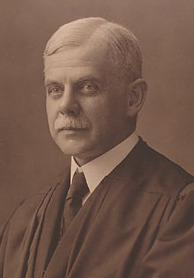
Historical · U.S. Court of Appeals for the First Circuit
James Madison Morton Jr.
Former Circuit Judge · U.S. Court of Appeals for the First Circuit · 1932–1940 · Appointed by Herbert Hoover
James Madison Morton Jr. served as a circuit judge of the U.S. Court of Appeals for the First Circuit (1932–1940). Jr. was appointed by Herbert Hoover.
Key facts
- Full name
- James Madison Morton Jr.
- Court
- U.S. Court of Appeals for the First Circuit
- Office
- Circuit Judge (U.S. Court of Appeals)
- Status
- Former circuit judge
- Duty status
- Not serving
- Appointment
- Senate-confirmed
- FJC seat
- CA10305
- Tenure
- 1932–1940
- Confirmed
- 1932-01-06
- Born
- 1869-08-24
- Died
- 1940-06-26
- First year on the bench
- 1932
- Dataset version
- 1.20260711
Appointment & service record
U.S. Court of Appeals for the First Circuit · 1932–1939
- Seat
- CA10305
- Appointment
- Senate-confirmed
- Appointing president
- Herbert Hoover
- Confirmed
- 1932-01-06
- Commissioned
- 1932-01-09
- Senior status
- 1939-09-30
Court, FJC seat, appointment type (Senate-confirmed or recess), appointing president, confirmation and commission dates, and senior-status date are drawn from the Federal Judicial Center Biographical Directory and Wikidata.[1][2][3]
Sources
- [1]https://www.fjc.gov/node/1385416fjc · retrieved 2026-07-11
- [2]https://www.fjc.gov/history/judges/biographical-directory-article-iii-federal-judges-exportfjc-directory · retrieved 2026-07-11
- [3]https://www.wikidata.org/wiki/Q6138782Wikidata · retrieved 2026-07-11
Biographical narrative
1,026 words · sourced from the Wikipedia REST extract
James Madison Morton Jr. was a United States circuit judge who served on the United States Court of Appeals for the First Circuit from 1932 until his death in 1940. Born in Massachusetts in 1869, he spent nearly two decades as a federal district judge before his elevation to the appellate bench. Appointed to the First Circuit by President Herbert Hoover, a Republican, Morton served during a transformative period in American legal history that encompassed the Great Depression and the early years of the New Deal. His judicial career at the federal level spanned nearly three decades, beginning with his district court appointment in 1912 and continuing until his death.
Early life and legal career
James Madison Morton Jr. was born on August 24, 1869, in Fall River, Massachusetts, a major textile manufacturing center in the southeastern part of the state. He came from a distinguished legal family; his father, James Madison Morton Sr., was a prominent attorney practicing in Boston who eventually ascended to the Massachusetts Supreme Judicial Court, the highest court in the Commonwealth. This family background provided the younger Morton with early exposure to the legal profession and the judiciary.
Morton pursued his higher education at Harvard University, where he earned an Artium Baccalaureus degree in 1891. He continued his studies at Harvard, obtaining an Artium Magister degree in 1894. During this same period, he attended Harvard Law School, completing his legal education with a Bachelor of Laws degree in 1894. This combination of graduate-level academic work and professional legal training was characteristic of the educational path followed by many elite lawyers of his generation.
Following his graduation from law school, Morton returned to his birthplace of Fall River to establish himself in private legal practice. He practiced law in Fall River for eighteen years, from 1894 to 1912, building a career in a city that was then one of the most important industrial centers in New England. During this period, Fall River's textile mills made it one of the leading manufacturing cities in the United States, and Morton's practice would have served the legal needs of a community shaped by industrial commerce. His nearly two decades in private practice provided him with substantial experience in the practical application of law before he entered the federal judiciary.
Federal appellate service
Morton's path to the federal appellate bench began with his appointment to the trial court level. President William Howard Taft, a Republican, nominated him to serve as a United States District Judge for the United States District Court for the District of Massachusetts. The nomination came on August 9, 1912, to fill a vacancy that had been created by Judge Frederic Dodge. The Senate moved swiftly on the nomination, confirming Morton just three days later on August 12, 1912. He received his commission on the same day and began his service on the federal trial court. Morton would serve in this capacity for nearly twenty years, presiding over federal cases in Massachusetts during a period that included World War I, the 1920s economic expansion, and the onset of the Great Depression.
Morton's elevation to the circuit court came near the end of President Herbert Hoover's administration. On December 15, 1931, President Hoover nominated Morton to a seat on the United States Court of Appeals for the First Circuit. This vacancy had been created by Judge George W. Anderson, who had previously occupied the position. The Senate confirmed the nomination on January 6, 1932, and Morton received his commission three days later on January 9, 1932. His service on the district court officially terminated on January 19, 1932, upon his elevation to the appellate bench.
As a circuit judge on the First Circuit, Morton joined a court with jurisdiction over federal appeals from Maine, Massachusetts, New Hampshire, Rhode Island, and Puerto Rico. He served during a particularly significant era in American law, as the federal courts grappled with constitutional challenges to New Deal legislation and the expanding role of federal regulatory authority. Morton served as an active circuit judge for more than seven years before assuming senior status on September 30, 1939. Senior status allowed him to continue hearing cases with a reduced caseload. However, his time in senior status was brief; his service on the First Circuit terminated on June 26, 1940, when he died in Fall River, the city where he had been born seventy years earlier.
Jurisprudence and legacy
Morton's judicial service spanned a critical transition in American federal jurisprudence. His nearly two decades on the district court, from 1912 to 1932, placed him on the trial bench during the Progressive Era, World War I, and the prosperous 1920s, while his circuit court service from 1932 to 1940 coincided with the Depression and the legal controversies surrounding the federal government's response to economic crisis. As a circuit judge during the 1930s, he would have participated in reviewing lower court decisions during a time when fundamental questions about federal power, economic regulation, and constitutional interpretation were being actively contested in the courts.
The First Circuit during Morton's tenure handled appeals involving a diverse range of federal questions, from admiralty and maritime law—particularly significant given New England's coastal economy—to questions of federal taxation, bankruptcy, and regulatory authority. Morton's background in private practice in an industrial city, combined with his extensive experience as a trial judge, would have informed his approach to the appellate review of complex factual and legal questions.
Morton's service bridged two different eras of the federal judiciary. Appointed to the district court by President Taft, himself a former federal circuit judge and future Chief Justice of the United States, Morton began his judicial career in an era when the federal docket was considerably smaller and the scope of federal law more limited. By the time of his death in 1940, the federal courts had assumed a substantially larger role in American life, reflecting the growth of federal regulatory authority and the expansion of federal jurisdiction. His career thus reflected the broader institutional evolution of the federal judiciary during the early twentieth century, from a more limited tribunal to an increasingly central institution in American governance and law.
Sources & provenance
Every quantitative or attributable claim above carries a per-section [N] marker that resolves to the corresponding URL below. Each entry records the upstream provider, the canonical URL, and the timestamp at which the underlying source was retrieved.
Key facts
- https://www.fjc.gov/node/1385416fjc · retrieved 2026-07-11
- https://www.fjc.gov/history/judges/biographical-directory-article-iii-federal-judges-exportfjc-directory · retrieved 2026-07-11
- https://www.wikidata.org/wiki/Q6138782Wikidata · retrieved 2026-07-11
Biographical narrative
- https://en.wikipedia.org/wiki/James_Madison_Morton_Jr.Wikipedia · retrieved 2026-07-11
Explore the federal judiciary
The U.S. Courts of Appeals are the intermediate appellate courts of the federal judiciary — thirteen circuits sitting between the district courts and the Supreme Court. Browse the full roster of judges on the U.S. Court of Appeals for the First Circuit, or explore how the appointed federal judiciary fits into the federal government.