
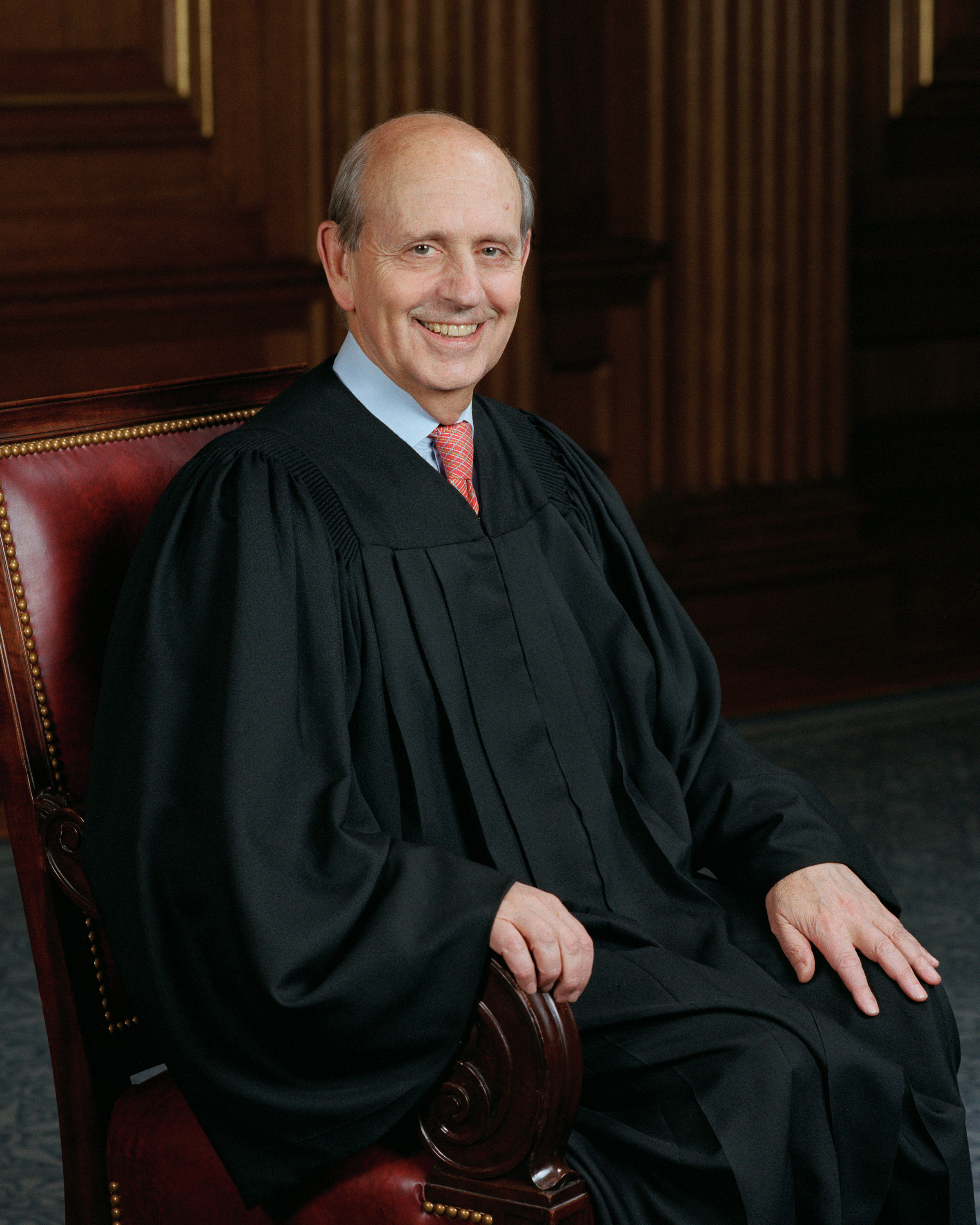
Historical · U.S. Court of Appeals for the First Circuit
Stephen Gerald Breyer
Former Circuit Judge · U.S. Court of Appeals for the First Circuit · 1980–1994 · Appointed by Jimmy Carter
Stephen Gerald Breyer served as a circuit judge of the U.S. Court of Appeals for the First Circuit (1980–1994). Breyer was appointed by Jimmy Carter.
Key facts
- Full name
- Stephen Gerald Breyer
- Court
- U.S. Court of Appeals for the First Circuit
- Office
- Circuit Judge (U.S. Court of Appeals)
- Status
- Former circuit judge
- Duty status
- Not serving
- Appointment
- Senate-confirmed
- FJC seat
- CA10401
- Tenure
- 1980–1994
- Confirmed
- 1980-12-09
- Born
- 1938
- Died
- —
- First year on the bench
- 1980
- Dataset version
- 1.20260711
Appointment & service record
U.S. Court of Appeals for the First Circuit · 1980–1994
- Seat
- CA10401
- Appointment
- Senate-confirmed
- Appointing president
- Jimmy Carter
- Confirmed
- 1980-12-09
- Commissioned
- 1980-12-10
- Senior status
- —
- Chief Judge
- 1990–1994
Court, FJC seat, appointment type (Senate-confirmed or recess), appointing president, confirmation and commission dates, and senior-status date are drawn from the Federal Judicial Center Biographical Directory and Wikidata.[1][2][3]
Sources
- [1]https://www.fjc.gov/node/1378241fjc · retrieved 2026-07-11
- [2]https://www.fjc.gov/history/judges/biographical-directory-article-iii-federal-judges-exportfjc-directory · retrieved 2026-07-11
- [3]https://www.wikidata.org/wiki/Q11124Wikidata · retrieved 2026-07-11
Biographical narrative
1,693 words · sourced from the Wikipedia REST extract
Stephen Gerald Breyer is an American jurist and legal scholar who served as a judge on the United States Court of Appeals for the First Circuit from 1980 to 1994, including a tenure as Chief Judge from 1990 to 1994. Born in 1938, he was appointed to the federal appellate bench by President Jimmy Carter, a Democrat, and confirmed in December 1980. His service on the First Circuit preceded his subsequent appointment to the United States Supreme Court, where he served as an associate justice from 1994 until his retirement in 2022. Throughout his judicial career, Breyer has been recognized as an expert in administrative law and regulatory policy, bringing scholarly rigor and practical governmental experience to his work on the federal bench.
Early life and legal career
Stephen Gerald Breyer was born on August 15, 1938, in San Francisco, California, into a middle-class family. His father, Irving Gerald Breyer, worked as a lawyer serving as legal counsel to the San Francisco Board of Education, while his mother was Anne A. Breyer, née Roberts. The family practiced Reform Judaism, and Breyer's paternal heritage traced back to Romania, from which his great-grandfather had emigrated to the United States, eventually settling in Cleveland, Ohio, where Breyer's grandfather was born.
Growing up in San Francisco, Breyer attended Lowell High School, where he developed skills in debate and public speaking as a member of the Lowell Forensic Society. He participated regularly in high school debate tournaments, competing against peers who would later achieve prominence in law and politics. Breyer was also active in the Boy Scouts of America alongside his younger brother Charles, who would later become a federal district judge. Both brothers achieved the rank of Eagle Scout, and Stephen Breyer later received the Distinguished Eagle Scout Award in recognition of his accomplishments.
After graduating from high school in 1955, Breyer enrolled at Stanford University to study philosophy. He excelled academically, graduating in 1959 with a Bachelor of Arts degree with highest honors and membership in the prestigious Phi Beta Kappa honor society. His academic achievements earned him a Marshall Scholarship, which enabled him to continue his studies abroad at Magdalen College, Oxford, where he studied philosophy, politics, and economics. He completed his Oxford degree in 1961, receiving a Bachelor of Arts with first-class honors.
Returning to the United States, Breyer pursued legal education at Harvard Law School, one of the nation's most prestigious law schools. During his time at Harvard, he served as an articles editor of the Harvard Law Review, a position typically reserved for top-performing students. He graduated in 1964 with a Bachelor of Laws degree, magna cum laude, demonstrating his exceptional aptitude for legal scholarship.
Breyer also fulfilled military service obligations during the Vietnam War era, spending eight years in the United States Army Reserve. His service included six months on active duty with the Army Strategic Intelligence. He attained the rank of corporal and received an honorable discharge in 1965.
Following his graduation from law school, Breyer secured a prestigious clerkship with Associate Justice Arthur Goldberg of the United States Supreme Court, serving from 1964 to 1965. During this clerkship, he gained invaluable experience in constitutional law and the workings of the nation's highest court. He also briefly worked as a fact-checker for the Warren Commission, which investigated the assassination of President John F. Kennedy. Subsequently, Breyer spent two years in the Antitrust Division of the United States Department of Justice, serving as a special assistant to the assistant attorney general.
In 1967, Breyer began what would become a distinguished academic career at Harvard Law School, joining the faculty as an assistant professor. He taught at Harvard Law School until 1980, establishing himself as a leading authority on administrative law and regulatory policy. From 1977 to 1980, he also held a joint appointment at the Harvard Kennedy School, broadening his engagement with public policy issues. During his academic tenure, Breyer authored influential scholarly works on regulation and deregulation. He co-wrote a major textbook on administrative law with Richard Stewart, and his writings on regulatory reform and risk regulation became widely cited in legal and policy circles. His scholarship also extended to intellectual property law, where he contributed important critical analysis of copyright law. Breyer additionally served as a visiting professor at several institutions, including the College of Law in Sydney, Australia, the University of Rome, and Tulane University Law School.
While maintaining his academic position at Harvard, Breyer took several leaves of absence to serve in significant governmental roles. In 1973, he served as an assistant special prosecutor on the Watergate Special Prosecution Force during the constitutional crisis that followed the Watergate scandal. From 1974 to 1975, he worked as special counsel to the United States Senate Committee on the Judiciary, and from 1979 to 1980, he served as the committee's chief counsel. In this latter capacity, he worked closely with Senator Edward M. Kennedy, the committee chairman, on major legislative initiatives. Breyer played a significant role in the passage of the Airline Deregulation Act, landmark legislation that fundamentally restructured the commercial aviation industry by closing the Civil Aeronautics Board and introducing market competition to airline routes and pricing.
Federal appellate service
In 1980, President Jimmy Carter, a Democrat, nominated Breyer to serve as a judge on the United States Court of Appeals for the First Circuit. The First Circuit has jurisdiction over federal appeals from the district courts in Maine, Massachusetts, New Hampshire, Rhode Island, and Puerto Rico, making it an important regional appellate court. The Senate confirmed Breyer's appointment on December 9, 1980, and he took his seat on the court, filling a specific judicial seat designated in federal records.
Breyer served on the First Circuit for fourteen years, from 1980 to 1994. During this period, he heard and decided a wide range of federal appeals involving constitutional questions, statutory interpretation, administrative law, criminal law, and civil litigation. His background in administrative law and regulatory policy, developed through years of academic scholarship and governmental service, informed his approach to cases involving federal agencies and regulatory schemes. His experience with antitrust matters and economic regulation also provided valuable perspective in commercial and economic cases that came before the court.
In 1990, Breyer was elevated to the position of Chief Judge of the First Circuit, the administrative and ceremonial head of the court. As Chief Judge, he bore responsibility not only for deciding cases but also for managing the court's operations, assigning cases to panels of judges, and representing the court in its relations with other branches of government and the public. He served in this leadership capacity from 1990 until 1994, providing administrative direction during a period of growth in the federal judiciary's caseload.
Throughout his tenure on the First Circuit, Breyer maintained connections to legal scholarship and education. His judicial opinions reflected careful attention to statutory text, legislative history, and practical consequences of legal rules. Colleagues and observers noted his analytical approach to legal problems and his ability to synthesize complex regulatory and technical issues. His work on the court built upon the foundation he had established as an academic, bringing scholarly methods to the resolution of concrete disputes.
Breyer's service on the First Circuit came to an end in 1994 when he was nominated to the United States Supreme Court by President Bill Clinton, a Democrat, to fill the vacancy created by the retirement of Associate Justice Harry Blackmun. Following his confirmation by the Senate, Breyer left the First Circuit to assume his new position on the Supreme Court, where he would serve for nearly three decades.
Jurisprudence and legacy
Breyer's years on the First Circuit established him as a jurist with particular expertise in administrative law, regulatory policy, and complex statutory interpretation. His academic background distinguished him from many federal judges, as he brought to the bench not only practical legal experience but also sustained scholarly engagement with theoretical questions about the role of regulation in modern society and the relationship between governmental institutions and individual liberty.
The approach to judging that Breyer developed during his First Circuit tenure emphasized careful analysis of statutory language and structure, attention to legislative purpose, and consideration of the practical effects of judicial decisions. His background in economics and public policy informed his understanding of regulatory schemes and administrative agency decision-making. These characteristics of his judicial philosophy would continue to develop during his subsequent Supreme Court service, where he articulated views about the importance of democratic participation in governmental processes and the judiciary's role in facilitating rather than obstructing such participation.
Breyer's service as Chief Judge of the First Circuit from 1990 to 1994 demonstrated his capacity for judicial leadership and court administration. Managing a multi-state circuit during a period of increasing federal caseloads required both legal acumen and administrative skill. His experience in this role prepared him for the collegial and institutional responsibilities he would later assume on the Supreme Court.
The legacy of Breyer's First Circuit service is intertwined with his broader contributions to American law. His fourteen years on the court represented a bridge between his earlier career as a legal academic and government lawyer and his later service on the nation's highest court. The First Circuit provided the forum in which Breyer translated his scholarly insights about administrative law and regulation into practical judicial decisions, developing the interpretive methods and analytical frameworks that would characterize his later work. His tenure on the court contributed to the First Circuit's reputation as a thoughtful and scholarly appellate court, and his elevation to the Supreme Court reflected recognition of the quality of his judicial work at the circuit level.
After leaving the First Circuit in 1994, Breyer served on the Supreme Court until his retirement in 2022, a tenure of nearly twenty-eight years. Following his retirement from the Supreme Court, he returned to Harvard Law School as the Byrne Professor of Administrative Law and Process, continuing his lifelong engagement with legal education and scholarship. His career arc—from legal academic to circuit judge to Supreme Court justice and back to legal academia—reflects an enduring commitment to the development and application of legal principles in service of democratic governance.
Sources & provenance
Every quantitative or attributable claim above carries a per-section [N] marker that resolves to the corresponding URL below. Each entry records the upstream provider, the canonical URL, and the timestamp at which the underlying source was retrieved.
Key facts
- https://www.fjc.gov/node/1378241fjc · retrieved 2026-07-11
- https://www.fjc.gov/history/judges/biographical-directory-article-iii-federal-judges-exportfjc-directory · retrieved 2026-07-11
- https://www.wikidata.org/wiki/Q11124Wikidata · retrieved 2026-07-11
Biographical narrative
- https://en.wikipedia.org/wiki/Stephen_BreyerWikipedia · retrieved 2026-07-11
Explore the federal judiciary
The U.S. Courts of Appeals are the intermediate appellate courts of the federal judiciary — thirteen circuits sitting between the district courts and the Supreme Court. Browse the full roster of judges on the U.S. Court of Appeals for the First Circuit, or explore how the appointed federal judiciary fits into the federal government.