
Historical · U.S. Court of Appeals for the Fourth Circuit
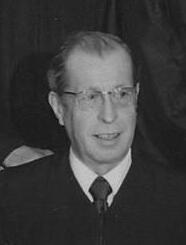
Clement Furman Haynsworth Jr.
Former Circuit Judge · U.S. Court of Appeals for the Fourth Circuit · 1957–1989 · Appointed by Dwight D Eisenhower
Clement Furman Haynsworth Jr. served as a circuit judge of the U.S. Court of Appeals for the Fourth Circuit (1957–1989). Jr. was appointed by Dwight D Eisenhower.
Key facts
- Full name
- Clement Furman Haynsworth Jr.
- Court
- U.S. Court of Appeals for the Fourth Circuit
- Office
- Circuit Judge (U.S. Court of Appeals)
- Status
- Former circuit judge
- Duty status
- Not serving
- Appointment
- Senate-confirmed
- FJC seat
- CA40404
- Tenure
- 1957–1989
- Confirmed
- 1957-04-04
- Born
- 1912-10-30
- Died
- 1989-11-22
- First year on the bench
- 1957
- Dataset version
- 1.20260711
Appointment & service record
U.S. Court of Appeals for the Fourth Circuit · 1957–1981
- Seat
- CA40404
- Appointment
- Senate-confirmed
- Appointing president
- Dwight D Eisenhower
- Confirmed
- 1957-04-04
- Commissioned
- 1957-04-04
- Senior status
- 1981-04-06
- Chief Judge
- 1964–1981
Court, FJC seat, appointment type (Senate-confirmed or recess), appointing president, confirmation and commission dates, and senior-status date are drawn from the Federal Judicial Center Biographical Directory and Wikidata.[1][2][3]
Sources
- [1]https://www.fjc.gov/node/1381976fjc · retrieved 2026-07-11
- [2]https://www.fjc.gov/history/judges/biographical-directory-article-iii-federal-judges-exportfjc-directory · retrieved 2026-07-11
- [3]https://www.wikidata.org/wiki/Q5131335Wikidata · retrieved 2026-07-11
Biographical narrative
1,117 words · sourced from the Wikipedia REST extract
Clement Furman Haynsworth Jr. was a United States circuit judge who served on the United States Court of Appeals for the Fourth Circuit from 1957 to 1989, including a tenure as Chief Judge from 1964 to 1981. Born in South Carolina in 1912, he spent more than three decades on the federal appellate bench following his appointment by President Dwight D. Eisenhower, a Republican. Haynsworth is perhaps best known nationally for his unsuccessful nomination to the United States Supreme Court in 1969, which became one of the most contentious confirmation battles of the twentieth century and resulted in only the second rejection of a Supreme Court nominee by the Senate in nearly four decades.
Early life and legal career
Haynsworth was born on October 30, 1912, in Greenville, South Carolina, where he would maintain deep roots throughout his life. He pursued his undergraduate education at Furman University, an institution that shared his family name, earning an Artium Baccalaureus degree in 1933. He continued his legal education at Harvard Law School, one of the nation's most prestigious law schools, where he received a Bachelor of Laws degree in 1936.
Following his graduation from Harvard, Haynsworth returned to Greenville and entered private legal practice, establishing himself in the South Carolina legal community from 1936 to 1942. His early career in private practice was interrupted by World War II, during which he served in the United States Navy from 1942 to 1945. After completing his military service, Haynsworth resumed his private practice in Greenville, where he continued to work for another twelve years, from 1945 to 1957. During this period, he built a reputation as a skilled attorney in South Carolina, which would eventually lead to his nomination to the federal bench. His two decades of legal experience before his judicial appointment provided him with a foundation in both civil and commercial law that would inform his later work as a federal appellate judge.
Federal appellate service
President Dwight D. Eisenhower, a Republican, nominated Haynsworth to the United States Court of Appeals for the Fourth Circuit on February 19, 1957. The nomination was to fill a seat that had been vacated by Judge Armistead Mason Dobie. The United States Senate confirmed Haynsworth on April 4, 1957, and he received his commission on the same day, beginning what would become a thirty-two-year tenure on the federal appellate bench.
Haynsworth's service on the Fourth Circuit was marked by steady advancement in responsibility and leadership. In 1964, he was elevated to the position of Chief Judge of the Fourth Circuit, a role he would hold for seventeen years until 1981. As Chief Judge, he not only presided over the court's administration but also served as a member of the Judicial Conference of the United States, the principal policymaking body for the federal court system. This dual role gave him significant influence over both the operation of his own circuit and the broader federal judiciary during a period of substantial legal and social change in the United States.
The most dramatic episode of Haynsworth's judicial career came in 1969 when President Richard Nixon nominated him to serve as an associate justice of the United States Supreme Court. The nomination came on August 21, 1969, reportedly on the recommendation of South Carolina Senator Fritz Hollings, a Democrat. Haynsworth was proposed to fill the vacancy created by the resignation of Associate Justice Abe Fortas, who had stepped down amid conflict of interest allegations.
The nomination quickly became controversial and attracted opposition from multiple quarters. A coalition formed against Haynsworth that included Democrats, Republicans associated with the party's more liberal wing, and civil rights organizations including the NAACP. Critics raised concerns about several aspects of his judicial record and conduct. Allegations emerged regarding decisions that opponents characterized as favoring segregation, including rulings that affirmed local authorities' closure of schools in Prince Edward County to avoid integration, upheld school voucher programs that critics said funded segregated private schools, and sided with management in labor disputes. Additionally, questions were raised about whether Haynsworth had ruled in cases where he held financial interests, though these allegations were not definitively established.
The confirmation process became highly contentious, with defenders and critics offering sharply divergent assessments of Haynsworth's character and record. After the Senate Judiciary Committee heard seven days of testimony, it voted to report the nomination favorably to the full Senate by a margin of ten to seven on October 9, 1969. However, the full Senate rejected the nomination on November 21, 1969, making Haynsworth the first Supreme Court nominee defeated by the Senate since the rejection of Judge John J. Parker, also of the Fourth Circuit, in 1930. Following this defeat, President Nixon nominated G. Harrold Carswell, who also failed to win Senate confirmation, before successfully appointing Harry Blackmun to the Supreme Court.
Despite this setback, Haynsworth continued his service on the Fourth Circuit. He remained Chief Judge until 1981, when he assumed senior status on April 6 of that year. Senior status allowed him to continue hearing cases with a reduced caseload while making his seat available for a new active judge. He continued to serve in this capacity until his death.
Jurisprudence and legacy
Haynsworth's judicial career spanned more than three decades on the Fourth Circuit, a period during which the federal courts grappled with fundamental questions about civil rights, labor relations, and the scope of federal authority. His work as Chief Judge for seventeen years gave him substantial influence over the development of Fourth Circuit jurisprudence and the administration of justice across the states within the circuit's jurisdiction, which included several Southern states undergoing significant social transformation during the civil rights era.
The failed Supreme Court nomination, while a significant moment in Haynsworth's career and in the history of judicial confirmations, did not end his judicial service or diminish his role on the Fourth Circuit. He continued to participate in the work of the court for two more decades, contributing to the body of federal appellate law in his circuit. The controversy surrounding his nomination reflected broader political and social tensions of the late 1960s, including debates over the proper role of the judiciary in addressing civil rights and labor issues, as well as partisan conflicts over control of the Supreme Court.
Haynsworth died on November 22, 1989, in Greenville, South Carolina, the city where he had been born, practiced law, and maintained his residence throughout his life. In recognition of his long service to the federal judiciary, the federal building in Greenville was renamed the Clement F. Haynsworth Jr. Federal Building in his honor, ensuring that his connection to the city and to the federal court system would be commemorated for future generations.
Sources & provenance
Every quantitative or attributable claim above carries a per-section [N] marker that resolves to the corresponding URL below. Each entry records the upstream provider, the canonical URL, and the timestamp at which the underlying source was retrieved.
Key facts
- https://www.fjc.gov/node/1381976fjc · retrieved 2026-07-11
- https://www.fjc.gov/history/judges/biographical-directory-article-iii-federal-judges-exportfjc-directory · retrieved 2026-07-11
- https://www.wikidata.org/wiki/Q5131335Wikidata · retrieved 2026-07-11
Biographical narrative
- https://en.wikipedia.org/wiki/Clement_HaynsworthWikipedia · retrieved 2026-07-11
Explore the federal judiciary
The U.S. Courts of Appeals are the intermediate appellate courts of the federal judiciary — thirteen circuits sitting between the district courts and the Supreme Court. Browse the full roster of judges on the U.S. Court of Appeals for the Fourth Circuit, or explore how the appointed federal judiciary fits into the federal government.