
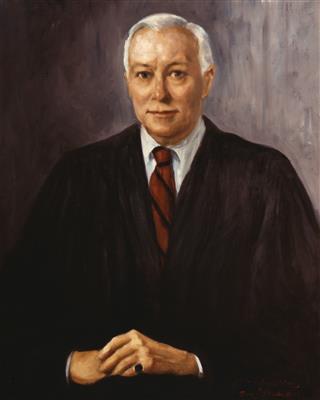
Historical · U.S. Court of Appeals for the Fourth Circuit
Harrison Lee Winter
Former Circuit Judge · U.S. Court of Appeals for the Fourth Circuit · 1966–1990 · Appointed by Lyndon B Johnson
Harrison Lee Winter served as a circuit judge of the U.S. Court of Appeals for the Fourth Circuit (1966–1990). Winter was appointed by Lyndon B Johnson.
Key facts
- Full name
- Harrison Lee Winter
- Court
- U.S. Court of Appeals for the Fourth Circuit
- Office
- Circuit Judge (U.S. Court of Appeals)
- Status
- Former circuit judge
- Duty status
- Not serving
- Appointment
- Senate-confirmed
- FJC seat
- CA40701
- Tenure
- 1966–1990
- Confirmed
- 1966-06-24
- Born
- 1921-04-18
- Died
- 1990-04-10
- First year on the bench
- 1966
- Dataset version
- 1.20260711
Appointment & service record
U.S. Court of Appeals for the Fourth Circuit · 1966–1990
- Seat
- CA40701
- Appointment
- Senate-confirmed
- Appointing president
- Lyndon B Johnson
- Confirmed
- 1966-06-24
- Commissioned
- 1966-06-24
- Senior status
- 1990-01-01
- Chief Judge
- 1981–1989
Court, FJC seat, appointment type (Senate-confirmed or recess), appointing president, confirmation and commission dates, and senior-status date are drawn from the Federal Judicial Center Biographical Directory and Wikidata.[1][2][3]
Sources
- [1]https://www.fjc.gov/node/1389961fjc · retrieved 2026-07-11
- [2]https://www.fjc.gov/history/judges/biographical-directory-article-iii-federal-judges-exportfjc-directory · retrieved 2026-07-11
- [3]https://www.wikidata.org/wiki/Q5665726Wikidata · retrieved 2026-07-11
Biographical narrative
1,292 words · sourced from the Wikipedia REST extract
Harrison Lee Winter was a United States circuit judge who served on the United States Court of Appeals for the Fourth Circuit from 1966 until his death in 1990. Appointed to the federal appellate bench by President Lyndon B. Johnson, a Democrat, Winter served as Chief Judge of the Fourth Circuit from 1981 to 1989, during which time he also participated in the Judicial Conference of the United States. His federal judicial career spanned nearly three decades, beginning with his appointment to the United States District Court for the District of Maryland in 1961 and culminating in his leadership of one of the nation's most significant regional appellate courts. Winter's service on the federal bench represented a substantial contribution to the administration of justice in the mid-Atlantic region during a period of significant legal and social change in American history.
Early life and legal career
Harrison Lee Winter was born on April 18, 1921, in Baltimore, Maryland, where he would spend most of his professional life and career. He pursued his undergraduate education at Johns Hopkins University, one of Baltimore's most prestigious institutions, earning an Artium Baccalaureus degree in 1942. Following his undergraduate studies, Winter attended the University of Maryland School of Law, where he completed his legal education and received a Bachelor of Laws degree in 1944, during the final years of World War II.
After obtaining his law degree, Winter entered private practice in Baltimore in 1945, establishing himself in the legal community of Maryland's largest city. He maintained a private practice for approximately fourteen years, during which time he also took on significant public service roles. Beginning in 1948, Winter served as an assistant attorney general for the State of Maryland, a position he held until 1951. This role provided him with substantial experience in state-level legal matters and government litigation. He returned to the Maryland Attorney General's office several years later, serving as deputy attorney general from 1954 to 1955, further deepening his expertise in public law and governmental affairs.
Winter's career in public service continued to evolve when he transitioned from state-level positions to municipal government. In 1959, he was appointed city solicitor for Baltimore, the chief legal officer for the city government. He served in this capacity until 1961, gaining extensive experience in municipal law, local governance, and the legal challenges facing urban areas during a period of significant demographic and social change. This combination of private practice, state government service, and municipal legal work provided Winter with a broad foundation of legal experience that would inform his subsequent federal judicial service.
Federal appellate service
Winter's federal judicial career began at the district court level. On November 9, 1961, he received a recess appointment from President John F. Kennedy to a newly created seat on the United States District Court for the District of Maryland. The seat had been established by congressional legislation. President Kennedy formally nominated Winter to the position on January 15, 1962, and the United States Senate confirmed the nomination on February 7, 1962. Winter received his commission on February 17, 1962, and began his service as a federal trial judge. He served on the district court for approximately four and a half years, presiding over federal cases in Maryland and gaining experience with the full range of matters that come before federal trial courts.
Winter's tenure on the district court was relatively brief, as he was soon elevated to the appellate bench. On June 13, 1966, President Lyndon B. Johnson nominated Winter to a newly created seat on the United States Court of Appeals for the Fourth Circuit. The new position had been authorized by federal statute as part of an expansion of the federal judiciary. The Senate moved quickly on the nomination, confirming Winter on June 24, 1966. He received his commission the same day, and his service on the district court terminated on June 27, 1966, as he assumed his new duties as a circuit judge.
Winter served on the Fourth Circuit for nearly a quarter century, participating in the resolution of countless appeals from federal district courts across the circuit's jurisdiction. The Fourth Circuit hears appeals from federal courts in Maryland, Virginia, West Virginia, North Carolina, and South Carolina, making it one of the geographically significant circuits in the federal system. In 1981, Winter assumed the position of Chief Judge of the Fourth Circuit, the administrative and leadership role for the court. As Chief Judge, he was responsible not only for his own caseload but also for the management and administration of the court itself. His tenure as Chief Judge lasted from 1981 to 1989, a period of eight years during which he guided the court through its operations and helped shape its institutional practices.
During his time as Chief Judge, Winter also served as a member of the Judicial Conference of the United States, the principal policymaking body for the federal court system. The Judicial Conference, chaired by the Chief Justice of the United States, brings together the chief judges of the various circuits and other judicial representatives to address administrative and policy matters affecting the federal judiciary. Winter's participation in this body from 1981 to 1989 gave him a role in shaping national judicial policy and administration beyond his own circuit.
Winter stepped down as Chief Judge in 1989 and assumed senior status on January 1, 1990, a form of semi-retirement that allows federal judges to continue hearing cases with a reduced caseload. However, his senior service was brief. Winter died on April 10, 1990, in Baltimore, just eight days before what would have been his sixty-ninth birthday, bringing to a close a distinguished career in federal judicial service.
Jurisprudence and legacy
Winter's nearly twenty-four years of service on the Fourth Circuit placed him on the bench during a significant period in American legal history, spanning from the mid-1960s through 1990. During these decades, the federal courts addressed numerous important questions involving civil rights, criminal procedure, administrative law, and constitutional interpretation. As a member of the Fourth Circuit, Winter participated in the appellate review of cases from a region that included some of the states most affected by the legal and social transformations of the civil rights era and its aftermath.
His eight-year tenure as Chief Judge represented a substantial period of leadership for the Fourth Circuit. The Chief Judge's role encompasses not only judicial decision-making but also administrative responsibilities, including case assignment, court management, and representation of the circuit in the broader federal judicial system. Winter's simultaneous service on the Judicial Conference of the United States during his entire tenure as Chief Judge indicates that he played a role in the national administration of the federal court system during the 1980s, a decade that saw continued growth and evolution in the federal judiciary.
Winter's career trajectory—from private practice and state and local government service to the federal district court and then to nearly a quarter century on a federal appellate court—reflected a comprehensive engagement with multiple levels of the American legal system. His experience in the Maryland Attorney General's office and as Baltimore's city solicitor provided him with grounding in both state constitutional law and the practical legal challenges facing state and local governments, perspective that would have informed his work on the federal bench. The combination of trial court and appellate court experience gave him familiarity with both the fact-finding and legal-interpretation functions of the federal judiciary.
Winter's death in 1990 came shortly after he assumed senior status, cutting short what might have been additional years of continued judicial service. His decades on the Fourth Circuit, including his leadership as Chief Judge during the 1980s, represented a significant contribution to the federal appellate judiciary during an important era in American legal development.
Sources & provenance
Every quantitative or attributable claim above carries a per-section [N] marker that resolves to the corresponding URL below. Each entry records the upstream provider, the canonical URL, and the timestamp at which the underlying source was retrieved.
Key facts
- https://www.fjc.gov/node/1389961fjc · retrieved 2026-07-11
- https://www.fjc.gov/history/judges/biographical-directory-article-iii-federal-judges-exportfjc-directory · retrieved 2026-07-11
- https://www.wikidata.org/wiki/Q5665726Wikidata · retrieved 2026-07-11
Biographical narrative
- https://en.wikipedia.org/wiki/Harrison_Lee_WinterWikipedia · retrieved 2026-07-11
Explore the federal judiciary
The U.S. Courts of Appeals are the intermediate appellate courts of the federal judiciary — thirteen circuits sitting between the district courts and the Supreme Court. Browse the full roster of judges on the U.S. Court of Appeals for the Fourth Circuit, or explore how the appointed federal judiciary fits into the federal government.