
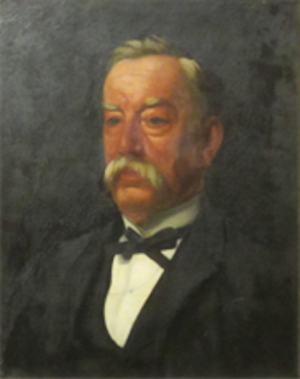
Historical · U.S. Court of Appeals for the Fourth Circuit
Hugh Lennox Bond
Former Circuit Judge · U.S. Court of Appeals for the Fourth Circuit · 1891–1893 · Appointed by None Assignment
Hugh Lennox Bond served as a circuit judge of the U.S. Court of Appeals for the Fourth Circuit (1891–1893). Bond was appointed by None Assignment.
Key facts
- Full name
- Hugh Lennox Bond
- Court
- U.S. Court of Appeals for the Fourth Circuit
- Office
- Circuit Judge (U.S. Court of Appeals)
- Status
- Former circuit judge
- Duty status
- Not serving
- Appointment
- Recess appointment
- FJC seat
- CA40101
- Tenure
- 1891–1893
- Confirmed
- —
- Born
- 1828-12-16
- Died
- 1893-10-24
- First year on the bench
- 1891
- Dataset version
- 1.20260711
Appointment & service record
U.S. Court of Appeals for the Fourth Circuit · 1891–1893
- Seat
- CA40101
- Appointment
- Recess appointment
- Appointing president
- None Assignment
- Confirmed
- Recess appointment
- Commissioned
- 1891-06-16
- Senior status
- —
Court, FJC seat, appointment type (Senate-confirmed or recess), appointing president, confirmation and commission dates, and senior-status date are drawn from the Federal Judicial Center Biographical Directory and Wikidata.[1][2][3]
Sources
- [1]https://www.fjc.gov/node/1377996fjc · retrieved 2026-07-11
- [2]https://www.fjc.gov/history/judges/biographical-directory-article-iii-federal-judges-exportfjc-directory · retrieved 2026-07-11
- [3]https://www.wikidata.org/wiki/Q15451836Wikidata · retrieved 2026-07-11
Biographical narrative
1,203 words · sourced from the Wikipedia REST extract
Hugh Lennox Bond was a United States circuit judge who served on the United States Circuit Courts for the Fourth Circuit from 1870 until his death in 1893, and concurrently on the United States Court of Appeals for the Fourth Circuit during the final two years of his tenure. Appointed by President Ulysses S. Grant, a Republican, Bond presided over significant cases during the Reconstruction era and played a notable role in federal judicial proceedings related to civil rights enforcement in the post-Civil War South. His judicial career spanned more than two decades of profound constitutional and social transformation in the United States.
Early life and legal career
Hugh Lennox Bond was born on December 16, 1828, in Baltimore, Maryland. He pursued his undergraduate education at the University of the City of New York, an institution now known as New York University, from which he graduated in 1848. Following his graduation, Bond studied law through the traditional method of reading law, which involved apprenticeship and independent study under the guidance of established attorneys. He was admitted to the bar in 1851, beginning what would become a distinguished legal career.
After gaining admission to practice, Bond established himself in private legal practice in Baltimore, where he worked from 1851 to 1860. During the 1850s, he became a prominent figure in local politics as a leader of the Know-Nothing party in Baltimore. This political movement, formally known as the American Party, was influential in Maryland and other states during that decade. Bond's involvement in this organization demonstrated his early engagement with the political currents of his time.
In 1860, Bond transitioned from private practice to the bench when he became a judge of the Baltimore City Criminal Court. He served in this judicial capacity for seven years, until 1867, gaining substantial experience in criminal law and trial court proceedings. His tenure on the criminal court coincided with the tumultuous years of the Civil War and its immediate aftermath, a period that would prove formative for his later judicial philosophy.
During the Civil War, Bond took a public stance on one of the era's most controversial issues. On August 15, 1863, he wrote a letter to Secretary of War Edwin M. Stanton that was subsequently published in newspapers. In this correspondence, Bond advocated for the enlistment of enslaved people in Maryland into military service. His position was particularly significant because Maryland, as a border state that remained in the Union, was not covered by the Emancipation Proclamation, which applied only to areas in rebellion against the United States. Bond had held abolitionist views since before the war began, and his advocacy reflected his commitment to these principles. The policy he championed was soon implemented, marking an important step in the expansion of emancipation and military recruitment during the conflict.
Following his service on the criminal court, Bond returned to private practice in Baltimore in 1867. That same year, he entered the gubernatorial race in Maryland but was unsuccessful, losing the election to Oden Bowie. He continued in private practice until 1870, when he received a federal judicial appointment.
Federal appellate service
Bond's federal judicial career began when President Ulysses S. Grant nominated him to the United States Circuit Courts for the Fourth Circuit on April 6, 1870. This nomination was for a newly created seat authorized by federal statute. The United States Senate confirmed his appointment on July 13, 1870, and he received his commission on the same day. The circuit courts at this time served as the principal federal trial courts and also heard appeals, functioning as an intermediate tier in the federal judiciary before the modern court structure was established.
Bond's service on the circuit court coincided with the Reconstruction era, a period when federal courts played a crucial role in enforcing civil rights legislation and addressing violence against formerly enslaved people and their allies. In December 1871, Bond and fellow judge George S. Bryan presided over a significant trial in Columbia, South Carolina, involving members of the Ku Klux Klan. The defendants in this case were convicted and received sentences ranging from three to five months of incarceration along with monetary fines. This trial was part of the federal government's broader effort to suppress organized terrorist violence in the South through enforcement of the Enforcement Acts passed by Congress.
In 1876, Bond decided a case involving South Carolina's presidential electoral votes, a matter of considerable importance during the disputed presidential election of that year. The resolution of electoral disputes from several Southern states, including South Carolina, ultimately determined the outcome of the contest between Rutherford B. Hayes and Samuel J. Tilden.
The structure of the federal judiciary underwent significant reorganization with the passage of the Evarts Act in 1891. This legislation created the modern United States Courts of Appeals as distinct appellate tribunals, separate from the trial-level circuit courts. By operation of law on June 16, 1891, Bond was assigned to additional and concurrent service on the newly established United States Court of Appeals for the Fourth Circuit. This assignment was to a new seat authorized by the Evarts Act. Bond thus served simultaneously on both the older circuit court system and the new appellate court during the final years of his life.
Bond's service on the federal bench terminated on October 24, 1893, when he died at his home in Baltimore. He had served in the federal judiciary for more than twenty-three years.
Jurisprudence and legacy
Bond's judicial tenure occurred during one of the most consequential periods in American constitutional history. His service spanned the Reconstruction era and its aftermath, when federal courts were called upon to interpret and apply the newly ratified Thirteenth, Fourteenth, and Fifteenth Amendments, as well as the civil rights legislation enacted by Congress to enforce these constitutional provisions. His willingness to preside over prosecutions of Ku Klux Klan members reflected the federal judiciary's role in attempting to protect the civil and political rights of African Americans in the face of organized resistance and violence.
The cases over which Bond presided addressed fundamental questions about federal authority, civil rights, and the rule of law in the post-Civil War South. His involvement in the 1876 South Carolina electoral case placed him at the intersection of law and politics during one of the most contested presidential elections in American history. These responsibilities illustrated the significant role that federal circuit judges played in shaping the legal and political landscape of Reconstruction and its decline.
Bond's earlier advocacy for the enlistment of enslaved people during the Civil War demonstrated a commitment to abolitionist principles that predated his federal judicial service. This background may have informed his approach to cases involving civil rights and federal enforcement authority during Reconstruction, though the specific contours of his judicial philosophy must be understood through the decisions he rendered rather than through political characterizations.
Following his death in Baltimore on October 24, 1893, Bond was interred at Green Mount Cemetery in that city. His more than two decades of federal judicial service left him as a figure who participated in the federal judiciary's efforts to navigate the complex legal and constitutional questions of the Reconstruction era and the subsequent period of American legal development.
Sources & provenance
Every quantitative or attributable claim above carries a per-section [N] marker that resolves to the corresponding URL below. Each entry records the upstream provider, the canonical URL, and the timestamp at which the underlying source was retrieved.
Key facts
- https://www.fjc.gov/node/1377996fjc · retrieved 2026-07-11
- https://www.fjc.gov/history/judges/biographical-directory-article-iii-federal-judges-exportfjc-directory · retrieved 2026-07-11
- https://www.wikidata.org/wiki/Q15451836Wikidata · retrieved 2026-07-11
Biographical narrative
- https://en.wikipedia.org/wiki/Hugh_Lennox_BondWikipedia · retrieved 2026-07-11
Explore the federal judiciary
The U.S. Courts of Appeals are the intermediate appellate courts of the federal judiciary — thirteen circuits sitting between the district courts and the Supreme Court. Browse the full roster of judges on the U.S. Court of Appeals for the Fourth Circuit, or explore how the appointed federal judiciary fits into the federal government.