
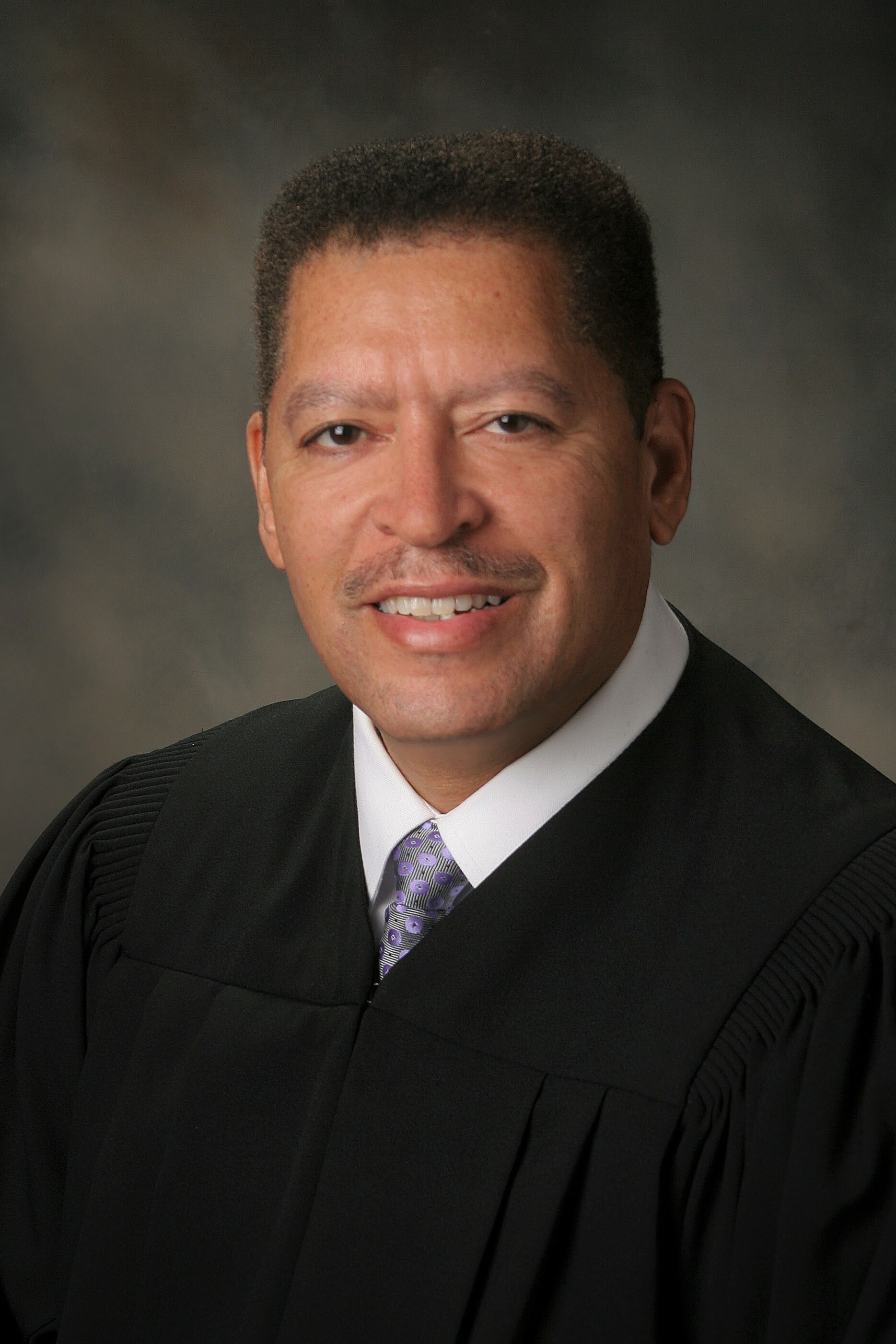
Currently serving · U.S. Court of Appeals for the Fourth Circuit
James Andrew Wynn Jr.
Currently serving
Circuit Judge · U.S. Court of Appeals for the Fourth Circuit · 2010–present · Appointed by Barack Obama
James Andrew Wynn Jr. serves as a circuit judge of the U.S. Court of Appeals for the Fourth Circuit (2010–present). Jr. was appointed by Barack Obama.
Key facts
- Full name
- James Andrew Wynn Jr.
- Court
- U.S. Court of Appeals for the Fourth Circuit
- Office
- Circuit Judge (U.S. Court of Appeals)
- Status
- Active circuit judge
- Duty status
- Active
- Appointment
- Senate-confirmed
- FJC seat
- CA40803
- Tenure
- 2010–present
- Confirmed
- 2010-08-05
- Born
- 1954
- Died
- —
- First year on the bench
- 2010
- Dataset version
- 1.20260705
Appointment & service record
U.S. Court of Appeals for the Fourth Circuit · 2010–present
- Seat
- CA40803
- Appointment
- Senate-confirmed
- Appointing president
- Barack Obama
- Confirmed
- 2010-08-05
- Commissioned
- 2010-08-10
- Senior status
- —
Court, FJC seat, appointment type (Senate-confirmed or recess), appointing president, confirmation and commission dates, and senior-status date are drawn from the Federal Judicial Center Biographical Directory and Wikidata.[1][2][3]
Sources
- [1]https://www.fjc.gov/node/1393301fjc · retrieved 2026-07-05
- [2]https://www.fjc.gov/history/judges/biographical-directory-article-iii-federal-judges-exportfjc-directory · retrieved 2026-07-05
- [3]https://www.wikidata.org/wiki/Q6128330Wikidata · retrieved 2026-07-05
Biographical narrative
1,317 words · sourced from the Wikipedia REST extract
James Andrew Wynn Jr. is an American jurist who has served as a United States circuit judge on the Fourth Circuit since 2010. Prior to his federal appointment, he held positions on both the North Carolina Court of Appeals and the North Carolina Supreme Court, and he spent more than three decades in the United States Navy’s legal branch, retiring at the rank of captain. His career reflects extensive experience in military law, state appellate adjudication, and federal appellate jurisprudence, as well as involvement in a range of professional and civic organizations.
Early life and legal career
James Andrew Wynn Jr. was born in 1954 and raised in Robersonville, a community in eastern North Carolina. He grew up as one of eight children in a family that operated a farm, where he performed agricultural work during his youth. Wynn pursued higher education at the University of North Carolina at Chapel Hill, earning a Bachelor of Arts in journalism in 1975. He continued his studies at Marquette University Law School, receiving a Juris Doctor degree in 1979. Further specialization came with a Master of Laws in Judicial Process from the University of Virginia School of Law, completed in 1995.
Following law school, Wynn entered military service as an officer in the Judge Advocate General’s Corps of the United States Navy. He served on active duty for four years, stationed in Norfolk, Virginia, where he performed legal duties typical of naval JAG officers. After completing his active tour, he remained in the Naval Reserve for an additional 26 years, a period that included service as a military judge. Wynn retired from the reserve component in 2009 with the rank of captain.
After leaving active duty, Wynn briefly worked as an Assistant Appellate Defender for the State of North Carolina, representing indigent clients on appeal. He then entered private practice by joining the Wilson, North Carolina firm Fitch & Butterfield, which later became known as Fitch, Butterfield & Wynn. His work in private practice complemented his public service and provided a foundation for his subsequent judicial career.
Wynn’s involvement in professional and civic organizations has been extensive. He has served on the board of trustees at Marquette University, chairing its athletic committee, and held leadership roles with the American Bar Endowment, Pitt Community College, and the American Bar Association’s Rule of Law Initiative. His affiliations also include membership in the American Law Institute, life membership in the National Conference of Uniform Law Commissioners, and past chairmanship of the ABA Center for Human Rights. In addition to his legal work, Wynn is a member of Kappa Alpha Psi fraternity, Sigma Pi Phi fraternity, and holds the 33rd degree in Prince Hall Freemasonry. He has also served as chair of the board of deacons at his church.
Federal appellate service
Wynn’s first nomination to the federal bench came during President Bill Clinton’s administration. On August 5 1999, Clinton nominated him to fill a vacancy on the Fourth Circuit that had been created when Judge James Dickson Phillips Jr. assumed senior status in 1994. The nomination was part of an effort to bring greater racial diversity to a circuit that, despite serving a region with a large African‑American population, had never before seated a judge of color. However, North Carolina Senator Jesse Helms declined to return the customary “blue slip” required for a Senate Judiciary Committee hearing, effectively blocking the nomination. The seat remained vacant until Wynn’s eventual confirmation many years later.
President Clinton issued a recess appointment in December 2000 for Judge Roger Gregory of Virginia, making Gregory the first African‑American judge to sit on the Fourth Circuit. Clinton renominated Wynn on January 3 2001, shortly before leaving office, but the nomination was withdrawn by President George W. Bush two months later.
Nearly a decade after his initial nomination, Wynn was again considered for the Fourth Circuit under President Barack Obama. On November 4 2009, Obama nominated Wynn alongside Special Superior Court Judge Albert Diaz to fill separate vacancies on the circuit. Both nominations received bipartisan endorsement from North Carolina’s senators at the time—Democrat Kay Hagan and Republican Richard Burr. The United States Senate confirmed Wynn by unanimous consent on August 5 2010, and he received his commission five days later, on August 10 2010. Since that date, Judge Wynn has remained an active member of the Fourth Circuit, participating in panels that address a broad spectrum of federal appellate issues.
In early 2024, Judge Wynn signaled an intention to assume senior status—a form of semi‑retirement that creates a vacancy while allowing a judge to continue hearing cases on a reduced basis. On January 9 2024, he wrote to President Joe Biden indicating that he would take senior status once a successor was confirmed. The administration subsequently nominated North Carolina Solicitor General Ryan Park for the anticipated opening. Although Park advanced through the Senate Judiciary Committee, opposition from the state’s home‑state senators prevented his nomination from moving forward. In December 2024, a bipartisan agreement in the Senate allowed certain judicial nominees to proceed while others, including Park, were not advanced; Park withdrew his name in response.
Following this development, Judge Wynn sent another letter to President Biden withdrawing his earlier senior‑status request and electing to remain in active service on the Fourth Circuit. The reversal generated commentary from political figures, with some Republican senators expressing disappointment that a vacancy would not become available for the incoming administration. Other observers noted that judges have previously rescinded senior‑status notices when confirmation processes stalled, emphasizing Wynn’s discretion to continue serving while the Senate considered his successor.
Jurisprudence and legacy
Judge Wynn’s judicial output on the Fourth Circuit includes participation in numerous opinions across civil rights, administrative law, criminal procedure, and other areas of federal jurisprudence. One notable contribution is his concurring opinion in *Liberty University, Inc. v. Geithner* (2011). In that case, Judge Wynn was the first lower‑federal‑court judge to articulate a view that Congress possessed authority under its plenary taxing power to enact the individual mandate provision of the Affordable Care Act. While the Supreme Court later addressed the constitutional basis for the mandate in separate decisions, Wynn’s analysis added an early perspective on the interplay between taxation and health‑care legislation.
Beyond specific opinions, Judge Wynn’s career reflects a broader impact on the composition and perception of the Fourth Circuit. His eventual confirmation marked the fulfillment of a long‑standing effort to diversify a circuit that had historically lacked representation from people of color. The decades between his initial nomination in 1999 and his confirmation in 2010 underscore both the political challenges surrounding judicial appointments and the persistence of efforts to achieve greater inclusivity on the federal bench.
Wynn’s extensive background—spanning military law, state appellate service, private practice, and federal adjudication—has contributed to a reputation for thorough legal analysis and an understanding of varied procedural contexts. His involvement in professional organizations dedicated to legal education, rule‑of‑law initiatives, and human‑rights advocacy further illustrates a commitment to the development of the legal profession beyond courtroom duties.
As a judge who has served on both state and federal appellate courts, Wynn brings a perspective that bridges differing judicial hierarchies and jurisdictions. His tenure on the North Carolina Court of Appeals and Supreme Court from 1990 to 2010 provided him with experience in interpreting state statutes and constitutional provisions, which informs his approach to federal questions involving similar legal principles.
In sum, James Andrew Wynn Jr.’s career embodies a trajectory from rural upbringing in eastern North Carolina through military service, academic achievement, private practice, and extensive judicial service at both the state and federal levels. His role in advancing diversity on the Fourth Circuit, coupled with his participation in significant appellate decisions, positions him as an influential figure within the American judiciary. Continued active service after 2024 ensures that his contributions to federal appellate jurisprudence will extend further into the evolving landscape of United States law.
Sources & provenance
Every quantitative or attributable claim above carries a per-section [N] marker that resolves to the corresponding URL below. Each entry records the upstream provider, the canonical URL, and the timestamp at which the underlying source was retrieved.
Key facts
- https://www.fjc.gov/node/1393301fjc · retrieved 2026-07-05
- https://www.fjc.gov/history/judges/biographical-directory-article-iii-federal-judges-exportfjc-directory · retrieved 2026-07-05
- https://www.wikidata.org/wiki/Q6128330Wikidata · retrieved 2026-07-05
Biographical narrative
- https://en.wikipedia.org/wiki/James_Andrew_WynnWikipedia · retrieved 2026-07-05
Explore the federal judiciary
The U.S. Courts of Appeals are the intermediate appellate courts of the federal judiciary — thirteen circuits sitting between the district courts and the Supreme Court. Browse the full roster of judges on the U.S. Court of Appeals for the Fourth Circuit, or explore how the appointed federal judiciary fits into the federal government.