
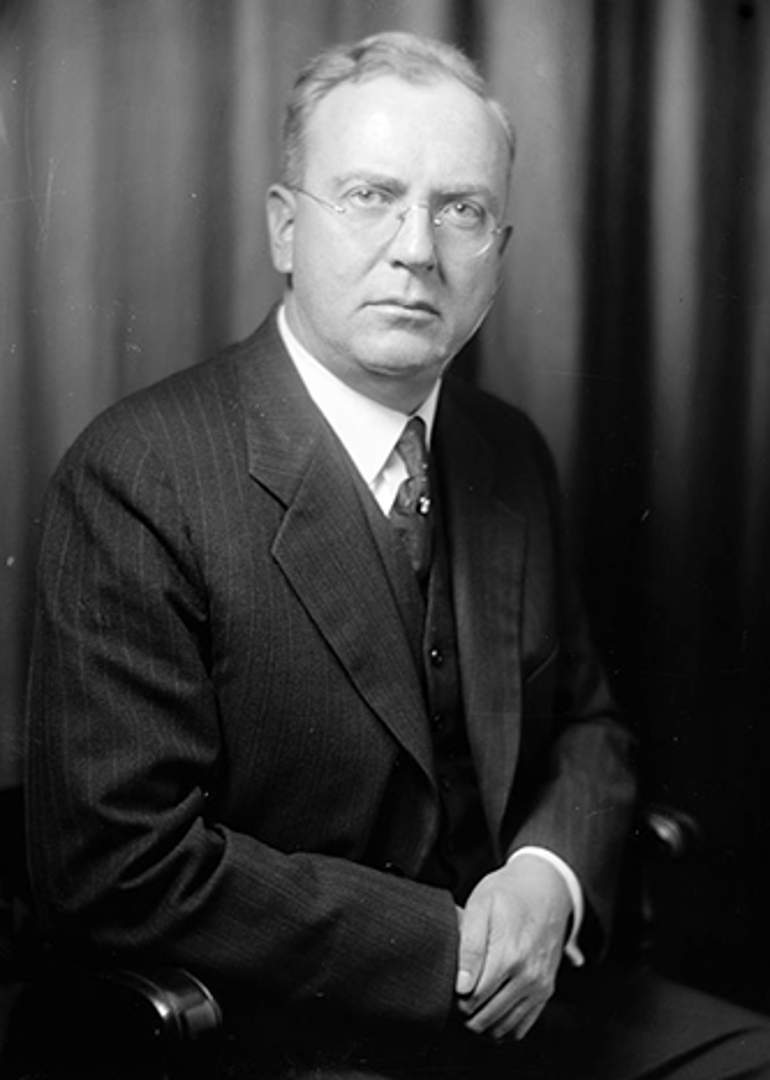
Historical · U.S. Court of Appeals for the Fourth Circuit
John Johnston Parker
Former Circuit Judge · U.S. Court of Appeals for the Fourth Circuit · 1925–1958 · Appointed by Calvin Coolidge
John Johnston Parker served as a circuit judge of the U.S. Court of Appeals for the Fourth Circuit (1925–1958). Parker was appointed by Calvin Coolidge.
Key facts
- Full name
- John Johnston Parker
- Court
- U.S. Court of Appeals for the Fourth Circuit
- Office
- Circuit Judge (U.S. Court of Appeals)
- Status
- Former circuit judge
- Duty status
- Not serving
- Appointment
- Senate-confirmed
- FJC seat
- CA40203
- Tenure
- 1925–1958
- Confirmed
- 1925-12-14
- Born
- 1885-11-20
- Died
- 1958-03-17
- First year on the bench
- 1925
- Dataset version
- 1.20260711
Appointment & service record
U.S. Court of Appeals for the Fourth Circuit · 1925–1958
- Seat
- CA40203
- Appointment
- Senate-confirmed
- Appointing president
- Calvin Coolidge
- Confirmed
- 1925-12-14
- Commissioned
- 1925-12-14
- Senior status
- —
- Chief Judge
- 1948–1958
Court, FJC seat, appointment type (Senate-confirmed or recess), appointing president, confirmation and commission dates, and senior-status date are drawn from the Federal Judicial Center Biographical Directory and Wikidata.[1][2][3]
Sources
- [1]https://www.fjc.gov/node/1386096fjc · retrieved 2026-07-11
- [2]https://www.fjc.gov/history/judges/biographical-directory-article-iii-federal-judges-exportfjc-directory · retrieved 2026-07-11
- [3]https://www.wikidata.org/wiki/Q532337Wikidata · retrieved 2026-07-11
Biographical narrative
1,642 words · sourced from the Wikipedia REST extract
John Johnston Parker was a United States circuit judge who served on the United States Court of Appeals for the Fourth Circuit from 1925 until his death in 1958, including a decade as Chief Judge from 1948 onward. Appointed by President Calvin Coolidge, a Republican, Parker became one of the most influential federal appellate judges of the mid-twentieth century, though he is perhaps best remembered for two defining episodes: his unsuccessful nomination to the Supreme Court of the United States in 1930, and his significant role in shaping the implementation of school desegregation following the Supreme Court's landmark decision in Brown v. Board of Education. Beyond his domestic judicial service, Parker also participated in international legal proceedings as the United States alternate judge at the Nuremberg trials of accused Nazi war criminals and later served on the United Nations' International Law Commission.
Early life and legal career
Born on November 20, 1885, in Monroe, North Carolina, John Johnston Parker came from a family with deep roots in American history. He was the eldest of four children born to Frances Ann Johnston and John Daniel Parker. His ancestry included William Bradford, one of the founders of Plymouth Colony in Massachusetts, and James Iredell, who served as an associate justice of the Supreme Court of the United States. Parker's family also produced notable military service; his brother, Samuel I. Parker, became the first recipient of the army's three highest decorations for valor.
Parker pursued his undergraduate education at the University of North Carolina at Chapel Hill, where he distinguished himself academically and socially. He earned a Bachelor of Arts degree in 1907, during which time he was elected to membership in Phi Beta Kappa, the prestigious academic honor society, and served as president of his class. He continued his education at the University of North Carolina School of Law, receiving a Bachelor of Laws degree in 1908. After completing a legal apprenticeship in Greensboro, North Carolina, Parker established a law practice in Monroe in 1909, where he practiced until 1922. He then moved his practice to Charlotte, North Carolina, where he continued until his appointment to the federal bench in 1925.
On November 23, 1910, Parker married Maria Burgwin Maffitt. The couple had three children together: Sara Burgwin, John Jr., and Francis Iredell, the last named presumably in honor of Parker's distinguished ancestor.
Before ascending to the federal judiciary, Parker harbored political ambitions and sought elected office on multiple occasions as a Republican, though without success. In 1910, he ran for the United States House of Representatives from North Carolina's 10th congressional district. Six years later, in 1916, he sought the position of Attorney General of North Carolina. His most prominent political campaign came in 1920, when he ran for Governor of North Carolina. Despite these electoral setbacks, Parker's legal abilities and Republican connections brought him into federal service.
From 1923 to 1924, Parker served as a special assistant to the Attorney General of the United States. In this capacity, he was assigned to prosecute former officials from the Wilson Administration for alleged frauds connected with World War I demobilization efforts. Although his work in this role did not result in any indictments or convictions, Parker made favorable impressions on his colleagues in the Justice Department, including the then-Attorney General Harlan F. Stone, who would later serve as Chief Justice of the United States. These professional relationships would prove significant for Parker's subsequent judicial career.
Federal appellate service
Parker's appointment to the federal appellate bench came in 1925. President Calvin Coolidge gave him a recess appointment on October 3, 1925, to fill a seat on the United States Court of Appeals for the Fourth Circuit that had been vacated by Judge Charles Albert Woods. The president formally nominated Parker to the same position on December 8, 1925. The United States Senate confirmed the nomination on December 14, 1925, and Parker received his commission the same day. He would serve on the Fourth Circuit for more than three decades, until his death.
Parker's service extended beyond his role as a circuit judge. He was a member of the Conference of Senior Circuit Judges, which later became the Judicial Conference of the United States, from 1931 to 1948. After 1948, he continued as a member of the Judicial Conference of the United States until 1957. In 1948, Parker assumed the position of Chief Judge of the Fourth Circuit, a role he held for the final decade of his life until his death in 1958.
During his tenure on the Fourth Circuit, Parker presided over numerous cases, but his most consequential and controversial work involved school desegregation litigation. He played a central role in Briggs v. Elliott, one of the school desegregation cases that would eventually be consolidated into the Supreme Court's landmark Brown v. Board of Education decision. In 1951, Parker issued a ruling in the Briggs case that, while finding that specific schools in South Carolina being challenged by the National Association for the Advancement of Colored People were unequal and violated the "separate but equal" requirement established under Plessy v. Ferguson, nonetheless held that segregation in public schools was constitutional.
In his 1951 opinion, Parker wrote that when seventeen states and the Congress of the United States had for more than three-quarters of a century required segregation of the races in public schools, and when this practice had received approval from leading appellate courts including the unanimous approval of the Supreme Court at a time when that court included Chief Justice Taft and Justices Stone, Holmes, and Brandeis, it was too late in the day to declare such segregation violative of fundamental constitutional rights.
The case proceeded to the Supreme Court, which in 1954 unanimously ruled in Brown that in the field of public education, the doctrine of "separate but equal" had no place and that separate educational facilities were inherently unequal. The following term, the Court held additional arguments to determine implementation of the Brown decision. In what became known as Brown II, the Court decided that rather than ordering immediate desegregation throughout the country and risking civil unrest and resistance, local authorities would develop plans to implement Brown "with all deliberate speed."
The Briggs case subsequently returned to the Fourth Circuit, and in 1955 Parker issued another opinion that would prove highly influential and controversial. He interpreted Brown as outlawing only state-sponsored segregation of public schools. Parker wrote that the Constitution did not require integration but merely forbade discrimination. It did not forbid segregation that occurred as the result of voluntary action but merely forbade the use of governmental power to enforce segregation. In other words, according to Parker's interpretation, de facto public school segregation was permissible, while de jure segregation was not.
This interpretation, which became known as the "Parker Doctrine," became highly influential among judges, particularly throughout the South, and provided a framework that allowed schools to delay, evade, and avoid integration. Historians have noted the doctrine's significant impact on the pace of desegregation. The Supreme Court would effectively overturn the Parker Doctrine in 1968, ruling in Green v. County School Board of New Kent County that school boards had an affirmative duty to end segregation "root and branch," and emphasizing that the time for mere "deliberate speed" had run out.
Jurisprudence and legacy
Parker's judicial philosophy and approach to the law developed over more than three decades on the federal bench. His work encompassed a wide range of federal appellate matters beyond the school desegregation cases for which he became best known. As a circuit judge on the Fourth Circuit, he participated in shaping federal law across the mid-Atlantic region during a period of significant legal and social transformation in American history.
Beyond his domestic judicial service, Parker contributed to international legal proceedings in the aftermath of World War II. He served as the United States alternate judge at the Nuremberg trials, the historic proceedings that prosecuted accused Nazi war criminals. This role placed him at the center of efforts to establish principles of international criminal law and accountability for wartime atrocities. Parker's participation in these trials reflected the esteem in which he was held within the legal community and demonstrated the breadth of his legal expertise beyond domestic appellate matters.
Parker also served on the United Nations' International Law Commission, contributing to the development of international legal principles in the early years of the United Nations. This service further demonstrated his engagement with legal questions beyond the Fourth Circuit and indicated his standing as a jurist of international reputation.
The legacy of Parker's judicial career remains complex and contested, particularly regarding his role in school desegregation. While his interpretation of Brown v. Board of Education in the Briggs case provided a framework that many historians believe significantly delayed meaningful integration of public schools throughout the South, his broader body of work on the Fourth Circuit encompassed many other areas of federal law. His long tenure as Chief Judge, from 1948 to 1958, placed him in a position of administrative leadership within the federal judiciary during a crucial period of American legal history.
Parker's service on the Fourth Circuit spanned thirty-three years, from his confirmation in December 1925 until his death on March 17, 1958. This extended tenure allowed him to influence the development of federal appellate jurisprudence across multiple generations and through periods of profound social and legal change. His appointment by President Coolidge and his subsequent decades of service made him one of the longest-serving judges in the history of the Fourth Circuit. The combination of his domestic appellate work, his participation in the Nuremberg trials, and his service to the United Nations reflected a career that extended well beyond the typical scope of a federal circuit judge, even as the controversies surrounding his desegregation rulings continued to shape assessments of his judicial legacy.
Sources & provenance
Every quantitative or attributable claim above carries a per-section [N] marker that resolves to the corresponding URL below. Each entry records the upstream provider, the canonical URL, and the timestamp at which the underlying source was retrieved.
Key facts
- https://www.fjc.gov/node/1386096fjc · retrieved 2026-07-11
- https://www.fjc.gov/history/judges/biographical-directory-article-iii-federal-judges-exportfjc-directory · retrieved 2026-07-11
- https://www.wikidata.org/wiki/Q532337Wikidata · retrieved 2026-07-11
Biographical narrative
- https://en.wikipedia.org/wiki/John_J._ParkerWikipedia · retrieved 2026-07-11
Explore the federal judiciary
The U.S. Courts of Appeals are the intermediate appellate courts of the federal judiciary — thirteen circuits sitting between the district courts and the Supreme Court. Browse the full roster of judges on the U.S. Court of Appeals for the Fourth Circuit, or explore how the appointed federal judiciary fits into the federal government.