
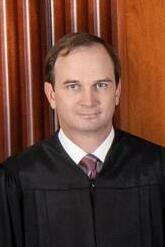
Currently serving · U.S. Court of Appeals for the Fourth Circuit
Julius Ness Richardson
Currently serving
Circuit Judge · U.S. Court of Appeals for the Fourth Circuit · 2018–present · Appointed by Donald Trump
Julius Ness Richardson serves as a circuit judge of the U.S. Court of Appeals for the Fourth Circuit (2018–present). Richardson was appointed by Donald Trump.
Key facts
- Full name
- Julius Ness Richardson
- Court
- U.S. Court of Appeals for the Fourth Circuit
- Office
- Circuit Judge (U.S. Court of Appeals)
- Status
- Active circuit judge
- Duty status
- Active
- Appointment
- Senate-confirmed
- FJC seat
- CA41303
- Tenure
- 2018–present
- Confirmed
- 2018-08-16
- Born
- 1976
- Died
- —
- First year on the bench
- 2018
- Dataset version
- 1.20260705
Appointment & service record
U.S. Court of Appeals for the Fourth Circuit · 2018–present
- Seat
- CA41303
- Appointment
- Senate-confirmed
- Appointing president
- Donald Trump
- Confirmed
- 2018-08-16
- Commissioned
- 2018-08-20
- Senior status
- —
Court, FJC seat, appointment type (Senate-confirmed or recess), appointing president, confirmation and commission dates, and senior-status date are drawn from the Federal Judicial Center Biographical Directory and Wikidata.[1][2][3]
Sources
- [1]https://www.fjc.gov/node/5090921fjc · retrieved 2026-07-05
- [2]https://www.fjc.gov/history/judges/biographical-directory-article-iii-federal-judges-exportfjc-directory · retrieved 2026-07-05
- [3]https://www.wikidata.org/wiki/Q52201270Wikidata · retrieved 2026-07-05
Biographical narrative
1,185 words · sourced from the Wikipedia REST extract
Julius Ness Richardson (born 1976) is an American jurist who serves as a United States circuit judge on the Fourth Circuit Court of Appeals. Appointed by President Donald J. Trump in 2018, he has been an active member of the appellate bench since receiving his commission that August. Prior to joining the federal judiciary, Richardson built a career that combined elite academic achievement, prestigious clerkships, private‑practice litigation experience, and a decade of service as an Assistant United States Attorney for the District of South Carolina, where he led several high‑profile criminal prosecutions.
Early life and legal career
Richardson was born and raised in Barnwell, South Carolina. He pursued his undergraduate education at Vanderbilt University, earning a Bachelor of Science degree in 1999. Continuing to a top law school, he attended the University of Chicago Law School, graduating with high honors in 2003. While there, he contributed to legal scholarship as an articles editor for the University of Chicago Law Review.
Following graduation, Richardson entered the federal judiciary as a clerk for Judge Richard Posner of the United States Court of Appeals for the Seventh Circuit, serving from 2003 to 2004. He then secured a second clerkship with Chief Justice William Rehnquist of the Supreme Court of the United States, which he completed in 2005. These experiences placed him at the center of appellate and constitutional adjudication early in his career.
After completing his clerkships, Richardson moved into private practice, joining the Washington, D.C., firm Kellogg, Hansen, Todd, Figel & Frederick. Over a three‑year period, he handled complex civil litigation matters, gaining experience in high‑stakes commercial disputes.
In 2009, Richardson returned to South Carolina to serve as an Assistant United States Attorney for the District of South Carolina. He advanced to the role of Deputy Criminal Chief, overseeing the office’s criminal prosecutions. Among the cases he led was the prosecution of Dylann Roof for the mass murder at a Charleston church, a trial that attracted national attention. His prosecutorial portfolio also included a public‑corruption case involving a county sheriff, a murder‑for‑hire scheme linked to an MS‑13 gang, and a substantial RICO action against a chapter of the Hells Angels motorcycle organization.
Richardson is married to Macon, and together they have four daughters.
Federal appellate service
President Donald J. Trump announced his intent to nominate Richardson to the United States Court of Appeals for the Fourth Circuit on April 26 2018. The nomination was formally transmitted to the Senate on May 7 2018 to fill the seat vacated by Judge Dennis Shedd, who had assumed senior status earlier that year. A confirmation hearing before the Senate Judiciary Committee took place on June 20 2018.
The committee reported Richardson’s nomination favorably on July 19 2018 with a vote of twenty‑to‑one. The full Senate invoked cloture on his nomination on August 16 2018 by an eighty‑to‑ten vote and subsequently confirmed him by an eighty‑one‑to‑eight margin. He received his judicial commission on August 20 2018 and has served as an active circuit judge since that date.
During Richardson’s tenure, the Fourth Circuit addressed the appeal of Dylann Roof’s conviction and death sentence. Because Richardson had been the lead prosecutor in the underlying criminal case, all judges of the Fourth Circuit recused themselves from reviewing the matter. The appeal was therefore decided by a panel composed of Judges Duane Benton (Eighth Circuit), Ronald Lee Gilman (Sixth Circuit), and Kent A. Jordan (Third Circuit), who affirmed the conviction and sentence.
Jurisprudence and legacy
Judge Richardson’s opinions on the Fourth Circuit illustrate his engagement with a range of constitutional and statutory issues, often reflecting a textualist approach to the Second Amendment, Fifth Amendment takings jurisprudence, and administrative law.
In Hirschfeld v. Bureau of Alcohol, Firearms, Tobacco & Explosives (2021), Richardson authored an opinion holding that federal statutes and regulations prohibiting federally licensed firearms dealers from selling handguns to individuals aged 18‑20 violated the Second Amendment. The panel’s decision was later vacated as moot after the plaintiff turned 21, but the case highlighted Richardson’s willingness to scrutinize age‑based restrictions on firearm ownership.
Richardson dissented in Harley v. Wilkinson (2021), a case involving an as‑applied Second Amendment challenge to a prohibition on firearm possession for individuals convicted of misdemeanor domestic‑violence offenses. While the majority barred such challenges categorically, Richardson argued that litigants should be permitted to raise as‑applied claims, emphasizing a more flexible view of constitutional rights in the context of individual conduct.
In Gonzalez v. Cuccinelli (2021), the panel considered whether delays in processing U‑Visa petitions constituted an unlawful withholding of agency action. Richardson rejected the plaintiffs’ challenge concerning pre‑waiting‑list work authorizations but allowed claims regarding unreasonable delay in adjudicating the visas themselves to proceed, demonstrating a nuanced approach to administrative timeliness.
Richardson authored the majority opinion in North Carolina State Conference of the NAACP v. Raymond (2020), reversing a district court’s injunction against North Carolina’s voter‑ID law. He held that the lower court had improperly shifted the burden of proof and failed to apply the presumption of legislative good faith required by precedent. Applying the correct burden, Richardson concluded that challengers had not met their responsibility to demonstrate intentional racial discrimination.
He dissented in Mayor of Baltimore v. Azar (2020), a case concerning Title X regulations that barred programs receiving federal funds from making abortion referrals and required separation from abortion providers. The majority found the rules exceeded the authority of the Department of Health and Human Services, whereas Richardson’s dissent relied on the Supreme Court’s decision in *Rust v. Sullivan*, arguing that similar regulations had previously been upheld.
In Maryland Shall Issue, Inc. v. Hogan (2020), the Fourth Circuit held that Maryland’s ban on bump stocks did not require just compensation under the Fifth Amendment because the law required forfeiture rather than transfer to a third party. Richardson dissented, contending that the distinction was insubstantial and that compensation should be mandated when property is effectively taken.
Finally, in United States v. Curry (2020), an en banc panel concluded that police officers violated Fourth Amendment rights by stopping a group of men after hearing gunshots and demanding they demonstrate they were unarmed. Richardson dissented, arguing that the circumstances justified the stop under exigent‑circumstances doctrine.
Through these opinions and dissents, Judge Richardson has contributed to ongoing debates over the scope of constitutional protections, the balance between individual rights and governmental interests, and the proper limits of administrative authority. His record reflects a consistent focus on textual interpretation of statutes and amendments, as well as an attentiveness to procedural safeguards in criminal and civil contexts.
As an active member of the Fourth Circuit, Richardson continues to shape federal appellate jurisprudence across a jurisdiction that includes Maryland, Virginia, West Virginia, North Carolina, and South Carolina. His background as a prosecutor, combined with his academic credentials and clerkship experience at both appellate and Supreme Court levels, informs a judicial perspective that emphasizes rigorous legal analysis and adherence to established precedent. While still relatively early in his appellate career, Richardson’s body of work already marks him as an influential voice on the bench, particularly on issues involving the Second Amendment, administrative law, and criminal procedure.
Sources & provenance
Every quantitative or attributable claim above carries a per-section [N] marker that resolves to the corresponding URL below. Each entry records the upstream provider, the canonical URL, and the timestamp at which the underlying source was retrieved.
Key facts
- https://www.fjc.gov/node/5090921fjc · retrieved 2026-07-05
- https://www.fjc.gov/history/judges/biographical-directory-article-iii-federal-judges-exportfjc-directory · retrieved 2026-07-05
- https://www.wikidata.org/wiki/Q52201270Wikidata · retrieved 2026-07-05
Biographical narrative
- https://en.wikipedia.org/wiki/Julius_N._RichardsonWikipedia · retrieved 2026-07-05
Explore the federal judiciary
The U.S. Courts of Appeals are the intermediate appellate courts of the federal judiciary — thirteen circuits sitting between the district courts and the Supreme Court. Browse the full roster of judges on the U.S. Court of Appeals for the Fourth Circuit, or explore how the appointed federal judiciary fits into the federal government.