
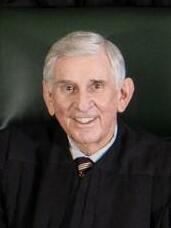
Currently serving · U.S. Court of Appeals for the Fourth Circuit
Robert Bruce King
Currently serving
Circuit Judge · U.S. Court of Appeals for the Fourth Circuit · 1998–present · Appointed by Bill Clinton
Robert Bruce King serves as a circuit judge of the U.S. Court of Appeals for the Fourth Circuit (1998–present). King was appointed by Bill Clinton.
Key facts
- Full name
- Robert Bruce King
- Court
- U.S. Court of Appeals for the Fourth Circuit
- Office
- Circuit Judge (U.S. Court of Appeals)
- Status
- Active circuit judge
- Duty status
- Active
- Appointment
- Senate-confirmed
- FJC seat
- CA40207
- Tenure
- 1998–present
- Confirmed
- 1998-10-08
- Born
- 1940
- Died
- —
- First year on the bench
- 1998
- Dataset version
- 1.20260705
Appointment & service record
U.S. Court of Appeals for the Fourth Circuit · 1998–present
- Seat
- CA40207
- Appointment
- Senate-confirmed
- Appointing president
- Bill Clinton
- Confirmed
- 1998-10-08
- Commissioned
- 1998-10-09
- Senior status
- —
Court, FJC seat, appointment type (Senate-confirmed or recess), appointing president, confirmation and commission dates, and senior-status date are drawn from the Federal Judicial Center Biographical Directory and Wikidata.[1][2][3]
Sources
- [1]https://www.fjc.gov/node/1390786fjc · retrieved 2026-07-05
- [2]https://www.fjc.gov/history/judges/biographical-directory-article-iii-federal-judges-exportfjc-directory · retrieved 2026-07-05
- [3]https://www.wikidata.org/wiki/Q7342454Wikidata · retrieved 2026-07-05
Biographical narrative
1,044 words · sourced from the Wikipedia REST extract
Robert Bruce King (born 1940) is an American jurist who has served as an active judge on the United States Court of Appeals for the Fourth Circuit since his appointment in 1998. Prior to joining the federal bench, he held a distinguished career that included service as United States Attorney for the Southern District of West Virginia, extensive private‑practice experience, and earlier work as an Assistant United States Attorney and law clerk. His professional life reflects long‑standing involvement in both criminal prosecution and civil litigation across state and federal courts.
Early life and legal career
Robert Bruce King was born in 1940 in White Sulphur Springs, West Virginia. He lost his father at the age of ten; his mother, Gladys, subsequently raised him and two siblings while working in a kitchen at The Greenbrier resort. Emphasizing hard work and education, she influenced King's later decision to endow a scholarship at West Virginia University in honor of her dedication.
King earned a Bachelor of Arts degree from West Virginia University in 1961. Following graduation he entered active duty with the United States Air Force, serving as an officer in the Office of Special Investigations until his discharge in 1964. Returning to Greenbrier County, he worked as a teacher, where he met fellow educator Julia Kay Doak; the two were married in April 1965.
Continuing his education, King enrolled at West Virginia University College of Law in 1966. While there he contributed to the West Virginia Law Review and served as president of the Student Bar Association, graduating with Order of the Coif honors in 1968. He began his legal career clerking for Judge John A. Field Jr. of the United States District Court for the Southern District of West Virginia, gaining early exposure to federal judicial processes.
After completing his clerkship, King joined the Lewisburg firm Haynes & Ford before returning to Charleston in 1970 to become an Assistant United States Attorney for the Southern District of West Virginia. During this period he participated in several high‑profile prosecutions. Notably, he was involved in a case concerning juror bribery linked to the 1968 trial of former Governor William Wallace Barron, which resulted in the governor’s guilty plea and lengthy prison sentence. King also led civil‑rights prosecutions against five Logan County officials accused of electoral fraud.
In 1974 King entered private practice with Spilman, Thomas, Battle & Klostermeyer in Charleston, attaining partnership the following year. While at the firm he served on the West Virginia State Bar’s Committee on Legal Ethics, investigating alleged ethical violations by attorneys and representing the committee before the state Supreme Court of Appeals.
President Jimmy Carter appointed King United States Attorney for the Southern District of West Virginia in 1977, a nomination that followed recommendation from Senator Robert Byrd. As U.S. Attorney, King directed investigations into white‑collar crime and public corruption, most prominently an inquiry into the state's liquor industry and Alcohol Beverage Control Commission. The investigation produced convictions of more than forty individuals and corporations on charges ranging from commercial bribery to mail fraud, extortion, and violations of the Racketeer Influenced and Corrupt Organizations Act.
After leaving federal service in 1981, King co‑founded the law firm King Betts & Allen (now known as Allen Guthrie McHugh & Thomas). He served as managing partner from 1981 to 1993 and again from 1997 until his judicial appointment. Over roughly three decades of practice he tried more than one hundred trials and argued numerous appeals, handling criminal matters such as public corruption, organized‑crime prosecutions, and electoral fraud, as well as civil actions involving wrongful death, personal injury, products liability, professional malpractice, and civil‑rights claims.
Federal appellate service
On June 24, 1998 President William J. Clinton nominated King to the United States Court of Appeals for the Fourth Circuit, filling a vacancy created when Judge Kenneth Keller Hall assumed senior status. The Senate Judiciary Committee held a hearing on September 9, 1998, during which Senator Robert Byrd highlighted King's integrity and dedication to public service. The full United States Senate confirmed King unanimously on October 8, 1998; he received his commission the following day.
Throughout his tenure on the Fourth Circuit, Judge King has participated in panels addressing a broad spectrum of federal issues, ranging from constitutional questions to complex statutory interpretations. In August 2021 he announced an intention to assume senior status contingent upon the confirmation of a successor, but withdrew that request in November of the same year and elected to remain an active judge. Media reports at the time noted differing preferences for his replacement: former U.S. Senator Carte Goodwin was reportedly favored by King, while the White House expressed support for attorney J. Jeaneen Legato.
Jurisprudence and legacy
Judge King's jurisprudential contributions reflect both his extensive trial experience and his background in federal prosecution. His opinions often exhibit careful attention to procedural fairness and statutory construction, consistent with a career spent navigating both criminal and civil litigation. While the Fourth Circuit’s decisions are issued collectively, King has authored or joined opinions that have shaped legal discourse on matters such as governmental authority, individual rights, and administrative regulation.
A notable example of his appellate work occurred on April 7, 2025, when he sat on a three‑judge panel that ordered the federal government to return Kilmar Abrego Garcia—an individual who had been mistakenly deported to El Salvador—to the United States. The decision underscored the court’s role in correcting administrative errors that affect fundamental liberties.
Beyond specific rulings, King’s legacy includes his influence on the legal community of West Virginia and the broader Fourth Circuit region. His early mentorship of law students, involvement with bar‑ethics committees, and long record of public‑service prosecution have been cited by colleagues as illustrative of a comprehensive understanding of the law’s practical and ethical dimensions. Observers note that his career trajectory—from clerkship through private practice, federal prosecution, and ultimately appellate service—provides a model of professional versatility within the American legal system.
As an active circuit judge, King continues to hear appeals from district courts in Maryland, North Carolina, South Carolina, Virginia, and West Virginia, contributing to the development of precedent that guides lower courts and shapes federal jurisprudence. His ongoing participation affirms a commitment to the rule of law cultivated over decades of varied legal experience.
Sources & provenance
Every quantitative or attributable claim above carries a per-section [N] marker that resolves to the corresponding URL below. Each entry records the upstream provider, the canonical URL, and the timestamp at which the underlying source was retrieved.
Key facts
- https://www.fjc.gov/node/1390786fjc · retrieved 2026-07-05
- https://www.fjc.gov/history/judges/biographical-directory-article-iii-federal-judges-exportfjc-directory · retrieved 2026-07-05
- https://www.wikidata.org/wiki/Q7342454Wikidata · retrieved 2026-07-05
Biographical narrative
- https://en.wikipedia.org/wiki/Robert_Bruce_KingWikipedia · retrieved 2026-07-05
Explore the federal judiciary
The U.S. Courts of Appeals are the intermediate appellate courts of the federal judiciary — thirteen circuits sitting between the district courts and the Supreme Court. Browse the full roster of judges on the U.S. Court of Appeals for the Fourth Circuit, or explore how the appointed federal judiciary fits into the federal government.