
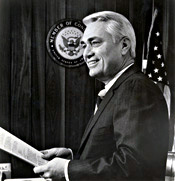
Historical · U.S. Court of Appeals for the Ninth Circuit
Charles Edward Wiggins
Former Circuit Judge · U.S. Court of Appeals for the Ninth Circuit · 1984–2000 · Appointed by Ronald Reagan
Charles Edward Wiggins served as a circuit judge of the U.S. Court of Appeals for the Ninth Circuit (1984–2000). Wiggins was appointed by Ronald Reagan.
Key facts
- Full name
- Charles Edward Wiggins
- Court
- U.S. Court of Appeals for the Ninth Circuit
- Office
- Circuit Judge (U.S. Court of Appeals)
- Status
- Former circuit judge
- Duty status
- Not serving
- Appointment
- Senate-confirmed
- FJC seat
- CA92501
- Tenure
- 1984–2000
- Confirmed
- 1984-10-03
- Born
- 1927-12-03
- Died
- 2000-03-02
- First year on the bench
- 1984
- Dataset version
- 1.20260711
Appointment & service record
U.S. Court of Appeals for the Ninth Circuit · 1984–1996
- Seat
- CA92501
- Appointment
- Senate-confirmed
- Appointing president
- Ronald Reagan
- Confirmed
- 1984-10-03
- Commissioned
- 1984-10-11
- Senior status
- 1996-12-31
Court, FJC seat, appointment type (Senate-confirmed or recess), appointing president, confirmation and commission dates, and senior-status date are drawn from the Federal Judicial Center Biographical Directory and Wikidata.[1][2][3]
Sources
- [1]https://www.fjc.gov/node/1389741fjc · retrieved 2026-07-11
- [2]https://www.fjc.gov/history/judges/biographical-directory-article-iii-federal-judges-exportfjc-directory · retrieved 2026-07-11
- [3]https://www.wikidata.org/wiki/Q992029Wikidata · retrieved 2026-07-11
Biographical narrative
1,230 words · sourced from the Wikipedia REST extract
Charles Edward Wiggins was a United States circuit judge who served on the United States Court of Appeals for the Ninth Circuit from 1984 to 1996. Before his appointment to the federal bench, he served twelve years as a member of the United States House of Representatives from California and held various local government positions in El Monte, California. Born in 1927, he is perhaps best remembered for his role during the Watergate crisis, when he initially defended President Richard Nixon during impeachment proceedings before ultimately concluding that the evidence warranted Nixon's resignation. President Ronald Reagan, a Republican, appointed him to the Ninth Circuit in 1984, where he served until taking senior status in 1996. He passed away in 2000.
Early life and legal career
Charles Edward Wiggins was born on December 3, 1927, in El Monte, California, where he attended the local public schools. His early adulthood was marked by military service; he served as a First Lieutenant in the United States Army during the post-World War II period, with his service spanning from 1945 to 1948 and resuming from 1950 to 1952. Following his military obligations, Wiggins pursued higher education at the University of Southern California, earning a Bachelor of Science degree in 1953. He continued his studies at the University of Southern California Law School, where he obtained his Bachelor of Laws degree in 1956.
After completing his legal education, Wiggins gained practical experience by serving as a law clerk to Judge Swain of the Appellate Division of the Los Angeles Superior Court. This clerkship provided him with valuable insight into the California judicial system and appellate practice. In 1957, he entered private practice in his hometown of El Monte, establishing himself as a practicing attorney in the community where he had grown up.
Wiggins's career was characterized by significant involvement in local government even before his entry into Congress. Beginning in 1954, while still pursuing his law degree, he served as a member of the El Monte Planning Commission, a position he held until 1960. His commitment to public service at the municipal level continued when he was elected as an El Monte Councilman, serving from 1960 to 1964. His leadership in local government culminated in his tenure as mayor of El Monte from 1964 to 1966, providing him with executive experience that would prove valuable in his subsequent political career.
Wiggins's congressional career began when he was elected to the United States House of Representatives. He won election to the Ninetieth Congress and continued to serve through five succeeding Congresses, representing California constituents from January 3, 1967, through January 3, 1979. Initially elected to represent California's 25th congressional district, he later represented the 39th congressional district after redistricting prior to the 1974 election. The territory he represented included much of the same area that Richard Nixon had represented during Nixon's own House service from 1947 to 1950.
His congressional service became nationally prominent during the Watergate scandal and the subsequent impeachment proceedings against President Nixon. Wiggins served on the House Judiciary Committee during the impeachment deliberations and initially mounted a vigorous defense of the president. However, his position shifted dramatically following the disclosure of what became known as the "Smoking Gun" tape. Prior to the public release of this recording, Wiggins had been invited to the White House by Chief of Staff Alexander Haig to review the transcripts. After examining this evidence, he reached the conclusion that the material demonstrated Nixon's participation in a plan to cover up the Watergate break-in and related illegal activities.
In a public statement, Wiggins acknowledged that the newly revealed facts had changed his understanding of the situation. He stated that the evidence showed Nixon had developed a plan of action to cover up the break-in, which Wiggins believed constituted legally sufficient proof of a conspiracy to obstruct justice. Although he believed competent legal counsel might offer an innocent explanation for Nixon's conduct in a Senate trial, Wiggins concluded that a prolonged impeachment trial would not serve the national interest. Consequently, he urged Nixon to resign and allow Vice President Gerald Ford to assume the presidency. Wiggins made clear that if Nixon refused to resign, he was prepared to vote for impeachment on the obstruction of justice charge, though he expressed reservations about supporting other articles of impeachment due to concerns about establishing unfortunate historical precedents. His change of position proved influential, as several other Republican members of the Judiciary Committee followed his lead. The New York Times emphasized this development in its coverage, highlighting Wiggins's shift and the other Republicans who joined him.
The political fallout from his involvement in the Nixon impeachment proceedings affected his electoral performance. His margin of victory in the 1974 congressional elections was notably reduced compared to previous campaigns. He was reelected in 1976, but chose not to seek reelection to the Ninety-sixth Congress in 1978. Following his departure from Congress, Wiggins returned to private legal practice, working in Los Angeles from 1979 to 1982, then in Washington, D.C., from 1982 to 1984, and briefly in San Francisco in 1984 before his judicial appointment.
Federal appellate service
On August 1, 1984, President Ronald Reagan nominated Wiggins to serve as a circuit judge on the United States Court of Appeals for the Ninth Circuit. The position was a newly created seat authorized by legislation. The United States Senate confirmed his nomination on October 3, 1984, and he received his commission on October 11, 1984, officially beginning his service on the federal appellate bench.
Wiggins served as an active circuit judge on the Ninth Circuit for over twelve years. The Ninth Circuit, which covers the western United States and is the largest of the federal appellate circuits by geographic area and caseload, provided Wiggins with a broad range of cases spanning numerous areas of federal law. On December 31, 1996, he assumed senior status, a form of semi-retirement that allows federal judges to continue hearing cases on a reduced schedule while creating a vacancy for a new active judge to be appointed. He continued to serve in senior status until his death.
Jurisprudence and legacy
Wiggins brought to the federal bench extensive experience in both legislative and executive functions of government, having served in Congress for twelve years and as a municipal executive. His background in local government, congressional service, and private practice provided him with a diverse perspective on legal and policy matters that came before the Ninth Circuit.
His judicial service spanned a period of significant development in federal law, and his experience on the House Judiciary Committee during one of the most consequential constitutional crises in American history gave him unique insight into questions of governmental accountability and the separation of powers. His willingness to change his position on the Nixon impeachment based on new evidence demonstrated a commitment to following facts and law even when politically difficult, a quality that likely informed his approach to judicial decision-making.
Wiggins died of cardiac arrest on March 2, 2000, in Las Vegas, Nevada. In recognition of his military service and public service to the nation, he was buried in Arlington National Cemetery. A cenotaph monument was also placed at Savannah Memorial Park in Rosemead, California. His career encompassed service at the local, national legislative, and federal judicial levels, reflecting a sustained commitment to public service across multiple decades and branches of government.
Sources & provenance
Every quantitative or attributable claim above carries a per-section [N] marker that resolves to the corresponding URL below. Each entry records the upstream provider, the canonical URL, and the timestamp at which the underlying source was retrieved.
Key facts
- https://www.fjc.gov/node/1389741fjc · retrieved 2026-07-11
- https://www.fjc.gov/history/judges/biographical-directory-article-iii-federal-judges-exportfjc-directory · retrieved 2026-07-11
- https://www.wikidata.org/wiki/Q992029Wikidata · retrieved 2026-07-11
Biographical narrative
- https://en.wikipedia.org/wiki/Charles_E._WigginsWikipedia · retrieved 2026-07-11
Explore the federal judiciary
The U.S. Courts of Appeals are the intermediate appellate courts of the federal judiciary — thirteen circuits sitting between the district courts and the Supreme Court. Browse the full roster of judges on the U.S. Court of Appeals for the Ninth Circuit, or explore how the appointed federal judiciary fits into the federal government.