
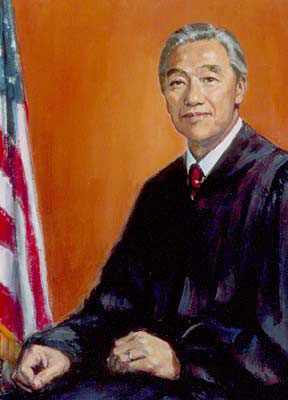
Historical · U.S. Court of Appeals for the Ninth Circuit
Herbert Young Cho Choy
Former Circuit Judge · U.S. Court of Appeals for the Ninth Circuit · 1971–2004 · Appointed by Richard Nixon
Herbert Young Cho Choy served as a circuit judge of the U.S. Court of Appeals for the Ninth Circuit (1971–2004). Choy was appointed by Richard Nixon.
Key facts
- Full name
- Herbert Young Cho Choy
- Court
- U.S. Court of Appeals for the Ninth Circuit
- Office
- Circuit Judge (U.S. Court of Appeals)
- Status
- Former circuit judge
- Duty status
- Not serving
- Appointment
- Senate-confirmed
- FJC seat
- CA90504
- Tenure
- 1971–2004
- Confirmed
- 1971-04-21
- Born
- 1916-01-06
- Died
- 2004-03-10
- First year on the bench
- 1971
- Dataset version
- 1.20260711
Appointment & service record
U.S. Court of Appeals for the Ninth Circuit · 1971–1984
- Seat
- CA90504
- Appointment
- Senate-confirmed
- Appointing president
- Richard Nixon
- Confirmed
- 1971-04-21
- Commissioned
- 1971-04-23
- Senior status
- 1984-10-03
Court, FJC seat, appointment type (Senate-confirmed or recess), appointing president, confirmation and commission dates, and senior-status date are drawn from the Federal Judicial Center Biographical Directory and Wikidata.[1][2][3]
Sources
- [1]https://www.fjc.gov/node/1379086fjc · retrieved 2026-07-11
- [2]https://www.fjc.gov/history/judges/biographical-directory-article-iii-federal-judges-exportfjc-directory · retrieved 2026-07-11
- [3]https://www.wikidata.org/wiki/Q5733798Wikidata · retrieved 2026-07-11
Biographical narrative
1,153 words · sourced from the Wikipedia REST extract
Herbert Young Cho Choy was a United States circuit judge who served on the United States Court of Appeals for the Ninth Circuit from 1971 to 1984, when he assumed senior status and continued serving until his death in 2004. Born in 1916 in Hawaii to Korean immigrant parents, he made history as the first Asian American to serve as a United States federal judge and the first person of Korean ancestry to be admitted to the bar in the United States. Appointed to the federal appellate bench by President Richard M. Nixon, a Republican, Choy's judicial career represented a significant milestone in the diversification of the federal judiciary and the recognition of Asian Americans in the legal profession.
Early life and legal career
Herbert Young Cho Choy was born on January 6, 1916, in Makaweli, located on the island of Kauai in what was then the Territory of Hawaii. His parents were Korean immigrants who labored in Hawaii's sugar plantations, part of the substantial wave of Korean immigration to Hawaii in the early twentieth century. Growing up in this working-class immigrant community, Choy pursued his education in Hawaii, ultimately earning a Bachelor of Arts degree from the University of Hawaii in 1938. He then traveled to the mainland United States to attend Harvard Law School, one of the nation's most prestigious legal institutions, where he received his Juris Doctor degree in 1941.
Following his graduation from law school, Choy's early career was interrupted by World War II. He served in the Hawaii Territorial Guard from 1941 to 1942, during the critical period immediately following the attack on Pearl Harbor. He subsequently entered the United States Army, serving from 1942 to 1946. In 1946, he served in the Judge Advocate General's Corps, the legal branch of the military, where he gained valuable experience in military law and procedure.
After completing his military service in 1946, Choy returned to civilian life and established himself in private legal practice in Honolulu, Hawaii, where he would practice for the next quarter-century until his appointment to the federal bench. When he was admitted to the bar, he became the first person of Korean ancestry to be admitted to the practice of law in the United States, breaking a significant barrier for Korean Americans in the legal profession. From 1947 to 1957, he practiced with the law firm of Fong Miho Choy & Robinson. Among his law partners was Hiram Fong, who would later become a United States Senator from Hawaii, representing the state after it achieved statehood in 1959. This professional relationship would prove significant in Choy's later appointment to the federal judiciary.
Choy's legal career expanded beyond private practice when he accepted a position in territorial government. From 1957 to 1958, he served as Attorney General for the Territory of Hawaii, the chief legal officer for the territorial government. This role placed him at the center of legal affairs during a pivotal period in Hawaii's history, just before the territory's transition to statehood. His service as Attorney General demonstrated his capabilities in public law and government administration, complementing his extensive experience in private practice.
Federal appellate service
Choy's appointment to the federal judiciary came through the recommendation of Senator Hiram Fong, his former law partner. President Richard M. Nixon nominated Choy on April 7, 1971, to fill a seat on the United States Court of Appeals for the Ninth Circuit that had been vacated by Judge Stanley Barnes. The nomination moved swiftly through the confirmation process, with the United States Senate confirming Choy on April 21, 1971. He received his commission two days later, on April 23, 1971, and began his service on the nation's largest federal appellate court.
The appointment was groundbreaking in multiple respects. Choy became the first Asian American to serve as a United States federal judge, opening the door for future Asian American jurists in the federal court system. He was also the first native of Hawaii to serve on the federal appellate bench, representing his island home at the national level. These historic firsts came during a period of gradual diversification of the federal judiciary, though progress remained slow in the early 1970s.
Choy served as an active circuit judge on the Ninth Circuit for thirteen years. The Ninth Circuit, which covers the western United States including Alaska, Hawaii, and several mainland states, is known for its large and diverse caseload. During his tenure as an active judge, Choy participated in the court's work reviewing appeals from federal district courts and administrative agencies across this vast geographic area.
On October 3, 1984, Choy assumed senior status, a form of semi-retirement available to federal judges who meet certain age and service requirements. Senior status allowed him to continue hearing cases on a reduced schedule while creating a vacancy for a new active judge to be appointed. He continued to serve the court in senior status for two decades, maintaining his connection to the federal judiciary until his death on March 10, 2004, which terminated his judicial service after more than thirty-three years on the bench.
Jurisprudence and legacy
Choy's legacy extends beyond his individual judicial work to his role as a pioneer who opened pathways for others. His appointment demonstrated that Asian Americans could serve at the highest levels of the federal judiciary, challenging prevailing assumptions about who could hold such positions. The significance of his appointment was recognized both within the legal community and among Asian American communities across the United States.
The impact of Choy's trailblazing appointment can be seen in subsequent appointments of Asian Americans to the federal bench. His presence on the Ninth Circuit helped normalize the idea of diversity on federal appellate courts. One tangible connection to this legacy came in 2001, when Richard Clifton, who had served as one of Choy's law clerks, became the second judge from Hawaii to serve on the Ninth Circuit. This connection illustrated how Choy's service created opportunities for mentorship and advancement of future generations of legal professionals.
Choy's personal life reflected his deep roots in Hawaii. He married Dorothy Helen Shular, known as Henny, on June 19, 1945, during the final months of World War II. The couple did not have children but maintained their life together in Honolulu throughout Choy's legal and judicial career.
Choy died in Honolulu on March 10, 2004, from complications related to pneumonia. He was eighty-eight years old and had served on the federal bench for more than three decades. His death marked the end of a judicial career that had spanned from the early 1970s into the twenty-first century, a period of tremendous change in American law and society. His historic role as the first Asian American federal judge and the first Korean American lawyer in the United States ensured that his contributions would be remembered as part of the broader story of diversification and inclusion in the American legal system.
Sources & provenance
Every quantitative or attributable claim above carries a per-section [N] marker that resolves to the corresponding URL below. Each entry records the upstream provider, the canonical URL, and the timestamp at which the underlying source was retrieved.
Key facts
- https://www.fjc.gov/node/1379086fjc · retrieved 2026-07-11
- https://www.fjc.gov/history/judges/biographical-directory-article-iii-federal-judges-exportfjc-directory · retrieved 2026-07-11
- https://www.wikidata.org/wiki/Q5733798Wikidata · retrieved 2026-07-11
Biographical narrative
- https://en.wikipedia.org/wiki/Herbert_ChoyWikipedia · retrieved 2026-07-11
Explore the federal judiciary
The U.S. Courts of Appeals are the intermediate appellate courts of the federal judiciary — thirteen circuits sitting between the district courts and the Supreme Court. Browse the full roster of judges on the U.S. Court of Appeals for the Ninth Circuit, or explore how the appointed federal judiciary fits into the federal government.