
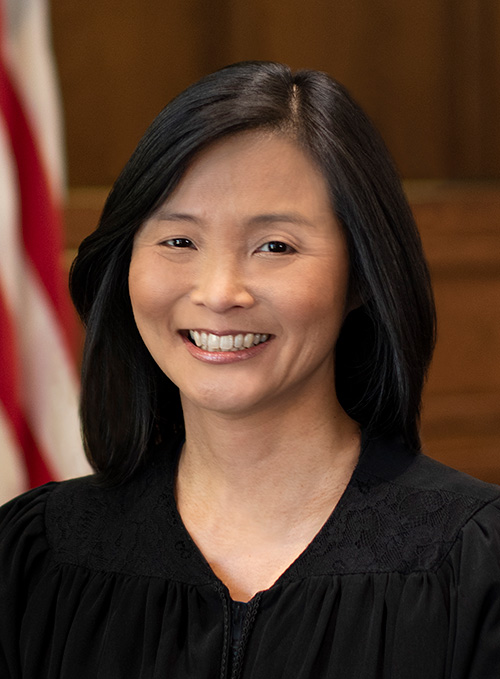
Currently serving · U.S. Court of Appeals for the Ninth Circuit
Jennifer Sung
Currently serving
Circuit Judge · U.S. Court of Appeals for the Ninth Circuit · 2021–present · Appointed by Joe Biden
Jennifer Sung serves as a circuit judge of the U.S. Court of Appeals for the Ninth Circuit (2021–present). Sung was appointed by Joe Biden.
Key facts
- Full name
- Jennifer Sung
- Court
- U.S. Court of Appeals for the Ninth Circuit
- Office
- Circuit Judge (U.S. Court of Appeals)
- Status
- Active circuit judge
- Duty status
- Active
- Appointment
- Senate-confirmed
- FJC seat
- CA91604
- Tenure
- 2021–present
- Confirmed
- 2021-12-15
- Born
- 1972
- Died
- —
- First year on the bench
- 2021
- Dataset version
- 1.20260705
Appointment & service record
U.S. Court of Appeals for the Ninth Circuit · 2021–present
- Seat
- CA91604
- Appointment
- Senate-confirmed
- Appointing president
- Joe Biden
- Confirmed
- 2021-12-15
- Commissioned
- 2021-12-20
- Senior status
- —
Court, FJC seat, appointment type (Senate-confirmed or recess), appointing president, confirmation and commission dates, and senior-status date are drawn from the Federal Judicial Center Biographical Directory and Wikidata.[1][2][3]
Sources
- [1]https://www.fjc.gov/node/11201336fjc · retrieved 2026-07-05
- [2]https://www.fjc.gov/history/judges/biographical-directory-article-iii-federal-judges-exportfjc-directory · retrieved 2026-07-05
- [3]https://www.wikidata.org/wiki/Q107380107Wikidata · retrieved 2026-07-05
Biographical narrative
1,049 words · sourced from the Wikipedia REST extract
Jennifer Sung (born 1972) serves as an active circuit judge on the United States Court of Appeals for the Ninth Circuit. Appointed by President Joseph R. Biden, she has been a member of the federal appellate bench since December 2021 and is noted as Oregon’s first Asian Pacific American to sit on the Ninth Circuit. Her career spans experience in labor organizing, civil‑rights advocacy, private practice, and state administrative adjudication before her elevation to the federal judiciary.
Early life and legal career
Jennifer Sung was born in 1972 in Edison, New Jersey, into a Chinese‑American family. She pursued undergraduate studies at Oberlin College, where she earned a Bachelor of Arts degree with honors in politics in 1994. Following graduation, Sung entered the labor movement, working as an organizer for the Service Employees International Union from 1994 until 2001. This period provided her with direct experience in collective‑bargaining issues and workers’ rights advocacy.
Seeking to transition into law, Sung enrolled at Yale Law School and received her Juris Doctor in 2004. Upon completing her legal education, she served a one‑year clerkship with Judge Betty Binns Fletcher of the Ninth Circuit (2004–2005), gaining insight into appellate procedures and judicial reasoning at the federal level.
From 2005 to 2007, Sung was awarded a Skadden Fellowship, which placed her at the Brennan Center for Justice within New York University School of Law. In this capacity she contributed to research and policy work focused on civil liberties and democratic reforms. After completing the fellowship, she entered private practice in California, joining Altshuler Berzon LLP in San Francisco where she worked from 2007 through 2013. Her practice during these years involved complex litigation matters, including employment and civil‑rights issues.
In 2013 Sung relocated to Portland, Oregon, becoming a partner at McKanna Bishop Joffe. She remained with the firm until 2017, continuing to handle appellate and trial work while also engaging in pro bono activities. On July 1 2017 she transitioned from private practice to public service by accepting an appointment to the Oregon Employment Relations Board. As a board member, Sung participated in adjudicating disputes involving state labor relations, collective‑bargaining agreements, and employer‑employee matters until her departure on December 20 2021, shortly after receiving her federal commission.
Federal appellate service
President Joseph R. Biden announced his intent to nominate Sung to the Ninth Circuit on June 30 2021. The nomination was formally transmitted to the United States Senate on July 13 2021, designating her as the successor to Judge Susan P. Graber, who had indicated plans to assume senior status upon confirmation of a replacement.
Sung’s confirmation process began with a hearing before the Senate Judiciary Committee on September 14 2021. During the session, committee members inquired about Sung’s prior involvement in a public letter concerning then‑Supreme Court nominee Brett Kavanaugh. While acknowledging that portions of the letter employed strong language, she did not retract her earlier statements nor provide an explicit assessment of Kavanaugh’s qualifications.
The Judiciary Committee was unable to report the nomination favorably, resulting in a tie vote of 10–10 on October 21 2021. Consequently, the full Senate exercised its procedural authority to discharge the nomination from the committee on November 3 2021. The motion succeeded with an evenly split vote of 49–49, and Vice President Kamala Harris cast the deciding ballot.
Subsequent Senate actions moved toward final confirmation. Majority Leader Chuck Schumer filed a cloture petition on December 7 2021 to limit further debate. The Senate invoked cloture two days later by a vote of 48–39, thereby setting the stage for an up‑or‑down vote on the nomination. On December 15 2021, Sung was confirmed by a narrow margin of 50–49. She received her judicial commission five days later, on December 20 2021, and officially entered active service on the Ninth Circuit.
Since joining the bench, Judge Sung has participated in numerous panels addressing a range of legal issues within the circuit’s jurisdiction, which encompasses several western states and territories. Her contributions reflect both her background in labor law and her experience with civil‑rights matters.
Jurisprudence and legacy
Judge Sung’s judicial record to date includes participation in high‑profile appellate decisions that illustrate her approach to statutory interpretation and constitutional analysis. On September 26 2022, she authored a dissenting opinion in an en banc hearing where the majority, by an 8–3 vote, held California’s Assembly Bill 32—legislation prohibiting private for‑profit prison and immigration detention facilities—to be unconstitutional. Sung’s dissent signaled disagreement with the majority’s reading of state authority over correctional enterprises.
In a separate matter concerning public order and federal authority, Judge Sung joined a unanimous three‑judge panel that upheld the Trump administration’s decision to deploy National Guard troops to address civil unrest in Los Angeles. The ruling affirmed the executive branch’s discretion to use military resources despite objections raised by California Governor Gavin Newsom, underscoring deference to federal emergency powers.
More recently, on August 1 2025, Judge Sung authored an opinion that barred U.S. Immigration and Customs Enforcement (ICE) from detaining individuals based solely on characteristics such as race, language, accent, occupation, or geographic location. This decision emphasized the constitutional limits on discriminatory governmental action and reinforced protections against arbitrary detention.
Through these opinions, Judge Sung has contributed to the development of Ninth Circuit jurisprudence in areas ranging from state regulatory authority over private detention facilities to the scope of federal executive power and the protection of individual rights against discriminatory enforcement practices. Her background as a labor organizer, civil‑rights fellow, and state adjudicator informs a perspective attentive to both procedural fairness and substantive legal principles.
As the first Asian Pacific American from Oregon appointed to the Ninth Circuit, Judge Sung’s presence on the federal appellate bench adds to the demographic diversity of the judiciary. While her tenure is still in its early stages, her participation in significant rulings and her professional trajectory—from union organizing through private practice to state administrative service—illustrate a career marked by engagement with complex legal issues across multiple sectors.
Judge Sung continues to serve actively on the Ninth Circuit, hearing appeals that shape federal law for millions of residents within the circuit’s expansive jurisdiction. Her contributions are expected to influence the interpretation of statutes and constitutional provisions for years to come, reflecting both her legal expertise and the broader evolution of the federal judiciary.
Sources & provenance
Every quantitative or attributable claim above carries a per-section [N] marker that resolves to the corresponding URL below. Each entry records the upstream provider, the canonical URL, and the timestamp at which the underlying source was retrieved.
Key facts
- https://www.fjc.gov/node/11201336fjc · retrieved 2026-07-05
- https://www.fjc.gov/history/judges/biographical-directory-article-iii-federal-judges-exportfjc-directory · retrieved 2026-07-05
- https://www.wikidata.org/wiki/Q107380107Wikidata · retrieved 2026-07-05
Biographical narrative
- https://en.wikipedia.org/wiki/Jennifer_SungWikipedia · retrieved 2026-07-05
Explore the federal judiciary
The U.S. Courts of Appeals are the intermediate appellate courts of the federal judiciary — thirteen circuits sitting between the district courts and the Supreme Court. Browse the full roster of judges on the U.S. Court of Appeals for the Ninth Circuit, or explore how the appointed federal judiciary fits into the federal government.