
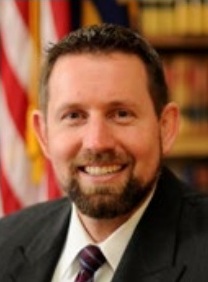
Currently serving · U.S. Court of Appeals for the Ninth Circuit
Lawrence James Christopher VanDyke
Currently serving
Circuit Judge · U.S. Court of Appeals for the Ninth Circuit · 2020–present · Appointed by Donald Trump
Lawrence James Christopher VanDyke serves as a circuit judge of the U.S. Court of Appeals for the Ninth Circuit (2020–present). VanDyke was appointed by Donald Trump.
Key facts
- Full name
- Lawrence James Christopher VanDyke
- Court
- U.S. Court of Appeals for the Ninth Circuit
- Office
- Circuit Judge (U.S. Court of Appeals)
- Status
- Active circuit judge
- Duty status
- Active
- Appointment
- Senate-confirmed
- FJC seat
- CA90705
- Tenure
- 2020–present
- Confirmed
- 2019-12-11
- Born
- 1972
- Died
- —
- First year on the bench
- 2020
- Dataset version
- 1.20260705
Appointment & service record
U.S. Court of Appeals for the Ninth Circuit · 2020–present
- Seat
- CA90705
- Appointment
- Senate-confirmed
- Appointing president
- Donald Trump
- Confirmed
- 2019-12-11
- Commissioned
- 2020-01-02
- Senior status
- —
Court, FJC seat, appointment type (Senate-confirmed or recess), appointing president, confirmation and commission dates, and senior-status date are drawn from the Federal Judicial Center Biographical Directory and Wikidata.[1][2][3]
Sources
- [1]https://www.fjc.gov/node/7504281fjc · retrieved 2026-07-05
- [2]https://www.fjc.gov/history/judges/biographical-directory-article-iii-federal-judges-exportfjc-directory · retrieved 2026-07-05
- [3]https://www.wikidata.org/wiki/Q68224505Wikidata · retrieved 2026-07-05
Biographical narrative
1,257 words · sourced from the Wikipedia REST extract
Lawrence James Christopher VanDyke (born 1972) is an American attorney who has served as a United States circuit judge on the Ninth Circuit Court of Appeals since 2020. Prior to his appointment, he held the position of solicitor general for both Nevada and Montana, worked in private practice at a major law firm, and clerked for a federal appellate judge. His career has included extensive involvement in appellate advocacy, pro‑bono representation, and service within the Department of Justice’s Environment and Natural Resources Division.
Early life and legal career
Lawrence VanDyke was born in 1972 in Midland, Texas, and spent his formative years in Bozeman, Montana. He began his post‑secondary education at Oklahoma Christian University from 1992 to 1995 before transferring to Montana State University, where he pursued civil engineering. He earned a Bachelor of Science with highest honors in 1997 and subsequently worked for his family’s construction business while continuing graduate studies at the same institution. In 2000, VanDyke completed a Master of Construction Engineering Management.
Following his technical training, VanDyke turned to theological study, graduating summa cum laude with a Bachelor of Theology from Bear Valley Bible Institute in Denver, Colorado, in 2002. He then enrolled at Harvard Law School, where he contributed as an editor to both the Harvard Law Review and the Harvard Journal of Law and Public Policy. He graduated magna cum laude with a Juris Doctor in 2005.
VanDyke’s early legal experience began at the law firm Gibson Dunn, where he worked from 2005 until 2006. He then served as a law clerk to Judge Janice Rogers Brown on the United States Court of Appeals for the District of Columbia Circuit during the 2006‑2007 term. After completing his clerkship, VanDyke returned to Gibson Dunn and remained there through 2012. While in private practice, he performed pro bono work for organizations such as the American Civil Liberties Union, the Free Market Foundation, and the Alliance Defending Freedom. In 2010, he filed an amicus brief in *Christian Legal Society v. Martinez* on behalf of Gays and Lesbians for Individual Liberty, arguing that a student organization possessed a First Amendment right to limit membership based on conduct consistent with its stated beliefs.
From 2012 to 2013 VanDyke served as an assistant to the Solicitor General of Texas. He was subsequently appointed solicitor general of Montana, a role he held from 2013 until his resignation in 2014, which he attributed to workplace strain. While representing Montana, he submitted numerous amicus curiae briefs on behalf of other states, advocated for joining challenges to state and federal gun regulations, co‑authored a brief supporting an Arizona statute that prohibited abortions after twenty weeks of gestation, and recommended that Montana intervene in a New Mexico case involving a photographer who declined to photograph a lesbian commitment ceremony.
In 2014 VanDyke sought election to the Montana Supreme Court but was defeated by incumbent Justice Mike Wheat. The following year he became solicitor general of Nevada under Attorney General Adam Laxalt, a position he occupied until 2019. During his tenure in Nevada, he oversaw appellate advocacy on behalf of the state and contributed to its legal strategy in federal courts. In early 2019 VanDyke transitioned to the United States Department of Justice as a deputy assistant attorney general within the Environment and Natural Resources Division. Throughout his career, he has been an active member of the Federalist Society.
Federal appellate service
President Donald J. Trump announced his intent to nominate VanDyke to the United States Court of Appeals for the Ninth Circuit on September 20 2019. The nomination was intended to fill the vacancy created by Judge Jay Bybee’s decision to assume senior status at the end of 2019. Both Nevada senators, Jacky Rosen and Catherine Cortez Masto, publicly expressed opposition to the nomination, as did six retired justices of the Montana Supreme Court.
The American Bar Association evaluated VanDyke’s qualifications and issued a “not qualified” rating. The ABA’s assessment was based on interviews with attorneys, judges, and others who had worked with him; evaluators reported observations describing him in terms such as “arrogant,” “lazy,” and “ideological.” The evaluation also raised concerns about his temperament, humility, openness to differing viewpoints, and potential fairness toward members of the LGBTQ community. The ABA’s lead evaluator was identified as having contributed financially to VanDyke’s opponent in the 2014 Montana Supreme Court race.
A confirmation hearing before the Senate Judiciary Committee took place on October 30 2019. The proceedings focused heavily on VanDyke’s record concerning LGBTQ issues, including his prior amicus brief and statements made during his earlier career. During questioning, Senator Josh Hawley asked whether VanDyke had indicated an inability to be fair to LGBTQ litigants; VanDyke responded emotionally, denying the allegation and emphasizing a belief that all individuals are created in the image of God and deserve dignity and respect. Senator Patrick Leahy also queried VanDyke about an op‑ed he authored while at Harvard Law School in 2004, which suggested that same‑sex marriage might be harmful to children; VanDyke acknowledged that some of his personal views had evolved since that time.
Despite the contentious hearing and the ABA’s rating, the Senate confirmed VanDyke on December 11 2019. He received his commission and began active service on the Ninth Circuit in 2020, occupying the seat previously held by Judge Bybee.
Jurisprudence and legacy
Since joining the Ninth Circuit, Judge VanDyke has participated in a broad array of appellate decisions covering federal law, constitutional issues, and matters specific to the circuit’s jurisdiction. While detailed statistics on his authored opinions are not provided in the source material, his prior experience as solicitor general for two states suggests a strong background in representing governmental interests before appellate courts. His earlier work filing amicus briefs on contentious cultural and policy topics indicates an engagement with First Amendment jurisprudence and issues related to reproductive rights, gun regulation, and LGBTQ matters.
The confirmation process highlighted divergent perspectives on VanDyke’s judicial temperament and ideological orientation. Critics pointed to the ABA’s “not qualified” rating and the language used by evaluators as evidence of concerns regarding impartiality and professionalism. Supporters emphasized his extensive appellate experience, scholarly credentials—including editorial roles at prominent law journals—and longstanding involvement with the Federalist Society, an organization that promotes a textualist and originalist approach to constitutional interpretation.
VanDyke’s career trajectory—from engineering and construction management studies through theological education, elite legal training, private practice, state‑level appellate advocacy, and finally federal judicial service—illustrates a multidisciplinary background uncommon among federal judges. His work in both Nevada and Montana as solicitor general placed him at the forefront of defending state statutes before the United States Supreme Court and other federal courts, shaping legal arguments on issues ranging from environmental regulation to civil liberties.
The legacy of Judge VanDyke’s tenure will likely be assessed through his contributions to Ninth Circuit jurisprudence, particularly in areas where the circuit often leads national legal developments, such as immigration, environmental law, and technology‑related disputes. Observers may also consider how his earlier public positions on socially contentious topics influence perceptions of his decision‑making process. As an active judge, his ongoing opinions will continue to add to the body of federal appellate precedent and inform debates about the role of personal belief in judicial reasoning.
Overall, Lawrence J. C. VanDyke’s professional path reflects a blend of technical expertise, theological study, high‑level legal advocacy, and federal judicial service. His appointment to the Ninth Circuit marks the culmination of decades of involvement in both state and national legal arenas, positioning him as a notable figure within the contemporary federal judiciary.
Sources & provenance
Every quantitative or attributable claim above carries a per-section [N] marker that resolves to the corresponding URL below. Each entry records the upstream provider, the canonical URL, and the timestamp at which the underlying source was retrieved.
Key facts
- https://www.fjc.gov/node/7504281fjc · retrieved 2026-07-05
- https://www.fjc.gov/history/judges/biographical-directory-article-iii-federal-judges-exportfjc-directory · retrieved 2026-07-05
- https://www.wikidata.org/wiki/Q68224505Wikidata · retrieved 2026-07-05
Biographical narrative
- https://en.wikipedia.org/wiki/Lawrence_VanDykeWikipedia · retrieved 2026-07-05
Explore the federal judiciary
The U.S. Courts of Appeals are the intermediate appellate courts of the federal judiciary — thirteen circuits sitting between the district courts and the Supreme Court. Browse the full roster of judges on the U.S. Court of Appeals for the Ninth Circuit, or explore how the appointed federal judiciary fits into the federal government.