
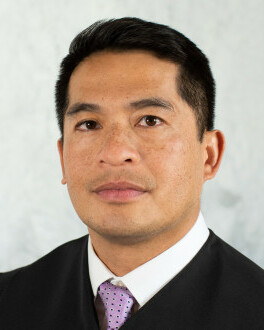
Currently serving · U.S. Court of Appeals for the Ninth Circuit
Patrick Joseph Bumatay
Currently serving
Circuit Judge · U.S. Court of Appeals for the Ninth Circuit · 2019–present · Appointed by Donald Trump
Patrick Joseph Bumatay serves as a circuit judge of the U.S. Court of Appeals for the Ninth Circuit (2019–present). Bumatay was appointed by Donald Trump.
Key facts
- Full name
- Patrick Joseph Bumatay
- Court
- U.S. Court of Appeals for the Ninth Circuit
- Office
- Circuit Judge (U.S. Court of Appeals)
- Status
- Active circuit judge
- Duty status
- Active
- Appointment
- Senate-confirmed
- FJC seat
- CA92503
- Tenure
- 2019–present
- Confirmed
- 2019-12-10
- Born
- 1978
- Died
- —
- First year on the bench
- 2019
- Dataset version
- 1.20260705
Appointment & service record
U.S. Court of Appeals for the Ninth Circuit · 2019–present
- Seat
- CA92503
- Appointment
- Senate-confirmed
- Appointing president
- Donald Trump
- Confirmed
- 2019-12-10
- Commissioned
- 2019-12-12
- Senior status
- —
Court, FJC seat, appointment type (Senate-confirmed or recess), appointing president, confirmation and commission dates, and senior-status date are drawn from the Federal Judicial Center Biographical Directory and Wikidata.[1][2][3]
Sources
- [1]https://www.fjc.gov/node/7499211fjc · retrieved 2026-07-05
- [2]https://www.fjc.gov/history/judges/biographical-directory-article-iii-federal-judges-exportfjc-directory · retrieved 2026-07-05
- [3]https://www.wikidata.org/wiki/Q57242772Wikidata · retrieved 2026-07-05
Biographical narrative
1,376 words · sourced from the Wikipedia REST extract
Patrick Joseph Bumatay (born 1978) is an active United States circuit judge on the Ninth Circuit Court of Appeals. Appointed by President Donald J. Trump and confirmed in December 2019, he became the first Filipino‑American to serve as an Article III federal appellate judge and the first openly gay jurist on the Ninth Circuit. Prior to his elevation to the bench, Bumatay built a career that combined private practice, extensive clerkships, service in the Department of Justice, and more than six years as a federal prosecutor in the Southern District of California.
Early life and legal career
Bumatay was born in Secaucus, New Jersey, in 1978. He pursued his undergraduate education at Yale University, where he earned a Bachelor of Arts degree cum laude in 2000. Following graduation, he spent three years working both as a political campaign staffer and as a paralegal within the Executive Office of the President of the United States, gaining early exposure to governmental operations.
He entered Harvard Law School in 2003 and completed his Juris Doctor in 2006. While at Harvard, Bumatay contributed to the Harvard Journal of Law and Public Policy as an editor, reflecting an early interest in legal scholarship and policy analysis. During law school, he also gained practical experience as a summer associate with the firm Gibson, Dunn & Crutcher in 2005.
After receiving his law degree, Bumatay embarked on a series of prestigious clerkships that laid the foundation for his later judicial work. He first served as a law clerk to Judge Timothy Tymkovich of the United States Court of Appeals for the Tenth Circuit from 2006 to 2007. This was followed by a role as a special assistant in the Department of Justice’s Office of Legal Policy (2007‑2008) and subsequently in the Office of the Associate Attorney General (2008‑2009). He then clerked for Judge Sandra L. Townes of the United States District Court for the Eastern District of New York from 2009 to 2010.
Bumatay entered private practice as an associate at Morvillo Abramowitz Grand Iason & Anello, a New York City law firm, where he worked from 2010 until 2012. In that capacity he handled a variety of civil and commercial matters, further broadening his litigation experience.
In 2012 Bumatay transitioned to public service as an Assistant United States Attorney in the Southern District of California, based in San Diego. He served in that office for more than six years, becoming a member of the Organized Crime and Drug Enforcement Task Forces Section. His prosecutorial work focused on complex criminal investigations and prosecutions involving organized crime, drug trafficking, and related offenses.
Throughout his career, Bumatay has been active in professional organizations. He joined the Federalist Society in 2003, reflecting an ongoing engagement with legal philosophy and policy debates. He became a member of the San Diego chapter of the Federal Bar Association in 2016, and he has participated in several affinity groups, including the National Asian Pacific American Bar Association (first in 2015 and again from 2018 onward), the National Filipino American Lawyers Association (2017‑2018), and the Tom Homann LGBT Law Association (since 2017). These affiliations underscore his connection to both broader legal communities and organizations representing specific ethnic and LGBTQ+ interests.
Federal appellate service
President Donald J. Trump announced his intent to nominate Bumatay to the Ninth Circuit on October 10, 2018. The nomination was intended to fill a vacancy created by the retirement of Judge Alex Kozinski in December 2017. Both California senators at the time—Dianne Feinstein and Kamala Harris—publicly expressed opposition to the selection, noting that Bumatay’s name had not been included among those they recommended for consideration.
The nomination was formally transmitted to the Senate on November 13, 2018. However, under Senate Rule XXXI, Paragraph 6, the nomination was returned to the President on January 3, 2019, without a confirmation vote. In response, the administration re‑submitted Bumatay’s name later that year.
On September 20, 2019, President Trump announced a second intent to nominate Bumatay, this time for the seat that would be vacated by Judge Carlos Bea upon his assumption of senior status. The nomination was sent to the Senate on October 15, 2019. A hearing before the Senate Judiciary Committee took place on October 30, 2019. Following deliberations, the committee reported Bumatay’s nomination favorably by a 12–10 vote on November 21, 2019.
The full Senate considered the nomination in December 2019. Cloture was invoked on December 9 with a vote of 47‑41, limiting further debate. The confirmation vote occurred the next day, resulting in a 53‑40 affirmation of Bumatay’s appointment. He received his judicial commission on December 12, 2019 and took the oath of office shortly thereafter.
Earlier in 2019, Bumatay had also been considered for a district court judgeship. On January 30, 2019, President Trump announced an intent to nominate him to the United States District Court for the Southern District of California, to fill the seat vacated by Judge Marilyn L. Huff, who had taken senior status in 2016. The nomination was transmitted on February 6, 2019 but was withdrawn on October 15, 2019 when Bumatay’s focus shifted back to the appellate appointment.
Since joining the Ninth Circuit, Bumatay has participated in a range of panels and authored opinions that reflect his judicial approach. His service contributes to the circuit’s extensive docket covering federal law across a geographically diverse region that includes several western states and Pacific territories.
Jurisprudence and legacy
Judge Bumatay’s early contributions on the Ninth Circuit include both majority opinions and notable dissents that illuminate his analytical perspective on constitutional and statutory issues. In February 2020, he authored a dissent when a three‑judge panel denied rehearing en banc in a case involving an Idaho prisoner who sought sex‑reassignment surgery. Bumatay argued that the panel’s reliance on evolving medical standards as a threshold for Eighth Amendment violations effectively lowered the constitutional bar for prison health care claims.
Later that same year, in September 2020, Bumatay dissented from another denial of rehearing en banc concerning the federal prohibition on firearm possession by individuals committed to mental institutions. In his dissent, he emphasized that the panel had overlooked historical understandings of the Second Amendment and had applied an intermediate scrutiny standard rather than a framework grounded in longstanding tradition.
Conversely, Judge Bumatay authored a unanimous opinion in October 2020 addressing enforcement of emission‑standard deadlines under the Clean Air Act. The panel concluded that an injunction compelling compliance with EPA‑set deadlines could not be enforced against the agency after the EPA itself revised those timelines, underscoring principles of administrative law and agency discretion.
These opinions illustrate Bumatay’s engagement with complex constitutional questions and his willingness to articulate positions that differ from his colleagues when he perceives a departure from established legal doctrines. His dissents have drawn attention within academic circles; for example, the Idaho prison‑care dissent inspired a silent walkout by a queer and trans law student organization during a Constitution Day lecture at Stanford Law School in 2021.
Beyond specific cases, Bumatay’s appointment carries symbolic significance. As the first Filipino American to serve on an Article III federal appellate court, he expands representation of Asian Pacific Americans within the highest tiers of the judiciary. His status as the first openly gay judge on the Ninth Circuit also marks a milestone for LGBTQ+ inclusion in the federal bench. These “firsts” have been noted by legal scholars and civil‑rights observers as steps toward a judiciary that more closely reflects the nation’s demographic diversity.
In his personal life, Bumatay identifies as both Filipino American and openly gay, aspects of identity he has not concealed despite the traditionally private nature of judicial biographies. His professional affiliations with organizations such as the National Asian Pacific American Bar Association and the Tom Homann LGBT Law Association further demonstrate a commitment to community engagement alongside his judicial responsibilities.
Overall, Judge Patrick J. Bumatay’s trajectory—from a New Jersey upbringing through elite academic training, varied clerkships, private practice, federal prosecution, and finally appellate service—exemplifies a multifaceted legal career that blends substantive expertise with an awareness of the broader social dimensions of the law. His contributions to Ninth Circuit jurisprudence, combined with his historic representation of minority groups on the federal bench, position him as a notable figure in contemporary American judicial history.
Sources & provenance
Every quantitative or attributable claim above carries a per-section [N] marker that resolves to the corresponding URL below. Each entry records the upstream provider, the canonical URL, and the timestamp at which the underlying source was retrieved.
Key facts
- https://www.fjc.gov/node/7499211fjc · retrieved 2026-07-05
- https://www.fjc.gov/history/judges/biographical-directory-article-iii-federal-judges-exportfjc-directory · retrieved 2026-07-05
- https://www.wikidata.org/wiki/Q57242772Wikidata · retrieved 2026-07-05
Biographical narrative
- https://en.wikipedia.org/wiki/Patrick_J._BumatayWikipedia · retrieved 2026-07-05
Explore the federal judiciary
The U.S. Courts of Appeals are the intermediate appellate courts of the federal judiciary — thirteen circuits sitting between the district courts and the Supreme Court. Browse the full roster of judges on the U.S. Court of Appeals for the Ninth Circuit, or explore how the appointed federal judiciary fits into the federal government.