
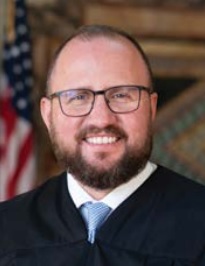
Currently serving · U.S. Court of Appeals for the Ninth Circuit
Salvador Mendoza Jr.
Currently serving
Circuit Judge · U.S. Court of Appeals for the Ninth Circuit · 2022–present · Appointed by Joe Biden
Salvador Mendoza Jr. serves as a circuit judge of the U.S. Court of Appeals for the Ninth Circuit (2022–present). Jr. was appointed by Joe Biden.
Key facts
- Full name
- Salvador Mendoza Jr.
- Court
- U.S. Court of Appeals for the Ninth Circuit
- Office
- Circuit Judge (U.S. Court of Appeals)
- Status
- Active circuit judge
- Duty status
- Active
- Appointment
- Senate-confirmed
- FJC seat
- CA91803
- Tenure
- 2022–present
- Confirmed
- 2022-09-12
- Born
- 1971
- Died
- —
- First year on the bench
- 2022
- Dataset version
- 1.20260705
Appointment & service record
U.S. Court of Appeals for the Ninth Circuit · 2022–present
- Seat
- CA91803
- Appointment
- Senate-confirmed
- Appointing president
- Joe Biden
- Confirmed
- 2022-09-12
- Commissioned
- 2022-09-15
- Senior status
- —
Court, FJC seat, appointment type (Senate-confirmed or recess), appointing president, confirmation and commission dates, and senior-status date are drawn from the Federal Judicial Center Biographical Directory and Wikidata.[1][2][3]
Sources
- [1]https://www.fjc.gov/node/1394566fjc · retrieved 2026-07-05
- [2]https://www.fjc.gov/history/judges/biographical-directory-article-iii-federal-judges-exportfjc-directory · retrieved 2026-07-05
- [3]https://www.wikidata.org/wiki/Q16213655Wikidata · retrieved 2026-07-05
Biographical narrative
1,158 words · sourced from the Wikipedia REST extract
Salvador Mendoza Jr. (born 1971) is an active United States circuit judge on the Ninth Circuit Court of Appeals. Appointed by President Joseph R. Biden and confirmed in September 2022, he previously served as a district judge for the Eastern District of Washington from 2014 to 2022 and held a state superior court judgeship in Washington from 2013 to 2014. His career spans public service as an assistant attorney general, a deputy prosecuting attorney, private criminal‑law practice, and extensive involvement in community legal aid initiatives.
Early life and legal career
Mendoza was born in 1971 in Pacoima, California, the third of five children of parents who had immigrated to the United States from Mexico. His family relocated to the Mid‑Columbia region of Washington state, where he completed his secondary education at Prosser High School, graduating in 1990. He pursued undergraduate studies at the University of Washington, earning a Bachelor of Arts in philosophy in 1994. Continuing toward a legal career, Mendoza attended the UCLA School of Law and received his Juris Doctor in 1997.
During law school he gained early exposure to labor advocacy through a summer internship with the United Farm Workers of America. Following graduation, he entered public service as a legal intern for the Washington State Attorney General’s Office from 1996 until 1998, after which he was hired as an assistant attorney general within the same office. In 1998, Mendoza transitioned to local prosecution, serving as a deputy prosecuting attorney in Franklin County for one year.
From 1999 through 2013, Mendoza practiced law primarily in the criminal field. His practice included periods of solo representation as well as partnership roles with various firms. Concurrently, he contributed to the judiciary on an interim basis, acting as a judge pro tempore in district, municipal, and juvenile courts across Benton and Franklin counties. His involvement in community legal services extended to board membership with the Benton‑Franklin Legal Aid Society, and he played a role in establishing two county‑level juvenile drug courts aimed at addressing substance‑related offenses among youth.
Mendoza’s first bid for elected judicial office occurred in 2008 when he ran for a vacant superior court seat covering Benton and Franklin counties; that campaign was unsuccessful. Nevertheless, his reputation within the legal community led Governor Jay Inslee to appoint him in May 2013 to fill another vacancy on the same superior court. He served as a state trial judge from 2013 until his elevation to the federal bench the following year.
Federal appellate service
The next phase of Mendoza’s judicial career began with a nomination by President Barack Obama on January 16, 2014 to serve as a United States district judge for the Eastern District of Washington. The vacancy arose after Judge Lonny R. Suko assumed senior status in November 2013. Senator Patty Murray forwarded Mendoza’s name to the president following a recommendation from an eight‑member bipartisan committee that evaluated candidates for the district. After a Senate Judiciary Committee hearing on March 12, 2014, his nomination was reported favorably by a 17–1 vote on April 3. Cloture was filed on June 12 and invoked four days later by a 55–37 vote. The full Senate confirmed Mendoza on June 17 with a 92–4 tally, and he received his commission two days thereafter. An installation ceremony took place in August 2014. His appointment marked the first time a Latino jurist served on that district court.
Mendoza’s service as a district judge concluded on September 16, 2022 when he was elevated to the United States Court of Appeals for the Ninth Circuit. President Joe Biden announced his intent to nominate Mendoza to the appellate bench on April 13, 2022, designating him to fill the seat that would become vacant upon Judge M. Margaret McKeown’s transition to senior status. The formal nomination was transmitted to the Senate on April 25. A confirmation hearing before the Senate Judiciary Committee occurred on May 11, and the committee reported his nomination favorably on June 9 by an 11–9–2 vote. Majority Leader Chuck Schumer filed cloture on September 6; the Senate invoked cloture two days later with a 48–43 vote. Mendoza’s confirmation followed on September 12, secured by a 46–40 vote, and he received his commission on September 15. His appointment represents the first Hispanic judge from Washington to serve on the Ninth Circuit.
Since joining the appellate court, Judge Mendoza has participated in panels addressing a range of federal issues. Notably, on November 13, 2023, he was part of a 7–4 majority that issued a temporary injunction against Idaho’s abortion ban because the statute lacked provisions for medical emergencies. The United States Supreme Court later agreed to review the case and stayed the Ninth Circuit’s order on January 5, 2024. Subsequent procedural developments returned the matter to an en banc panel of the Ninth Circuit.
Jurisprudence and legacy
Judge Mendoza’s judicial record reflects a trajectory from local prosecution and community‑focused legal work to service at both the district and appellate levels of the federal judiciary. His early career emphasized criminal law, public defense, and juvenile justice reform, experiences that have informed his perspective on matters involving procedural fairness and individual rights. While on the district bench, he contributed to the administration of justice in a geographically expansive jurisdiction, handling civil and criminal cases that shaped regional legal precedent.
His elevation to the Ninth Circuit placed him within one of the nation’s most influential appellate courts, where decisions often address complex constitutional questions and set binding authority for multiple western states. Participation in the 2023 abortion‑related injunction illustrates his engagement with contentious issues at the intersection of health policy and reproductive rights. The subsequent Supreme Court involvement underscores the national significance of cases before the Ninth Circuit and highlights Mendoza’s role in shaping legal discourse that extends beyond his home district.
Mendoza’s appointments also carry symbolic importance within the broader context of judicial diversity. As the first Latino judge on the Eastern District of Washington and the first Hispanic judge from Washington to sit on the Ninth Circuit, his career milestones contribute to incremental progress toward a judiciary that more closely mirrors the demographic composition of the United States. This representation aligns with longstanding efforts to broaden access to the bench for individuals from historically underrepresented backgrounds.
Beyond his professional responsibilities, Judge Mendoza maintains residence in Kennewick, Washington, where he lives with his wife, attorney Mia Mendoza (née Danielson), and their three children. His personal ties to the Pacific Northwest, combined with a career rooted in both state and federal service, position him as a jurist whose experiences span multiple layers of the American legal system.
In sum, Salvador Mendoza Jr.’s path from immigrant family origins through varied roles in public prosecution, private practice, state judiciary, and ultimately the federal appellate courts exemplifies a sustained commitment to the rule of law. His contributions continue to influence jurisprudence within the Ninth Circuit while also marking notable firsts for Hispanic representation on the federal bench.
Sources & provenance
Every quantitative or attributable claim above carries a per-section [N] marker that resolves to the corresponding URL below. Each entry records the upstream provider, the canonical URL, and the timestamp at which the underlying source was retrieved.
Key facts
- https://www.fjc.gov/node/1394566fjc · retrieved 2026-07-05
- https://www.fjc.gov/history/judges/biographical-directory-article-iii-federal-judges-exportfjc-directory · retrieved 2026-07-05
- https://www.wikidata.org/wiki/Q16213655Wikidata · retrieved 2026-07-05
Biographical narrative
- https://en.wikipedia.org/wiki/Salvador_Mendoza_Jr.Wikipedia · retrieved 2026-07-05
Explore the federal judiciary
The U.S. Courts of Appeals are the intermediate appellate courts of the federal judiciary — thirteen circuits sitting between the district courts and the Supreme Court. Browse the full roster of judges on the U.S. Court of Appeals for the Ninth Circuit, or explore how the appointed federal judiciary fits into the federal government.