
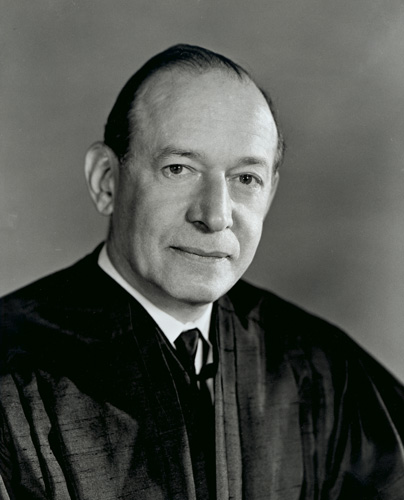
Historical · Supreme Court of the United States
Abe Fortas
Former justice
Former Associate Justice · Supreme Court of the United States · 1965–1969 · Appointed by Lyndon B Johnson
Abe Fortas served as an Associate Justice of the Supreme Court of the United States (1965–1969) was appointed by Lyndon B Johnson. The page below collects sourced biographical facts, the appointment record, and provenance for Fortas.
FJC ID: 1380861
Key facts
- Full name
- Abe Fortas
- Court
- Supreme Court of the United States
- Role
- Associate Justice
- Status
- Former justice
- Seat
- SCT0311
- Appointed by
- Lyndon B Johnson
- Appointment
- Senate-confirmed
- Confirmed
- 1965-08-11
- Supreme Court service
- 1965–1969
- Took seat
- 1965
- Born
- 1910
- Died
- 1982
- Dataset version
- 1.20260711
Appointment & service record
Associate Justice of the Supreme Court of the United States · 1965–1969
- Seat
- SCT0311
- Appointing president
- Lyndon B Johnson
- Appointment
- Senate-confirmed
- Confirmed
- August 11, 1965
Seat, appointing president, appointment type, confirmation date, and service dates are drawn from the Federal Judicial Center Biographical Directory and the Supreme Court's own members roster.[1][2][3]
Sources
- [1]https://www.fjc.gov/node/1380861fjc · retrieved 2026-06-16
- [2]https://www.supremecourt.gov/about/members_text.aspxsupremecourt.gov · retrieved 2026-06-16
- [3]https://www.fjc.gov/history/judges/biographical-directory-article-iii-federal-judges-exportfjc-directory · retrieved 2026-06-16
Biographical narrative
1,011 words · sourced from the Wikipedia REST extract
Abe Fortas was an American lawyer and jurist who served as an associate justice of the Supreme Court of the United States from 1965 to 1969. Born in Memphis, Tennessee, he rose through a distinguished legal career that included teaching at Yale Law School, advising federal agencies, and representing high‑profile clients before the nation's highest court. His tenure on the bench was marked by several influential opinions, an attempted elevation to chief justice, and ultimately a resignation amid controversy. After leaving the Court, Fortas returned to private practice until his death in 1982.
Early life and legal career
Abraham “Abe” Fortas entered the world on June 19, 1910, in Memphis, Tennessee. He was the youngest of five children born to Woolfe Fortas, a cabinetmaker originally from Russia, and Rachel Berzansky Fortas, who had emigrated from Lithuania. The family ran a small store together, and Abe’s early years were steeped in both hard work and cultural heritage. A lifelong passion for music, nurtured by his father’s encouragement to play the violin, earned him the nickname “Fiddlin’ Abe.” By thirteen he was performing with a local dance band, and later he studied chamber music under a trio leader.
Fortas graduated second in his class from South Side High School in 1926 at age sixteen. A scholarship carried him to Southwestern at Memphis—now Rhodes College—where he initially considered a musical career before deciding to focus on English and political science. He graduated at the top of his class in 1930, then secured scholarships to both Harvard Law School and Yale Law School. Choosing Yale, he became the youngest law student there at age twenty and served as editor‑in‑chief of the Yale Law Journal. In 1933 he earned a cum laude degree, ranking second in his graduating class.
One of Fortas’s professors, William O. Douglas, recognized his talent and arranged for him to remain at Yale as an assistant professor of law after graduation. While teaching, Fortas also began a series of federal appointments. He worked with the Agricultural Adjustment Administration and later joined the U.S. Securities and Exchange Commission (SEC), where in 1937 he became assistant director of its public utilities division. His responsibilities required frequent travel between New Haven and Washington, D.C., balancing academic duties with regulatory work.
In 1945 Fortas was appointed by President Harry S. Truman to delegations that helped establish the United Nations, a role that broadened his experience in international affairs. The following year he represented Lyndon B. Johnson in a dispute over the Democratic U.S. Senate nomination, forging a close relationship with the future president that would later prove pivotal.
Fortas’s legal acumen also led him to represent Clarence Earl Gideon before the Supreme Court in the landmark case Gideon v. Wainwright, which affirmed the right to counsel for criminal defendants. His involvement in this case underscored his commitment to civil liberties and set a precedent that would influence many of his later judicial opinions.
In 1948 he served as an advisor for the U.S. Securities and Exchange Commission, further cementing his reputation as a knowledgeable regulator. He also held positions within the Department of the Interior under President Franklin D. Roosevelt, serving first as general counsel of the Public Works Administration and then as Undersecretary of the Interior.
Fortas married Carolyn E. Agger in 1935; she became a successful tax lawyer. The couple had no children. After his Supreme Court appointment they resided at 3210 R Street NW in Washington’s Georgetown neighborhood.
Supreme Court tenure
President Lyndon B. Johnson nominated Fortas to the Supreme Court on August 11, 1965, and the Senate confirmed him that same day. He filled seat SCT0311 as an associate justice, serving until his resignation in 1969. During his time on the bench he maintained a close working relationship with President Johnson, reflecting the personal connection forged during their earlier collaboration.
Fortas authored several landmark opinions while on the Court. Notably, he contributed to decisions such as In re Gault, which expanded due process rights for juveniles, and Tinker v. Des Moines Independent Community School District, which protected students’ free speech rights in schools. His writing style was noted for its clarity and depth of analysis.
In 1968 President Johnson sought to elevate Fortas to the position of Chief Justice of the United States. The nomination faced a filibuster in the Senate, leading to its withdrawal. This episode highlighted the political complexities surrounding Supreme Court appointments during that era.
Fortas’s tenure ended amid controversy. He had accepted $20,000 from financier Louis Wolfson while Wolfson was under investigation for insider trading. The Justice Department investigated Fortas at President Richard Nixon’s behest. Attorney General John N. Mitchell pressured him to resign, and Fortas stepped down in 1969. After leaving the Court he returned to private practice, occasionally appearing before former colleagues on the bench.
Jurisprudence and legacy
Fortas’s judicial record is marked by a commitment to expanding individual rights within the framework of constitutional law. His opinions in In re Gault and Tinker v. Des Moines are frequently cited for their emphasis on due process and free expression, respectively. These cases have had lasting influence on American jurisprudence, shaping subsequent interpretations of civil liberties.
Beyond his written opinions, Fortas’s earlier legal work—particularly his representation of Gideon in Gideon v. Wainwright—demonstrated a consistent concern with ensuring fair access to the justice system. His advocacy helped establish the principle that counsel is essential for a fair trial, a standard that remains central to criminal procedure.
Fortas’s resignation under political pressure and the controversy surrounding his financial dealings remain a notable episode in Supreme Court history, illustrating the delicate balance between personal conduct and public office. Despite this, his contributions to constitutional law are recognized as significant, and he is often studied for his role in advancing civil rights during a transformative period in American society.
Abe Fortas passed away on April 5, 1982. His legacy endures through the opinions he authored, the legal principles he helped affirm, and the broader impact of his career on the development of constitutional law in the United States.
Sources & provenance
Every quantitative or attributable claim above carries a per-section [N] marker that resolves to the corresponding URL below. Each entry records the upstream provider, the canonical URL, and the timestamp at which the underlying source was retrieved.
Key facts
- https://www.fjc.gov/node/1380861fjc · retrieved 2026-06-16
- https://www.supremecourt.gov/about/members_text.aspxsupremecourt.gov · retrieved 2026-06-16
- https://www.fjc.gov/history/judges/biographical-directory-article-iii-federal-judges-exportfjc-directory · retrieved 2026-06-16
Biographical narrative
- https://en.wikipedia.org/wiki/Abe_FortasWikipedia · retrieved 2026-06-16
Explore the federal judiciary
Fewer than 120 people have served on the Supreme Court of the United States in its history. Browse the full roster of current and former justices, or explore how the appointed federal judiciary fits into the federal government.