
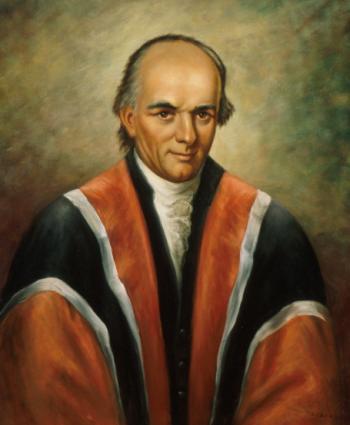
Historical · Supreme Court of the United States
Alfred Moore
Former justice
Former Associate Justice · Supreme Court of the United States · 1799–1804 · Appointed by John Adams
Alfred Moore served as an Associate Justice of the Supreme Court of the United States (1799–1804) was appointed by John Adams. The page below collects sourced biographical facts, the appointment record, and provenance for Moore.
FJC ID: 1385281
Key facts
- Full name
- Alfred Moore
- Court
- Supreme Court of the United States
- Role
- Associate Justice
- Status
- Former justice
- Seat
- SCT0602
- Appointed by
- John Adams
- Appointment
- Senate-confirmed
- Confirmed
- 1799-12-10
- Supreme Court service
- 1799–1804
- Took seat
- 1799
- Born
- 1755
- Died
- 1810
- Dataset version
- 1.20260711
Appointment & service record
Associate Justice of the Supreme Court of the United States · 1799–1804
- Seat
- SCT0602
- Appointing president
- John Adams
- Appointment
- Senate-confirmed
- Confirmed
- December 10, 1799
Seat, appointing president, appointment type, confirmation date, and service dates are drawn from the Federal Judicial Center Biographical Directory and the Supreme Court's own members roster.[1][2][3]
Sources
- [1]https://www.fjc.gov/node/1385281fjc · retrieved 2026-06-16
- [2]https://www.supremecourt.gov/about/members_text.aspxsupremecourt.gov · retrieved 2026-06-16
- [3]https://www.fjc.gov/history/judges/biographical-directory-article-iii-federal-judges-exportfjc-directory · retrieved 2026-06-16
Biographical narrative
804 words · sourced from the Wikipedia REST extract
Alfred Moore was an American jurist, planter, and military officer who served as an associate justice of the United States Supreme Court from 1799 until his resignation in 1804. Born into a prominent North Carolina family in 1755, he pursued legal studies under his father’s guidance, entered public service during the Revolutionary War, and held several state offices before being appointed to the nation’s highest court by President John Adams.
Early life and legal career
Alfred Moore was born on May 21, 1755, in New Hanover County, North Carolina. His parents were Anne (Grange) and Maurice Moore; the family had long ties to the region, with his great‑grandfather James Moore having served as governor of Carolina from 1700 to 1703. After his mother’s death and his father’s remarriage, young Alfred was sent to Boston around 1764 to complete his education. He later returned to North Carolina, where he read law under the supervision of his father, a colonial judge who had published an essay denouncing the Stamp Act. Moore was admitted to the bar in April 1775.
At the outbreak of the American Revolutionary War, Moore joined the Continental Army as a captain in the 1st North Carolina Regiment on September 1, 1775. He participated in the Battle of Moore’s Creek Bridge and later fought in the Siege of Charleston, South Carolina. On March 8, 1777, following the deaths of his father, brother, and uncle, he resigned his commission to tend to family affairs but continued active involvement in irregular military actions against British and Loyalist forces. He served as a colonel in the North Carolina militia from 1777 until 1782. During this period, British troops under Major James Craig destroyed Moore’s plantation and seized its livestock and enslaved people.
After the war, Moore entered state politics. He was elected to the North Carolina General Assembly and subsequently served as Attorney General of North Carolina from 1782 to 1791. In that capacity he argued the State’s case in Bayard v. Singleton (1787), a decision by the North Carolina Court of Conference that became an early example of judicial review. By 1790, Moore owned a plantation on which he enslaved 48 people. He was an ardent Federalist who supported a strong national government and played a leading role in securing North Carolina’s ratification of the United States Constitution after the state had initially rejected it in 1788.
Moore also contributed to higher education; he helped found the University of North Carolina at Chapel Hill, participated in selecting its site, and served on its board of trustees from 1789 until 1807. He returned to the state legislature as a member of the House of Representatives in 1792 for one term. In 1794 and again in 1798 he was the Federalist candidate for United States Senate but lost both elections by narrow margins. That same year, the General Assembly elected him to a seat on the North Carolina Superior Court.
Supreme Court tenure
President John Adams nominated Moore as an associate justice of the Supreme Court on December 4, 1799, to fill the vacancy left by James Iredell’s departure. The United States Senate confirmed his appointment on December 10, 1799, and he was sworn into office on April 21, 1800. Moore served until his resignation on January 26, 1804.
During his tenure, health issues limited his participation in the Court’s business. He authored only one opinion, Bas v. Tingy, which upheld a conclusion that France was an enemy during the Quasi‑War of 1798–1799. Because of his poor health and limited activity, he did not take part in Marbury v. Madison, a landmark case decided while he was on the Court. His brief service has led observers to rank him among the least effective justices in Supreme Court history.
Jurisprudence and legacy
Moore’s judicial record on the Supreme Court is sparse; his sole opinion, Bas v. Tingy, addressed maritime law during a period of undeclared conflict between the United States and France. The case reflected the Court’s early engagement with foreign policy issues but did not establish any lasting legal precedent.
Beyond his brief tenure on the bench, Moore left a broader legacy in North Carolina. Several places bear his name, including Moore Square—a park within the Moore Square Historic District in Raleigh—and Moore County, both named to honor his contributions to the state. His summer residence, Moorefields, built after the Revolutionary War and located near Hillsborough, remains standing and is listed on the National Register of Historic Places.
Alfred Moore died on October 15, 1810, in Bladen County, North Carolina, and was buried at St. Philip’s Church in Brunswick County. His life spanned military service, state and federal legal work, and a brief period as an associate justice of the United States Supreme Court, reflecting the varied roles played by early American public servants.
Sources & provenance
Every quantitative or attributable claim above carries a per-section [N] marker that resolves to the corresponding URL below. Each entry records the upstream provider, the canonical URL, and the timestamp at which the underlying source was retrieved.
Key facts
- https://www.fjc.gov/node/1385281fjc · retrieved 2026-06-16
- https://www.supremecourt.gov/about/members_text.aspxsupremecourt.gov · retrieved 2026-06-16
- https://www.fjc.gov/history/judges/biographical-directory-article-iii-federal-judges-exportfjc-directory · retrieved 2026-06-16
Biographical narrative
- https://en.wikipedia.org/wiki/Alfred_MooreWikipedia · retrieved 2026-06-16
Explore the federal judiciary
Fewer than 120 people have served on the Supreme Court of the United States in its history. Browse the full roster of current and former justices, or explore how the appointed federal judiciary fits into the federal government.