
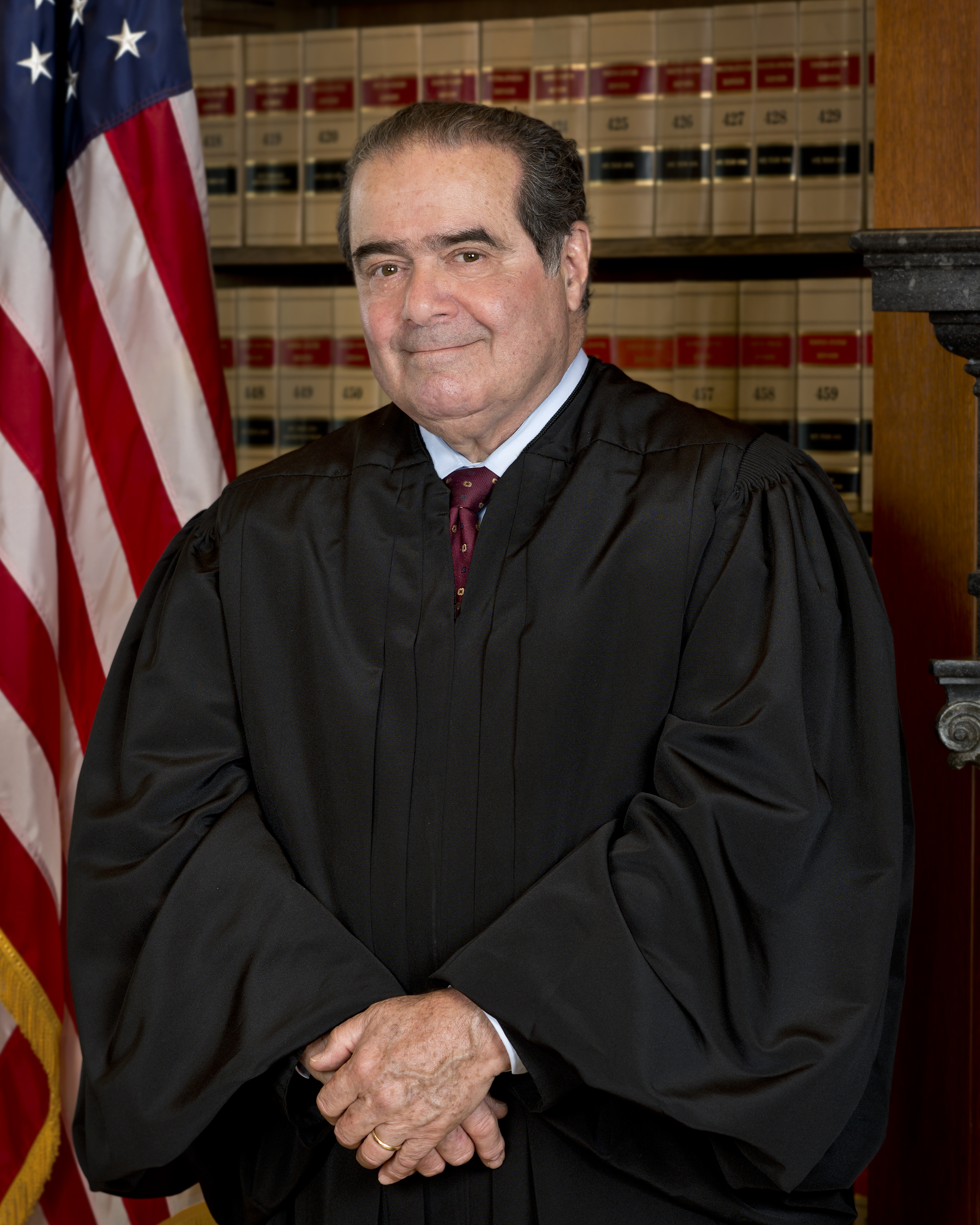
Historical · Supreme Court of the United States
Antonin Scalia
Former justice
Former Associate Justice · Supreme Court of the United States · 1986–2016 · Appointed by Ronald Reagan
Antonin Scalia served as an Associate Justice of the Supreme Court of the United States (1986–2016) was appointed by Ronald Reagan. The page below collects sourced biographical facts, the appointment record, and provenance for Scalia.
FJC ID: 1387421
Key facts
- Full name
- Antonin Scalia
- Court
- Supreme Court of the United States
- Role
- Associate Justice
- Status
- Former justice
- Seat
- SCT1007
- Appointed by
- Ronald Reagan
- Appointment
- Senate-confirmed
- Confirmed
- 1986-09-17
- Supreme Court service
- 1986–2016
- Took seat
- 1986
- Born
- 1936
- Died
- 2016
- Dataset version
- 1.20260711
Appointment & service record
Associate Justice of the Supreme Court of the United States · 1986–2016
- Seat
- SCT1007
- Appointing president
- Ronald Reagan
- Appointment
- Senate-confirmed
- Confirmed
- September 17, 1986
Seat, appointing president, appointment type, confirmation date, and service dates are drawn from the Federal Judicial Center Biographical Directory and the Supreme Court's own members roster.[1][2][3]
Sources
- [1]https://www.fjc.gov/node/1387421fjc · retrieved 2026-06-16
- [2]https://www.supremecourt.gov/about/members_text.aspxsupremecourt.gov · retrieved 2026-06-16
- [3]https://www.fjc.gov/history/judges/biographical-directory-article-iii-federal-judges-exportfjc-directory · retrieved 2026-06-16
Biographical narrative
1,019 words · sourced from the Wikipedia REST extract
Antonin Gregory Scalia was an American jurist who served as an Associate Justice of the Supreme Court of the United States from 1986 until his death in 2016. Born to Italian immigrant parents in Trenton, New Jersey, he rose through a rigorous academic path that included Georgetown University and Harvard Law School before embarking on a career that spanned private practice, academia, and public service. Appointed by President Ronald Reagan, Scalia became the first Italian‑American justice on the Court and was widely regarded as the intellectual leader of the conservative wing’s originalist and textualist philosophy. His opinions and dissents shaped major areas of constitutional law, and his legacy continues through honors such as a posthumous Presidential Medal of Freedom and a law school named in his memory.
Early life and legal career
Antonin Scalia was born on March 11, 1936, in Trenton, New Jersey. His father, Salvatore Eugenio “Eugene” Scalia, had emigrated from Sommatino, Sicily, and later earned a degree from Rutgers University before becoming a professor of Romance languages at Brooklyn College. His mother, Catherine Louise (née Panaro), was a native of Trenton whose parents were also Italian immigrants; she worked as an elementary school teacher. In 1939 the family moved to Elmhurst, Queens, where Scalia attended P.S. 13 Clement C. Moore School.
After completing eighth grade, he received a scholarship to Xavier High School, a Jesuit military academy in Manhattan. He graduated in 1953 ranked first in his class, having maintained a 97.5 average and earned distinctions in Latin, Greek, debate, and the glee club. Scalia’s early years were marked by disciplined study; classmates recalled him as an “archconservative Catholic” who excelled academically.
In 1953 Scalia entered Georgetown University to major in history. While there he became a prominent member of the Philodemic Society and was recognized for his theatrical talents. He spent his junior year abroad at the University of Fribourg in Switzerland, returning in 1957 as valedictorian with a Bachelor of Arts summa cum laude. He then attended Harvard Law School, where he served as notes editor for the Harvard Law Review. Graduating in 1960 with a Bachelor of Laws magna cum laude, Scalia was among the top of his class and received a Sheldon Fellowship that allowed him to travel throughout Europe during 1960–1961.
Scalia began his legal career at Jones Day (then Jones, Day, Cockley & Reavis) in Cleveland, Ohio, working there from 1961 until 1967. He was highly regarded within the firm and had been considered for partnership; however, he chose to pursue teaching instead. In 1967 he accepted a position as a professor at the University of Virginia School of Law, relocating his family to Charlottesville.
In 1971 Scalia entered public service when President Richard Nixon appointed him general counsel for the Office of Telecommunications Policy, where he helped shape federal policy on cable television. He later served in the Ford administration as an assistant attorney general. During the Carter years he returned to academia, teaching at the University of Chicago and becoming one of the first faculty advisers of the nascent Federalist Society.
In 1982 President Ronald Reagan appointed Scalia to the United States Court of Appeals for the District of Columbia Circuit, where he served until his elevation to the Supreme Court in 1986. His appointment to the appellate court marked a significant step in a career that blended scholarship, practice, and public service.
Supreme Court tenure
President Ronald Reagan nominated Scalia to the Supreme Court on September 17, 1986, filling the seat vacated by Justice William O. Douglas. The Senate confirmed him that same day, and he took his oath of office shortly thereafter. He became the first Italian‑American justice on the Court and served as an Associate Justice for thirty years until his death on February 13, 2016.
Scalia’s tenure was characterized by a strong commitment to textualism in statutory interpretation and originalism in constitutional analysis. He frequently communicated with colleagues through memos known informally as “ninograms,” named after his nickname “Nino.” These notes were intended to persuade fellow justices toward his interpretive positions. Scalia was also noted for filing separate opinions in many cases, often offering critiques of the Court’s majority reasoning.
Among his most significant opinions were a lone dissent in *Morrison v. Olson*, where he argued against the constitutionality of an Independent‑Counsel law; a majority opinion in *Crawford v. Washington*, which clarified the confrontation rights of criminal defendants under the Sixth Amendment; and a majority opinion in *District of Columbia v. Heller*, holding that the Second Amendment protects an individual right to handgun ownership. His jurisprudence consistently emphasized the limits on federal power, support for the death penalty, and opposition to constitutional guarantees of abortion or same‑sex marriage. He also expressed concerns about affirmative action policies, viewing them as unconstitutional when they conferred special status based on minority group membership.
Scalia’s influence extended beyond individual opinions; he was widely regarded as the intellectual anchor for the Court’s conservative wing. His approach to law and his willingness to challenge prevailing interpretations earned him a reputation as one of the most influential jurists of the twentieth century and among the most important figures in Supreme Court history.
Jurisprudence and legacy
Scalia’s impact on American jurisprudence is evident in the enduring prominence of originalist and textualist doctrines. His scholarship and opinions helped catalyze a broader movement within legal circles that emphasized adherence to the text of statutes and the original meaning of constitutional provisions. The principles he championed continue to shape contemporary debates over statutory interpretation, executive power, and individual rights.
After his death in 2016, Scalia was posthumously awarded the Presidential Medal of Freedom in 2018, recognizing his contributions to the nation’s legal system. In addition, George Mason University named its law school the Antonin Scalia Law School in his honor, reflecting his lasting influence on legal education and scholarship.
Throughout his career, Scalia maintained a reputation for rigorous analysis and uncompromising adherence to his interpretive principles. His legacy is reflected not only in the opinions he authored but also in the broader ideological currents that continue to shape constitutional law debates today.
Sources & provenance
Every quantitative or attributable claim above carries a per-section [N] marker that resolves to the corresponding URL below. Each entry records the upstream provider, the canonical URL, and the timestamp at which the underlying source was retrieved.
Key facts
- https://www.fjc.gov/node/1387421fjc · retrieved 2026-06-16
- https://www.supremecourt.gov/about/members_text.aspxsupremecourt.gov · retrieved 2026-06-16
- https://www.fjc.gov/history/judges/biographical-directory-article-iii-federal-judges-exportfjc-directory · retrieved 2026-06-16
Biographical narrative
- https://en.wikipedia.org/wiki/Antonin_ScaliaWikipedia · retrieved 2026-06-16
Explore the federal judiciary
Fewer than 120 people have served on the Supreme Court of the United States in its history. Browse the full roster of current and former justices, or explore how the appointed federal judiciary fits into the federal government.