
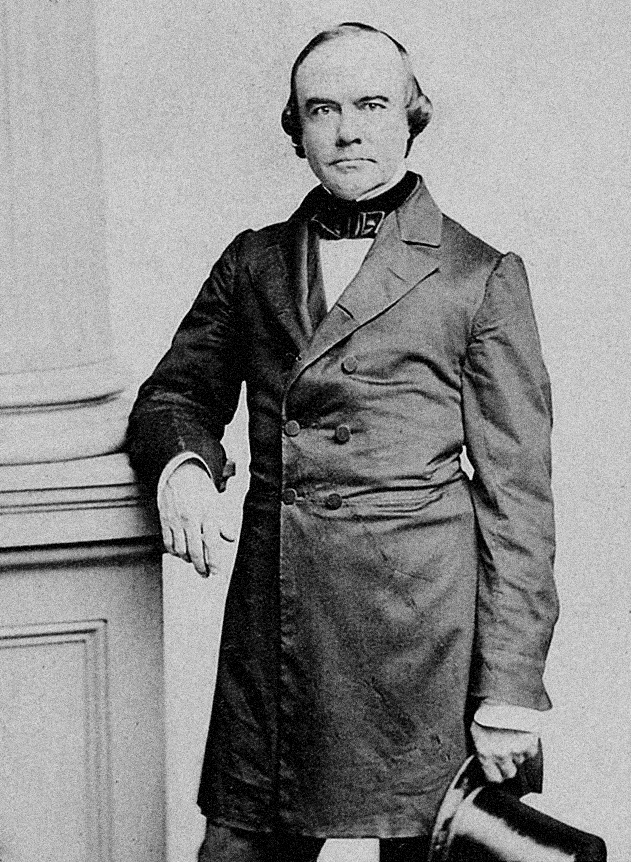
Historical · Supreme Court of the United States
Benjamin Robbins Curtis
Former justice
Former Associate Justice · Supreme Court of the United States · 1851–1857 · Appointed by Millard Fillmore
Benjamin Robbins Curtis served as an Associate Justice of the Supreme Court of the United States (1851–1857) was appointed by Millard Fillmore. The page below collects sourced biographical facts, the appointment record, and provenance for Curtis.
FJC ID: 1379691
Key facts
- Full name
- Benjamin Robbins Curtis
- Court
- Supreme Court of the United States
- Role
- Associate Justice
- Status
- Former justice
- Seat
- SCT0304
- Appointed by
- Millard Fillmore
- Appointment
- Senate-confirmed
- Confirmed
- 1851-12-20
- Supreme Court service
- 1851–1857
- Took seat
- 1851
- Born
- 1809
- Died
- 1874
- Dataset version
- 1.20260711
Appointment & service record
Associate Justice of the Supreme Court of the United States · 1851–1857
- Seat
- SCT0304
- Appointing president
- Millard Fillmore
- Appointment
- Senate-confirmed
- Confirmed
- December 20, 1851
Seat, appointing president, appointment type, confirmation date, and service dates are drawn from the Federal Judicial Center Biographical Directory and the Supreme Court's own members roster.[1][2][3]
Sources
- [1]https://www.fjc.gov/node/1379691fjc · retrieved 2026-06-16
- [2]https://www.supremecourt.gov/about/members_text.aspxsupremecourt.gov · retrieved 2026-06-16
- [3]https://www.fjc.gov/history/judges/biographical-directory-article-iii-federal-judges-exportfjc-directory · retrieved 2026-06-16
Biographical narrative
953 words · sourced from the Wikipedia REST extract
Benjamin Robbins Curtis was an American lawyer and jurist who served as an associate justice on the United States Supreme Court from 1851 to 1857. Born in Watertown, Massachusetts, he received a formal legal education at Harvard Law School before establishing a prominent practice in Boston. Appointed by President Millard Fillmore, Curtis became the first Supreme Court justice to hold a law degree and the only Whig justice of his era. After resigning from the bench, he returned to private practice and later represented President Andrew Johnson during the president’s impeachment trial.
Early life and legal career
Benjamin Robbins Curtis was born on November 4, 1809, in Watertown, Massachusetts, to Lois Robbins and Captain Benjamin Curtis, a merchant ship captain. He attended common schools in Newton before enrolling at Harvard College in 1825. While at Harvard he distinguished himself as an essayist, winning a contest during his junior year, and became a member of the Porcellian Club. He graduated in 1829 and was inducted into Phi Beta Kappa. In 1832 he completed studies at Harvard Law School, earning a formal law degree.
After admission to the Massachusetts bar later that same year, Curtis began practicing law. By 1834 he had relocated to Boston, joining the firm of Charles P. Curtis. There he developed expertise in admiralty and patent law, fields that would shape his reputation as one of New England’s leading attorneys. In 1836, Curtis represented the Aves family in the Massachusetts “freedom suit” Commonwealth v. Aves, defending a slaveholder whose enslaved child had been brought into the state. The case ultimately resulted in the Supreme Judicial Court of Massachusetts declaring the child free; however, Curtis’s participation was noted as part of his early legal career rather than an indication of personal convictions.
Curtis’s public service extended beyond private practice. He joined the Harvard Corporation in February 1846, becoming one of the university’s governing board members. In 1849 he was elected to the Massachusetts House of Representatives, where he chaired a committee tasked with reforming state judicial procedures. The committee produced the Massachusetts Practice Act of 1851, which was adopted by the legislature without amendment and regarded as a model for judicial reform.
During this period, Curtis was recognized as a rival to fellow New England lawyer Rufus Choate and was considered a preeminent leader of the regional bar. His legal arguments were praised for their clarity and persuasiveness, and his political alignment with the Whig Party placed him in favor when seeking federal appointments.
Supreme Court tenure
President Millard Fillmore, a member of the Whig Party, appointed Curtis to the United States Supreme Court on September 22, 1851, following the death of Justice Levi Woodbury. The appointment was made during a recess and subsequently confirmed by the Senate on December 20, 1851; Curtis received his commission that same day. He occupied seat SCT 0304 and served as an associate justice until his resignation in 1857.
Curtis’s tenure on the Court is notable for several reasons. He was the first Supreme Court justice to possess a formal law degree from an accredited institution. Prior justices had either read law under apprenticeship or attended law schools without receiving degrees. His appointment also marked him as the only Whig justice serving during that period, reflecting the political landscape of the time.
In 1854, Curtis was elected a Fellow of the American Academy of Arts and Sciences, acknowledging his contributions to legal scholarship and public service. One of his early opinions, Cooley v. Board of Wardens (1852), addressed the scope of federal power under the Commerce Clause. The decision held that the clause extended to laws concerning pilotage and that state regulations could be valid unless Congress explicitly required national uniformity. This opinion has been cited in subsequent commerce‑clause cases as a foundational precedent.
Perhaps most famously, Curtis was one of two dissenters in the 1857 Supreme Court case Dred Scott v. Sandford. While the majority denied the enslaved man’s claim to freedom and upheld the institution of slavery, Curtis disagreed with nearly every holding of the court. He argued against the denial of emancipation for Dred Scott, though his dissent was ultimately overruled.
Curtis resigned from the Supreme Court in 1857, choosing to return to private legal practice in Boston. His resignation marked the end of a six‑year judicial career that had spanned some of the most contentious issues of mid‑19th‑century America.
Jurisprudence and legacy
Benjamin Robbins Curtis’s legacy is multifaceted, encompassing his pioneering status as a formally educated Supreme Court justice, his involvement in significant early 19th‑century legal reforms, and his participation in landmark cases that shaped American jurisprudence. His opinion in Cooley v. Board of Wardens remains an important reference point for interpretations of the Commerce Clause, illustrating the balance between federal authority and state regulation.
Curtis’s dissent in Dred Scott v. Sandford demonstrates a willingness to challenge prevailing judicial consensus on matters of profound moral and constitutional consequence. Although his views were not adopted by the Court at that time, they contributed to ongoing debates about slavery, citizenship, and the limits of federal power—a debate that would culminate in the Civil War.
After leaving the bench, Curtis continued to influence national politics through his defense of President Andrew Johnson during the impeachment trial of 1868. His role as counsel in this high‑profile case underscored his enduring engagement with constitutional questions beyond the judiciary.
Curtis passed away on September 15, 1874, leaving behind a record of legal service that bridged private practice, legislative reform, and federal adjudication. His career illustrates the evolving professionalization of the American legal system in the 19th century and reflects the complex interplay between law, politics, and society during a pivotal era in United States history.
Sources & provenance
Every quantitative or attributable claim above carries a per-section [N] marker that resolves to the corresponding URL below. Each entry records the upstream provider, the canonical URL, and the timestamp at which the underlying source was retrieved.
Key facts
- https://www.fjc.gov/node/1379691fjc · retrieved 2026-06-16
- https://www.supremecourt.gov/about/members_text.aspxsupremecourt.gov · retrieved 2026-06-16
- https://www.fjc.gov/history/judges/biographical-directory-article-iii-federal-judges-exportfjc-directory · retrieved 2026-06-16
Biographical narrative
- https://en.wikipedia.org/wiki/Benjamin_Robbins_CurtisWikipedia · retrieved 2026-06-16
Explore the federal judiciary
Fewer than 120 people have served on the Supreme Court of the United States in its history. Browse the full roster of current and former justices, or explore how the appointed federal judiciary fits into the federal government.