
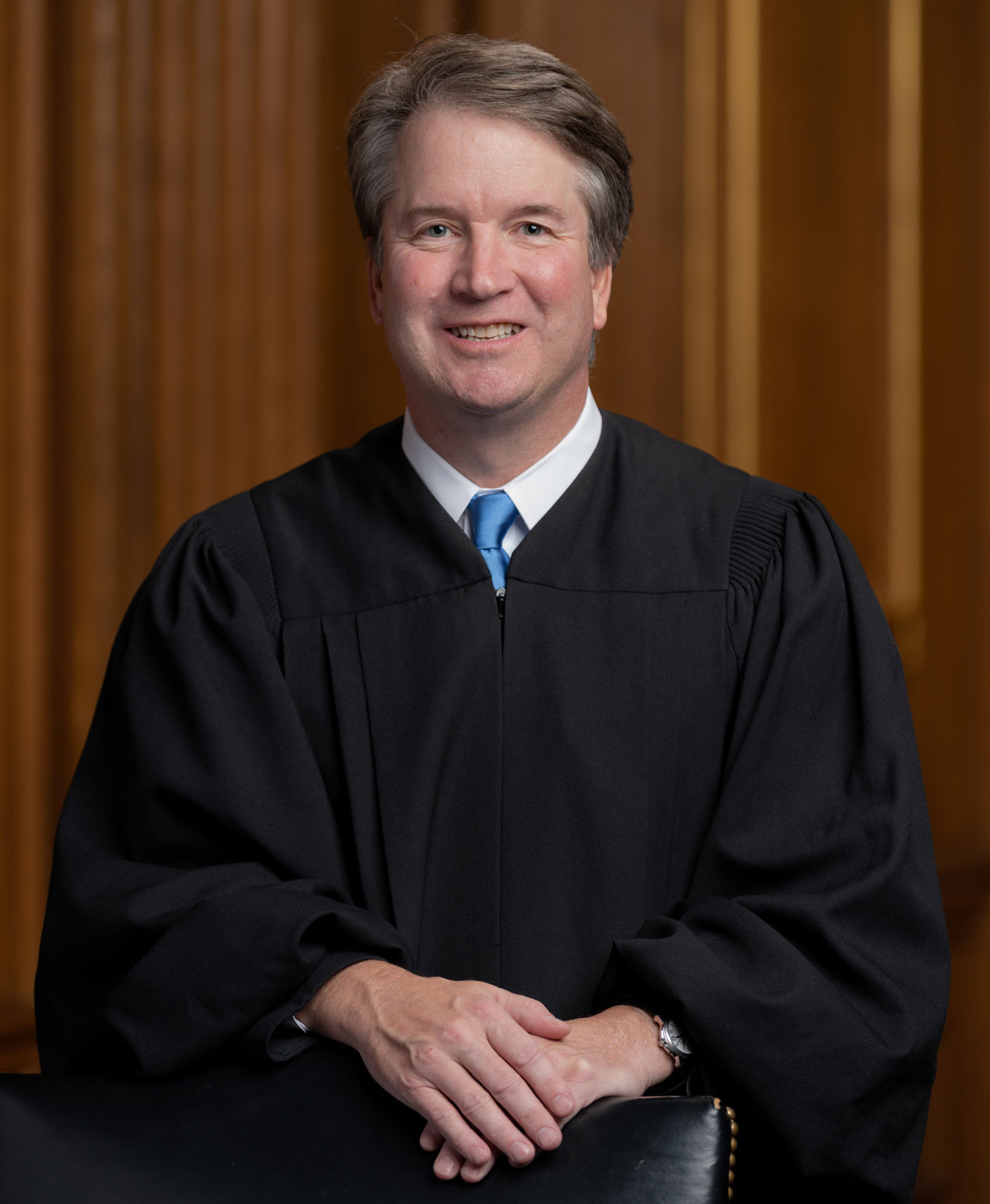
Currently serving · Supreme Court of the United States
Brett M. Kavanaugh
Currently serving
Associate Justice · Supreme Court of the United States · 2018–present · Appointed by Donald Trump
Brett M. Kavanaugh serves as an Associate Justice of the Supreme Court of the United States (2018–present) was appointed by Donald Trump. The page below collects sourced biographical facts, the appointment record, and provenance for Kavanaugh.
FJC ID: 1392406
Key facts
- Full name
- Brett M. Kavanaugh
- Court
- Supreme Court of the United States
- Role
- Associate Justice
- Status
- Currently serving
- Seat
- SCT0214
- Appointed by
- Donald Trump
- Appointment
- Senate-confirmed
- Confirmed
- 2018-10-06
- Supreme Court service
- 2018–present
- Took seat
- 2018
- Born
- —
- Died
- —
- Dataset version
- 1.20260711
Appointment & service record
Associate Justice of the Supreme Court of the United States · 2018–present
- Seat
- SCT0214
- Appointing president
- Donald Trump
- Appointment
- Senate-confirmed
- Confirmed
- October 6, 2018
Seat, appointing president, appointment type, confirmation date, and service dates are drawn from the Federal Judicial Center Biographical Directory and the Supreme Court's own members roster.[1][2][3]
Sources
- [1]https://www.fjc.gov/node/1392406fjc · retrieved 2026-06-16
- [2]https://www.supremecourt.gov/about/members_text.aspxsupremecourt.gov · retrieved 2026-06-16
- [3]https://www.fjc.gov/history/judges/biographical-directory-article-iii-federal-judges-exportfjc-directory · retrieved 2026-06-16
Biographical narrative
1,022 words · sourced from the Wikipedia REST extract
Brett M. Kavanaugh is an American lawyer and jurist who has served as an associate justice of the Supreme Court of the United States since October 6, 2018. Prior to his appointment to the nation's highest court, he was a judge on the United States Court of Appeals for the District of Columbia Circuit from 2006 until 2018. Kavanaugh’s career includes clerkships with federal appellate judges and a former Supreme Court justice, service in the Office of Independent Counsel during the Clinton administration, and a role as White House staff secretary under President George W. Bush.
Early life and legal career
Brett Michael Kavanaugh was born on February 12, 1965, in Washington, D.C., to Martha Gamble (née Murphy) and Everett Edward Kavanaugh Jr. Both sides of his family trace their ancestry to Ireland; his paternal great‑grandfather immigrated from Roscommon in 1878, while his maternal lineage includes a great‑great‑grandfather who settled in New Jersey. His father practiced law and later served as president of the Cosmetic, Toiletry and Fragrance Association for twenty years. His mother taught history at local high schools before earning a Juris Doctor from American University in 1978; she subsequently served as a Maryland Circuit Court judge.
Kavanaugh grew up in Bethesda, Maryland, where he attended Georgetown Preparatory School, a Jesuit boys’ college preparatory institution. There he distinguished himself athletically, captaining the basketball team and playing football as a wide receiver and cornerback. He was also classmates with future Supreme Court justice Neil Gorsuch, who would later serve alongside him on the Court.
After graduating from Georgetown Prep in 1983, Kavanaugh enrolled at Yale University, following in the footsteps of his paternal grandfather. At Yale he pursued a Bachelor of Arts in history, graduating cum laude in 1987. He was active in campus life as a member of the Delta Kappa Epsilon fraternity and contributed sports writing to the Yale Daily News.
He continued at Yale Law School, where he earned a Juris Doctor in 1990. While there he served on the Yale Law Journal as a notes editor during his third year. He also lived with future judge James E. Boasberg in a group house and played basketball with Professor George L. Priest, who would later become a prominent figure in the Federalist Society.
Kavanaugh’s early legal career began with clerkships on the federal appellate level. From 1990 to 1991 he clerked for Judge Walter King Stapleton of the United States Court of Appeals for the Third Circuit; during that time Stapleton authored the majority opinion in Planned Parenthood v. Casey, a case that upheld many Pennsylvania abortion restrictions. He then served as a clerk for Judge Alex Kozinski of the Ninth Circuit from 1991 to 1992.
In 1993 Kavanaugh joined the Office of Independent Counsel as an associate counsel under Ken Starr, working on investigations related to President Bill Clinton’s administration, including the reopening of the investigation into Vincent Foster’s death. He remained in that role until 1997, contributing to investigative work and drafting reports such as the Starr Report that recommended impeachment.
Following his time with the Independent Counsel, Kavanaugh returned to clerkship, this time for Supreme Court Justice Anthony Kennedy from 1993 to 1994. His colleagues during that term included future Supreme Court justice Neil Gorsuch and federal judge Gary Feinerman.
After completing his clerkships, Kavanaugh entered public service as White House staff secretary under President George W. Bush. In that capacity he was involved in the administration’s efforts to identify and confirm judicial nominees. His experience in both the executive branch and the judiciary positioned him for a federal judgeship; President Bush nominated him to the United States Court of Appeals for the District of Columbia Circuit in 2003, and after a confirmation process that spanned three years he was confirmed by the Senate in May 2006.
Supreme Court tenure
President Donald J. Trump nominated Kavanaugh to the Supreme Court on July 9, 2018, to fill the seat vacated by Justice Anthony Kennedy. The nomination proceeded amid a highly publicized controversy: before Senate confirmation hearings began, Christine Blasey Ford alleged that Kavanaugh had sexually assaulted her in the early 1980s; three other women also made accusations of sexual misconduct against him. No eyewitness testimony corroborated these claims, and Kavanaugh denied all allegations.
The Senate Judiciary Committee held a supplemental hearing to address the allegations and voted 11–10 along party lines to advance his nomination to the full Senate. On October 6, 2018, the Senate confirmed Kavanaugh by a vote of 50–48, and he was sworn in as an associate justice later that day.
Since the death of Justice Ruth Bader Ginsburg in 2020, Kavanaugh has been regarded as a swing vote on the Court. His position has attracted particular attention during cases such as Dobbs v. Jackson Women’s Health Organization and New York State Rifle & Pistol Association Inc. v. Bruen, where his votes have played pivotal roles. In June 2022, an individual was arrested for plotting to assassinate Kavanaugh in an attempt to disrupt the Court’s rulings on those cases.
Jurisprudence and legacy
Kavanaugh’s tenure on the Supreme Court has been marked by a reputation as a moderate or swing justice, often aligning with either side of contentious issues depending on the case. While his judicial record is still developing, observers note that he frequently engages in careful deliberation before issuing opinions. His role in recent landmark decisions underscores his influence in shaping contemporary constitutional law.
Beyond his legal work, Kavanaugh’s career reflects a trajectory through significant federal institutions: from appellate clerkships to investigative counsel for the Independent Counsel, to executive service as White House staff secretary, and ultimately to the federal judiciary at both appellate and supreme levels. His appointments by Presidents George W. Bush and Donald J. Trump illustrate the bipartisan nature of judicial selection processes, even amid politically charged confirmation battles.
Kavanaugh’s legacy will likely be defined by his contributions to the Court’s jurisprudence during a period of intense debate over constitutional interpretation. As an associate justice who has served since 2018, he continues to participate in decisions that shape American law and society for years to come.
Sources & provenance
Every quantitative or attributable claim above carries a per-section [N] marker that resolves to the corresponding URL below. Each entry records the upstream provider, the canonical URL, and the timestamp at which the underlying source was retrieved.
Key facts
- https://www.fjc.gov/node/1392406fjc · retrieved 2026-06-16
- https://www.supremecourt.gov/about/members_text.aspxsupremecourt.gov · retrieved 2026-06-16
- https://www.fjc.gov/history/judges/biographical-directory-article-iii-federal-judges-exportfjc-directory · retrieved 2026-06-16
Biographical narrative
- https://en.wikipedia.org/wiki/Brett_KavanaughWikipedia · retrieved 2026-06-16
Explore the federal judiciary
Fewer than 120 people have served on the Supreme Court of the United States in its history. Browse the full roster of current and former justices, or explore how the appointed federal judiciary fits into the federal government.