
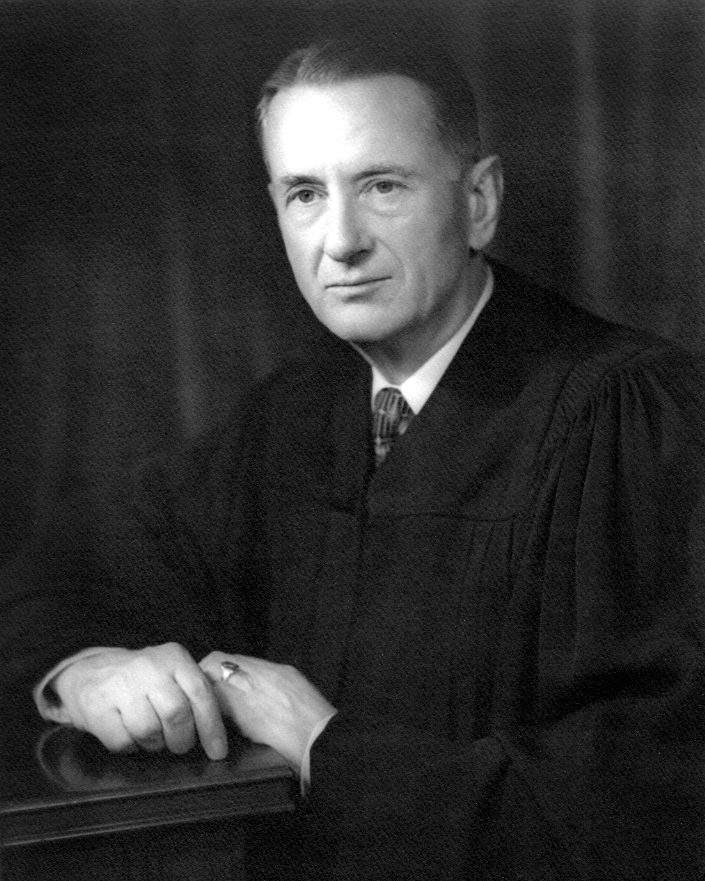
Historical · Supreme Court of the United States
Charles Evans Whittaker
Former justice
Former Associate Justice · Supreme Court of the United States · 1957–1962 · Appointed by Dwight D Eisenhower
Charles Evans Whittaker served as an Associate Justice of the Supreme Court of the United States (1957–1962) was appointed by Dwight D Eisenhower. The page below collects sourced biographical facts, the appointment record, and provenance for Whittaker.
FJC ID: 1389716
Key facts
- Full name
- Charles Evans Whittaker
- Court
- Supreme Court of the United States
- Role
- Associate Justice
- Status
- Former justice
- Seat
- SCT0711
- Appointed by
- Dwight D Eisenhower
- Appointment
- Senate-confirmed
- Confirmed
- 1957-03-19
- Supreme Court service
- 1957–1962
- Took seat
- 1957
- Born
- 1901
- Died
- 1973
- Dataset version
- 1.20260711
Appointment & service record
Associate Justice of the Supreme Court of the United States · 1957–1962
- Seat
- SCT0711
- Appointing president
- Dwight D Eisenhower
- Appointment
- Senate-confirmed
- Confirmed
- March 19, 1957
Seat, appointing president, appointment type, confirmation date, and service dates are drawn from the Federal Judicial Center Biographical Directory and the Supreme Court's own members roster.[1][2][3]
Sources
- [1]https://www.fjc.gov/node/1389716fjc · retrieved 2026-06-17
- [2]https://www.supremecourt.gov/about/members_text.aspxsupremecourt.gov · retrieved 2026-06-17
- [3]https://www.fjc.gov/history/judges/biographical-directory-article-iii-federal-judges-exportfjc-directory · retrieved 2026-06-17
Biographical narrative
924 words · sourced from the Wikipedia REST extract
Charles Evans Whittaker served as an Associate Justice of the United States Supreme Court from 1957 until his resignation in 1962. Born on a farm near Troy, Kansas, he rose through the ranks of the federal judiciary to become the first individual to hold judicial office at all three levels—district court, appellate court, and the nation’s highest court. Appointed by President Dwight D. Eisenhower, Whittaker’s tenure was marked by his role as a swing vote on a closely divided Court and by a brief period of intense personal stress that led to his departure from the bench.
Early life and legal career
Whittaker entered the world on February 22, 1901, the son of Charles Edward Whittaker, a farmer, and Ida Eve Miller, a schoolteacher. He received his early education at the Brush Creek School and Troy High School before leaving formal schooling in ninth grade after his mother’s death when he was sixteen. For three years he worked on the family farm while also engaging in hunting and trapping, activities that fostered a practical understanding of rural life.
In 1920, inspired by newspaper accounts of criminal trials, Whittaker applied to the part‑time evening program at the Kansas City School of Law—now part of the University of Missouri–Kansas City. After securing admission on the condition that he complete his high school education, he enrolled in Manual High School while attending law classes in the evenings. He supported himself through daytime work and earned a Bachelor of Laws degree in 1924, being admitted to the Missouri bar during his final year.
Whittaker’s early legal practice was rooted in corporate law. After joining Watson, Ess, Marshall & Enggas in Kansas City—a firm where he had previously worked as an office boy—he represented major clients such as Union Pacific Railroad, Montgomery Ward, and the City National Bank and Trust Company. His professional associations included membership in Tau Kappa Epsilon fraternity, and he cultivated close ties to the Republican Party, though he himself remained non‑partisan.
In 1954 President Eisenhower nominated Whittaker to the United States District Court for the Western District of Missouri, where he served from July 7, 1954, until June 21, 1956. The following year he was elevated by the same president to the United States Court of Appeals for the Eighth Circuit, serving from June 5, 1956, until March 24, 1957. His rapid progression through these federal courts made him one of only two individuals—alongside Samuel Blatchford—to hold judicial office at all three levels during that era.
Supreme Court tenure
On March 2, 1957, President Eisenhower nominated Whittaker to the Supreme Court as an Associate Justice, filling the seat vacated by Stanley Forman Reed. The Senate confirmed him unanimously on March 19, 1957, and he took his oath of office on March 25, 1957. His appointment made him the first person to serve at a district court, appellate court, and the Supreme Court.
During his time on the bench, Whittaker served as Circuit Justice for both the Eighth and Tenth Circuits. The Court was closely divided during this period, and Whittaker’s votes were often pivotal. Contemporary observers described him as a swing vote whose decisions varied from case to case. He did not develop a consistent judicial philosophy; instead, his opinions reflected careful deliberation in each instance.
The stress of the Court’s workload intensified for Whittaker in the spring of 1962, particularly surrounding the landmark reapportionment case Baker v. Carr. After extensive contemplation over his position on that decision, he suffered a nervous breakdown. At Chief Justice Earl Warren’s request, he recused himself from the case and subsequently retired effective March 31, 1962, citing a certified disability and exhaustion from the Court’s demands.
Whittaker remains the only Supreme Court Justice appointed from Missouri as of 2025, and he is also noted for being the most recently appointed Justice to have received his legal education from a public law school. His brief tenure on the Court left an imprint on the institution’s history through his role as a decisive vote in a closely divided era.
Jurisprudence and legacy
Whittaker’s jurisprudential record on the Supreme Court is characterized by its brevity and lack of a single, overarching theme. He participated in decisions that reflected the Court’s cautious approach to expanding federal power during the late 1950s and early 1960s. His most notable involvement was in Baker v. Carr, a case that addressed congressional reapportionment; his deliberations on this matter were particularly taxing and contributed to his eventual resignation.
After leaving the Supreme Court, Whittaker entered private practice as chief counsel for General Motors beginning September 30, 1965. In this capacity he became an outspoken critic of both the Warren Court’s decisions and the broader Civil Rights Movement. He characterized civil disobedience led by figures such as Martin Luther King Jr. as lawless and advised protesters to seek resolution through judicial channels rather than street demonstrations. His commentary appeared in publications including the FBI Law Enforcement Bulletin.
Whittaker’s death occurred on November 26, 1973, at St. Luke's Hospital in Kansas City, Missouri, following a ruptured abdominal aneurysm. He was survived by his wife, Winifred R. Pugh, and their three sons: Dr. Charles Keith Whittaker, Kent E. Whittaker, and Gary T. Whittaker.
Whittaker’s legacy is multifaceted. He remains a unique figure in the federal judiciary for having served at every level of the federal court system. His tenure on the Supreme Court exemplifies the pressures faced by justices during periods of intense social change, while his post‑judicial career reflects a continued engagement with legal and political discourse.
Sources & provenance
Every quantitative or attributable claim above carries a per-section [N] marker that resolves to the corresponding URL below. Each entry records the upstream provider, the canonical URL, and the timestamp at which the underlying source was retrieved.
Key facts
- https://www.fjc.gov/node/1389716fjc · retrieved 2026-06-17
- https://www.supremecourt.gov/about/members_text.aspxsupremecourt.gov · retrieved 2026-06-17
- https://www.fjc.gov/history/judges/biographical-directory-article-iii-federal-judges-exportfjc-directory · retrieved 2026-06-17
Biographical narrative
- https://en.wikipedia.org/wiki/Charles_Evans_WhittakerWikipedia · retrieved 2026-06-17
Explore the federal judiciary
Fewer than 120 people have served on the Supreme Court of the United States in its history. Browse the full roster of current and former justices, or explore how the appointed federal judiciary fits into the federal government.