
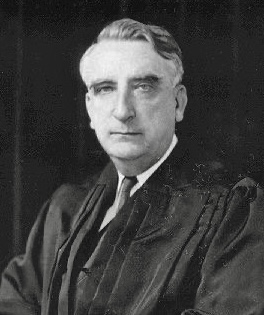
Historical · Supreme Court of the United States
Frederick Moore Vinson
Former justice
Former Chief Justice · Supreme Court of the United States · 1946–1953 · Appointed by Harry S Truman
Frederick Moore Vinson served as the Chief Justice of the Supreme Court of the United States (1946–1953) was appointed by Harry S Truman. The page below collects sourced biographical facts, the appointment record, and provenance for Vinson.
FJC ID: 1389186
Key facts
- Full name
- Frederick Moore Vinson
- Court
- Supreme Court of the United States
- Role
- Chief Justice
- Status
- Former justice
- Seat
- SCT0113
- Appointed by
- Harry S Truman
- Appointment
- Senate-confirmed
- Confirmed
- 1946-06-20
- Supreme Court service
- 1946–1953
- Took seat
- 1946
- Born
- 1890
- Died
- 1953
- Dataset version
- 1.20260711
Appointment & service record
Chief Justice of the United States · 1946–1953
- Seat
- SCT0113
- Appointing president
- Harry S Truman
- Appointment
- Senate-confirmed
- Confirmed
- June 20, 1946
Seat, appointing president, appointment type, confirmation date, and service dates are drawn from the Federal Judicial Center Biographical Directory and the Supreme Court's own members roster.[1][2][3]
Sources
- [1]https://www.fjc.gov/node/1389186fjc · retrieved 2026-06-16
- [2]https://www.supremecourt.gov/about/members_text.aspxsupremecourt.gov · retrieved 2026-06-16
- [3]https://www.fjc.gov/history/judges/biographical-directory-article-iii-federal-judges-exportfjc-directory · retrieved 2026-06-16
Biographical narrative
915 words · sourced from the Wikipedia REST extract
Frederick Moore Vinson was an American lawyer, legislator, judge, and statesman who served as the thirteenth Chief Justice of the United States from 1946 until his death in 1953. Born in Kentucky, he pursued a legal career that led him to serve in all three branches of federal government: as a member of Congress, an appellate judge on the United States Court of Appeals for the District of Columbia Circuit, and finally as Chief Justice of the Supreme Court. His tenure on the nation's highest court was marked by significant decisions related to executive power and civil rights, and he remains notable as the most recent chief justice appointed by a Democratic president.
Early life and legal career
Frederick Moore Vinson entered the world on January 22, 1890, in Louisa, Kentucky. His childhood unfolded in an eight‑room red brick house situated across from the Lawrence County jail where his father worked as the county jailer. The young Vinson assisted his father with duties at the jail and developed friendships with inmates who would later remember his kindness when he entered public life. He balanced work and schooling, taking on odd jobs while attending local schools.
In 1909, Vinson graduated from Kentucky Normal School before enrolling at Centre College in Danville, where he earned a Bachelor of Arts degree as the top graduate of his class. While at Centre, he joined the Kentucky Alpha Delta chapter of Phi Delta Theta fraternity. He then pursued legal studies at the now‑defunct College of Law, receiving a Bachelor of Laws.
Vinson began his professional life in private practice in Louisa and quickly entered public service. He was elected City Attorney of Louisa, marking his first foray into elected office. During World War I, he supported the war effort through speeches that promoted bond drives and Red Cross appeals. Although initially rejected twice as underweight when attempting to enlist, he was finally accepted into the United States Army in August 1918. He completed basic training at Camp Zachary Taylor in Kentucky and attended officer training at Camp Pike in Arkansas; however, the Armistice of November 11, 1918, ended hostilities before he saw combat.
After his brief military service, Vinson was elected Commonwealth's Attorney for Kentucky’s Thirty‑Second Judicial District. In 1924, he married Julia Roberta Dixon in Ashland, Kentucky; the couple would have two sons. His legal background and local reputation paved the way for a national political career.
Supreme Court tenure
President Harry S. Truman nominated Vinson to serve as Chief Justice of the United States on June 20, 1946, following the death of Chief Justice Harlan F. Stone. The Senate confirmed his appointment that same day, and he assumed office in 1946, serving until his passing on September 8, 1953. During this period, Vinson presided over a Supreme Court that grappled with issues ranging from wartime executive authority to the early stages of the civil rights movement.
One notable case during his tenure was *Youngstown Sheet & Tube Co. v. Sawyer*, in which the Court ruled against the Truman administration’s attempt to control steel mills amid a strike. Vinson dissented, expressing concern over the limits of presidential power in times of crisis. He also played a pivotal role in civil rights litigation by ordering a rehearing of *Briggs v. Elliott*. The case was later combined with other similar cases to form *Brown v. Board of Education*, a landmark decision that declared state laws establishing separate public schools for black and white students unconstitutional.
Vinson’s service as chief justice is distinguished by his unique experience across all three branches of federal government, a rare accomplishment among American jurists. He remains the most recent chief justice appointed by a Democratic president, reflecting the historical context of mid‑20th‑century American politics.
Jurisprudence and legacy
Before ascending to the Supreme Court, Vinson had already built a multifaceted career that spanned legislative, judicial, and executive roles. As a U.S. Representative from Kentucky (1924–1928 and 1930–1938), he served as an adviser and confidant to Senator Harry S. Truman, a relationship that would influence his later appointments. In 1937, President Franklin D. Roosevelt appointed him to the United States Court of Appeals for the District of Columbia Circuit, where he served until 1943. His judicial work included service as Chief Judge of the Emergency Court of Appeals.
In 1945, after Truman became president following Roosevelt’s death, Vinson was named Secretary of the Treasury. In that capacity, he negotiated the repayment of the Anglo‑American loan and oversaw the creation of key post‑war financial institutions, including the International Bank for Reconstruction and Development (commonly known as the World Bank) and the International Monetary Fund.
Vinson’s legacy is multifaceted. His dissent in *Youngstown* highlighted concerns about executive overreach, while his intervention in *Briggs* helped set the stage for the eventual dismantling of legal segregation in public schools. His administrative work as Treasury Secretary contributed to the stabilization of post‑war economies and the establishment of international financial frameworks that continue to influence global economics today.
Throughout his career, Vinson maintained a reputation for integrity and dedication to public service. He is remembered not only for his judicial opinions but also for his broader contributions to American governance, exemplifying a rare blend of legislative insight, judicial prudence, and executive experience. His death in 1953 marked the end of an era in which one individual had served at the highest levels of all three branches of the federal government, leaving a lasting imprint on the nation's legal and political landscape.
Sources & provenance
Every quantitative or attributable claim above carries a per-section [N] marker that resolves to the corresponding URL below. Each entry records the upstream provider, the canonical URL, and the timestamp at which the underlying source was retrieved.
Key facts
- https://www.fjc.gov/node/1389186fjc · retrieved 2026-06-16
- https://www.supremecourt.gov/about/members_text.aspxsupremecourt.gov · retrieved 2026-06-16
- https://www.fjc.gov/history/judges/biographical-directory-article-iii-federal-judges-exportfjc-directory · retrieved 2026-06-16
Biographical narrative
- https://en.wikipedia.org/wiki/Fred_M._VinsonWikipedia · retrieved 2026-06-16
Explore the federal judiciary
Fewer than 120 people have served on the Supreme Court of the United States in its history. Browse the full roster of current and former justices, or explore how the appointed federal judiciary fits into the federal government.