
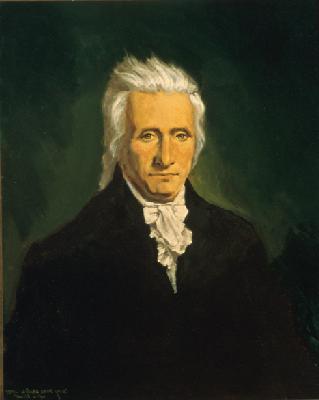
Historical · Supreme Court of the United States
Gabriel Duvall
Former justice
Former Associate Justice · Supreme Court of the United States · 1811–1835 · Appointed by James Madison
Gabriel Duvall served as an Associate Justice of the Supreme Court of the United States (1811–1835) was appointed by James Madison. The page below collects sourced biographical facts, the appointment record, and provenance for Duvall.
FJC ID: 1380306
Key facts
- Full name
- Gabriel Duvall
- Court
- Supreme Court of the United States
- Role
- Associate Justice
- Status
- Former justice
- Seat
- SCT0503
- Appointed by
- James Madison
- Appointment
- Senate-confirmed
- Confirmed
- 1811-11-18
- Supreme Court service
- 1811–1835
- Took seat
- 1811
- Born
- 1752
- Died
- 1844
- Dataset version
- 1.20260711
Appointment & service record
Associate Justice of the Supreme Court of the United States · 1811–1835
- Seat
- SCT0503
- Appointing president
- James Madison
- Appointment
- Senate-confirmed
- Confirmed
- November 18, 1811
Seat, appointing president, appointment type, confirmation date, and service dates are drawn from the Federal Judicial Center Biographical Directory and the Supreme Court's own members roster.[1][2][3]
Sources
- [1]https://www.fjc.gov/node/1380306fjc · retrieved 2026-06-16
- [2]https://www.supremecourt.gov/about/members_text.aspxsupremecourt.gov · retrieved 2026-06-16
- [3]https://www.fjc.gov/history/judges/biographical-directory-article-iii-federal-judges-exportfjc-directory · retrieved 2026-06-16
Biographical narrative
1,011 words · sourced from the Wikipedia REST extract
Gabriel Duvall served as an associate justice of the United States Supreme Court from 1811 until 1835, a period that encompassed much of the early development of federal jurisprudence under Chief Justice John Marshall. Prior to his appointment to the nation's highest court, Duvall held several significant positions in both state and federal government, including service as a member of the U.S. House of Representatives from Maryland, chief justice of the Maryland General Court, and the first Comptroller of the Treasury. His career spanned military service during the American Revolution, legislative work at the state level, and a long tenure on the Supreme Court where he authored a modest number of opinions.
Early life and legal career
Gabriel Duvall was born on December 6, 1752, in Prince George's County within the Province of Maryland. He was the sixth child of Benjamin Duvall and Susanna Tyler. The family owned land that would later become known as Marietta, a tobacco plantation that played an important role in his later life. Two of his older brothers died while fighting for independence during the American Revolutionary War.
In 1775, Duvall began working as a clerk for the Maryland Council of Safety, which oversaw the state militia. He continued in clerical roles with the Maryland House of Delegates from 1777 to 1781. During the Revolution he served first as a mustermaster and commissary of stores in 1776, then enlisted as a private in the Maryland militia, participating in engagements such as the Battle of Brandywine and at Morristown, New Jersey. After the war, he returned to civil service, acting as a commissioner tasked with preserving confiscated British property from 1781 to 1782, and later serving on the Governor's Council from 1782 until 1785.
Duvall pursued legal studies by reading law, gaining admission to the bar in Prince George's County in 1778. He practiced privately in both Anne Arundel and Prince George’s counties for many years, with a notable presence in Annapolis where he served as county prosecutor in the Mayor’s Court beginning in 1781 and later appeared before the Anne Arundel County court starting in 1783. By 1792, records indicate that he had formally participated in approximately six hundred cases.
His legal career was complemented by political service. Duvall was elected to the Maryland House of Delegates, serving from 1787 through 1794. In November 1794 he entered national politics as a member of the United States House of Representatives for Maryland’s second district, holding that seat until March 1796. After his congressional term, he returned to state service and was appointed chief justice of the Maryland General Court in 1796, a position he held until 1802.
In 1802, President Thomas Jefferson selected Duvall as the first Comptroller of the Treasury, a role that involved overseeing federal financial operations. He remained in this capacity until 1811, when his judicial career on the national stage began.
Supreme Court tenure
President James Madison nominated Gabriel Duvall to fill the vacancy left by former associate justice Samuel Chase on November 15, 1811. The United States Senate confirmed him on November 18, 1811, and he received his commission that same day. He was sworn into office on November 23, 1811, and served as an associate justice until January 14, 1835.
During the twenty-three years of Duvall’s service on the Supreme Court, the body operated largely under the leadership of Chief Justice John Marshall, whose expansive view of federal power dominated the court’s decisions. The period was characterized by a high volume of opinions written by Marshall himself; associate justices were rarely called upon to author separate opinions.
Duvall’s own record reflects this trend: he authored a total of eighteen opinions while on the bench. These included fifteen majority opinions, two concurring opinions, and one dissenting opinion. The lone dissent came in a case that remains notable for being the only instance in which Duvall opposed the prevailing view of his colleagues.
The court’s docket during this era addressed a wide array of issues, from federalism to commerce, but Duvall’s limited number of written opinions suggests he was not frequently called upon to shape the Court’s jurisprudence. Nonetheless, his presence contributed to the stability and continuity of the institution through a formative period in American legal history.
Jurisprudence and legacy
Gabriel Duvall’s judicial output on the Supreme Court was modest compared with that of many of his contemporaries. The fact that he authored only eighteen opinions over more than two decades has led some scholars to examine the extent of his influence within the Marshall Court. Academic debates have emerged regarding the relative significance of justices who produced few written judgments, and Duvall’s name often appears in discussions about judicial impact versus participation.
Beyond his role on the Supreme Court, Duvall’s earlier career offers insight into the legal and political culture of early America. As a lawyer, he represented more than one hundred enslaved individuals seeking freedom, achieving success in roughly seventy-five percent of those cases. This record illustrates both his legal skill and the complex moral landscape of the era. At the same time, Duvall was involved in the ownership of enslaved people on his Marietta plantation, a fact that underscores the contradictions present among many early American public officials.
After retiring from the Court in 1835, Duvall returned to private life at his home in Marietta, where he lived until his death on March 6, 1844. His burial took place at the family cemetery associated with the plantation. Throughout his career, Duvall maintained active ties to both Maryland and Washington, D.C., and was known for his involvement in local religious communities, including St. Anne’s Church in Annapolis and Holy Trinity Episcopal Church in Collington.
In sum, Gabriel Duvall’s life spanned military service, state and federal legislative roles, executive financial oversight, and a lengthy tenure on the Supreme Court during a pivotal era of American jurisprudence. While his judicial record was comparatively brief, his participation helped sustain the early development of the United States’ highest court amid the evolving interpretations of federal authority that defined the Marshallian period.
Sources & provenance
Every quantitative or attributable claim above carries a per-section [N] marker that resolves to the corresponding URL below. Each entry records the upstream provider, the canonical URL, and the timestamp at which the underlying source was retrieved.
Key facts
- https://www.fjc.gov/node/1380306fjc · retrieved 2026-06-16
- https://www.supremecourt.gov/about/members_text.aspxsupremecourt.gov · retrieved 2026-06-16
- https://www.fjc.gov/history/judges/biographical-directory-article-iii-federal-judges-exportfjc-directory · retrieved 2026-06-16
Biographical narrative
- https://en.wikipedia.org/wiki/Gabriel_DuvallWikipedia · retrieved 2026-06-16
Explore the federal judiciary
Fewer than 120 people have served on the Supreme Court of the United States in its history. Browse the full roster of current and former justices, or explore how the appointed federal judiciary fits into the federal government.