
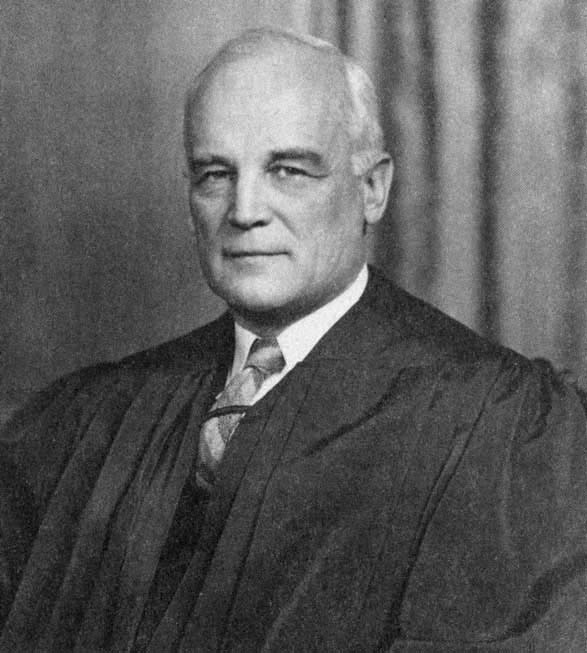
Historical · Supreme Court of the United States
Harold Hitz Burton
Former justice
Former Associate Justice · Supreme Court of the United States · 1945–1958 · Appointed by Harry S Truman
Harold Hitz Burton served as an Associate Justice of the Supreme Court of the United States (1945–1958) was appointed by Harry S Truman. The page below collects sourced biographical facts, the appointment record, and provenance for Burton.
FJC ID: 1378621
Key facts
- Full name
- Harold Hitz Burton
- Court
- Supreme Court of the United States
- Role
- Associate Justice
- Status
- Former justice
- Seat
- SCT0908
- Appointed by
- Harry S Truman
- Appointment
- Senate-confirmed
- Confirmed
- 1945-09-19
- Supreme Court service
- 1945–1958
- Took seat
- 1945
- Born
- 1888
- Died
- 1964
- Dataset version
- 1.20260711
Appointment & service record
Associate Justice of the Supreme Court of the United States · 1945–1958
- Seat
- SCT0908
- Appointing president
- Harry S Truman
- Appointment
- Senate-confirmed
- Confirmed
- September 19, 1945
Seat, appointing president, appointment type, confirmation date, and service dates are drawn from the Federal Judicial Center Biographical Directory and the Supreme Court's own members roster.[1][2][3]
Sources
- [1]https://www.fjc.gov/node/1378621fjc · retrieved 2026-06-17
- [2]https://www.supremecourt.gov/about/members_text.aspxsupremecourt.gov · retrieved 2026-06-17
- [3]https://www.fjc.gov/history/judges/biographical-directory-article-iii-federal-judges-exportfjc-directory · retrieved 2026-06-17
Biographical narrative
942 words · sourced from the Wikipedia REST extract
Harold Hitz Burton was an American lawyer, politician, and jurist who served in several prominent public offices before being appointed to the Supreme Court of the United States. Born in 1888, he practiced law in Cleveland, Ohio, where he also held elected positions as a state legislator and mayor. In 1940 he was chosen by Ohio voters for the U.S. Senate, serving until his appointment to the federal bench in 1945. As an associate justice from 1945 to 1958, Burton participated in landmark decisions during a period of significant social change, including the unanimous ruling that ended legal segregation in public schools.
Early life and legal career
Harold Hitz Burton entered the world on June 22, 1888, in Jamaica Plain, Massachusetts. His parents were Anna Gertrude (Hitz) and Alfred Edgar Burton, an engineer who later became the first Dean of Student Affairs at the Massachusetts Institute of Technology. After his mother’s early death, his father remarried Lena Yates, a poet and artist from England who adopted the name Jeanne D’Orge; together they raised three children, among whom Harold was one.
Burton pursued higher education at Bowdoin College in Maine, where he distinguished himself academically and athletically. He was elected to Phi Beta Kappa, served as quarterback of the football team, and graduated summa cum laude. In 1912 he entered Harvard Law School, completing his legal studies that same year.
Following graduation, Burton married Selma Florence Smith, also in 1912. The couple settled in Cleveland, Ohio, where he began a private law practice. His early professional life was marked by a brief tenure as company attorney for Utah Power and Light Company in Salt Lake City (1914), after which he worked for several utility firms—including Utah Light and Traction, Idaho Power Company, and Boise Valley Traction Company—in Boise, Idaho.
Burton’s interest in public service emerged during World War I. He enlisted in the United States Army in May 1917, completing officer training at the Presidio in San Francisco as a second lieutenant. Assigned to the 361st Infantry Regiment of the 91st Division at Camp Lewis near Tacoma, Washington, he commanded Company A and later served as regimental operations officer. He saw combat during the Meuse–Argonne Offensive in France, where he was promoted to captain and took on duties as assistant regimental adjutant.
After the war, Burton returned to Cleveland and entered politics. He was elected to the Ohio House of Representatives, where he began building a reputation within the Republican Party. His municipal leadership culminated in his election as mayor of Cleveland, a position that further elevated his profile at the state level. In 1940, leveraging his experience and name recognition, Burton ran for the United States Senate representing Ohio. He won the seat and served one term before being nominated to the Supreme Court.
Supreme Court tenure
President Harry S. Truman, a Democrat, selected Burton to fill the vacancy left by retiring Associate Justice Owen J. Roberts in 1945. The nomination was confirmed on September 19, 1945, and Burton took his seat as an associate justice that same year. He occupied seat SCT0908 until his retirement in 1958, when he was succeeded by Potter Stewart.
During his thirteen years on the Court, Burton was known for a measured, pragmatic approach to adjudication. Colleagues described him as dispassionate and somewhat plodding, favoring technical and procedural analysis over sweeping constitutional pronouncements. His demeanor contributed to a more collegial atmosphere during an era of intense ideological division among the justices.
Burton authored majority opinions in several notable cases. In 1951 he wrote the decision for Joint Anti‑Fascist Refugee Committee v. McGrath, addressing issues related to immigration and national security. That same year, he penned the opinion for Lorain Journal Co. v. United States, which dealt with federal regulatory authority over the press. While not a frequent author of opinions, Burton’s contributions were significant in shaping the Court’s jurisprudence during his tenure.
Perhaps most famously, Burton played a role in the unanimous decision that ended legal segregation in public schools. In 1954, the Supreme Court issued its landmark ruling in Brown v. Board of Education, declaring state laws establishing separate public schools for black and white students to be unconstitutional. Though the decision was unanimous, Burton’s participation helped ensure the Court’s cohesion during a pivotal moment in American history.
Jurisprudence and legacy
Harold Hitz Burton’s judicial philosophy emphasized careful attention to procedural detail and respect for established legal frameworks. He avoided sweeping constitutional declarations unless absolutely warranted, preferring instead to resolve disputes through meticulous analysis of statutes, regulations, and precedent. This approach earned him a reputation as an affable justice who could bridge divides among his colleagues.
Burton’s influence extended beyond the opinions he authored. His presence on the bench contributed to a more collaborative environment during a period marked by sharp ideological contrasts. By focusing on procedural clarity and fostering collegial dialogue, he helped temper tensions that might have otherwise escalated into prolonged deadlock.
After retiring from the Supreme Court in 1958, Burton’s legacy continued through his earlier public service roles. His tenure as mayor of Cleveland and U.S. Senator for Ohio reflected a commitment to civic responsibility and governance. In each capacity, he applied the same measured approach that characterized his judicial work: a focus on practical solutions grounded in established law.
Harold Hitz Burton passed away on October 28, 1964, leaving behind a record of public service that spanned local, state, and national levels. His contributions to the Supreme Court—particularly during the transformative era of the 1950s—remain part of the broader narrative of American jurisprudence, illustrating how a pragmatic, procedural focus can shape outcomes in moments of profound societal change.
Sources & provenance
Every quantitative or attributable claim above carries a per-section [N] marker that resolves to the corresponding URL below. Each entry records the upstream provider, the canonical URL, and the timestamp at which the underlying source was retrieved.
Key facts
- https://www.fjc.gov/node/1378621fjc · retrieved 2026-06-17
- https://www.supremecourt.gov/about/members_text.aspxsupremecourt.gov · retrieved 2026-06-17
- https://www.fjc.gov/history/judges/biographical-directory-article-iii-federal-judges-exportfjc-directory · retrieved 2026-06-17
Biographical narrative
- https://en.wikipedia.org/wiki/Harold_H._BurtonWikipedia · retrieved 2026-06-17
Explore the federal judiciary
Fewer than 120 people have served on the Supreme Court of the United States in its history. Browse the full roster of current and former justices, or explore how the appointed federal judiciary fits into the federal government.