
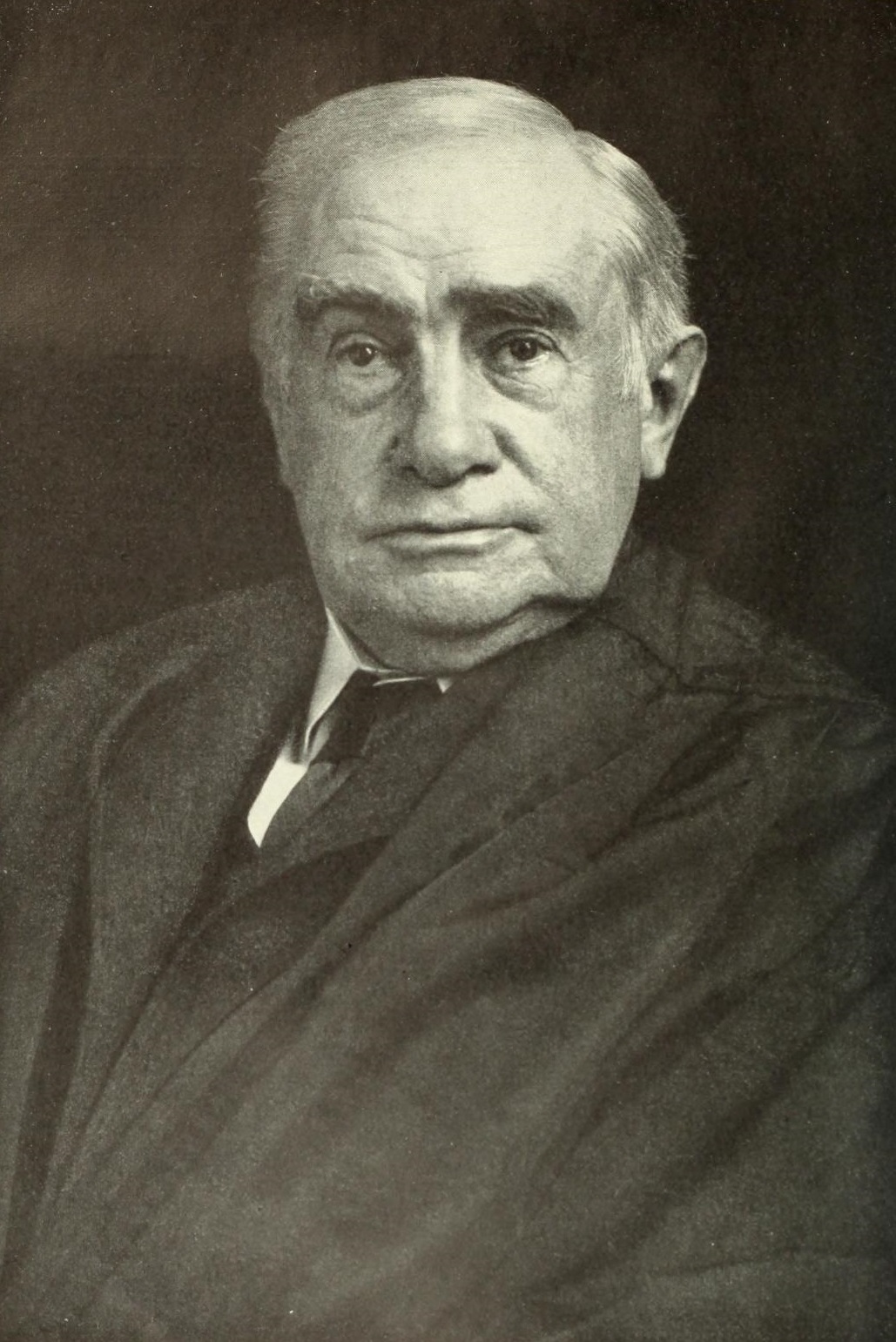
Historical · Supreme Court of the United States
Henry Billings Brown
Former justice
Former Associate Justice · Supreme Court of the United States · 1890–1906 · Appointed by Benjamin Harrison
Henry Billings Brown served as an Associate Justice of the Supreme Court of the United States (1890–1906) was appointed by Benjamin Harrison. The page below collects sourced biographical facts, the appointment record, and provenance for Brown.
FJC ID: 1378386
Key facts
- Full name
- Henry Billings Brown
- Court
- Supreme Court of the United States
- Role
- Associate Justice
- Status
- Former justice
- Seat
- SCT0507
- Appointed by
- Benjamin Harrison
- Appointment
- Senate-confirmed
- Confirmed
- 1890-12-29
- Supreme Court service
- 1890–1906
- Took seat
- 1890
- Born
- 1836
- Died
- 1913
- Dataset version
- 1.20260711
Appointment & service record
Associate Justice of the Supreme Court of the United States · 1890–1906
- Seat
- SCT0507
- Appointing president
- Benjamin Harrison
- Appointment
- Senate-confirmed
- Confirmed
- December 29, 1890
Seat, appointing president, appointment type, confirmation date, and service dates are drawn from the Federal Judicial Center Biographical Directory and the Supreme Court's own members roster.[1][2][3]
Sources
- [1]https://www.fjc.gov/node/1378386fjc · retrieved 2026-06-16
- [2]https://www.supremecourt.gov/about/members_text.aspxsupremecourt.gov · retrieved 2026-06-16
- [3]https://www.fjc.gov/history/judges/biographical-directory-article-iii-federal-judges-exportfjc-directory · retrieved 2026-06-16
Biographical narrative
1,007 words · sourced from the Wikipedia REST extract
Henry Billings Brown served as an associate justice of the United States Supreme Court from 1891 to 1906, following a distinguished career as a lawyer and federal district judge in Michigan. Appointed by President Benjamin Harrison, he succeeded Samuel Freeman Miller on the high court. Brown’s tenure is most noted for his authorship of the majority opinion in Plessy v. Ferguson, which upheld state laws permitting racial segregation in public transportation under the doctrine of “separate but equal.” His judicial record also includes opinions that reflected a general reluctance to endorse government intervention in business and support for federal taxation.
Early life and legal career
Brown was born on March 2, 1836, in South Lee, Massachusetts. He grew up in both Massachusetts and Connecticut within a family of English Puritan descent; the earliest ancestor to arrive in New England was Edward Brown, who settled in Ipswich, Massachusetts during the Puritan migration of the early seventeenth century. His parents were Mary Tyler and Billings Brown.
He attended Monson Academy before enrolling at Yale College at the age of sixteen. While a student he joined Alpha Delta Phi fraternity and earned membership in Phi Beta Kappa upon graduation with a Bachelor of Arts degree in 1856. Among his classmates were Chauncey Depew, who later served as a U.S. Senator from New York, and David Josiah Brewer, who would become a fellow associate justice on the Supreme Court. Brown spent a year touring Europe after college before studying law under Judge John H. Brockway in Ellington, Connecticut. He also completed one year at Yale Law School and a semester at Harvard Law School.
In 1860, Brown was admitted to the Michigan Bar and began his legal practice in Detroit. His early work focused on admiralty law as it applied to shipping on the Great Lakes. Between 1861 and 1868 he served in several federal roles: Deputy U.S. Marshal, Assistant United States Attorney for the Eastern District of Michigan, and briefly as a judge of the Wayne County Circuit Court in Detroit, although he did not win election to a full term. He later joined the firm Newberry, Pond & Brown, where he specialized in admiralty law for seven years. In 1872 he sought the Republican nomination for a congressional seat but was unsuccessful.
Brown married Caroline Pitts in 1864; she was the daughter of a wealthy Michigan lumber merchant. The couple had no children. He did not serve in the Union Army during the Civil War, opting instead to hire a substitute soldier. Brown maintained diaries from his college years onward, which are now preserved in the Burton Historical Collection of the Detroit Public Library. These journals portray him as both genial and ambitious, yet also suggest moments of depression and self-doubt. He was raised in the Congregational Church and later attended Presbyterian services with his wife, though he generally showed little interest in religious matters.
In 1875, President Ulysses S. Grant nominated Brown to a seat on the United States District Court for the Eastern District of Michigan, vacated by the death of John Wesley Longyear. The Senate confirmed him two days later, and he received his commission immediately. During his district court tenure, Brown edited collections of admiralty rulings and compiled a case book used in lectures at Georgetown University. He also taught admiralty law at the University of Michigan Law School from 1860 to 1875 and medical jurisprudence at the Detroit Medical College (now part of Wayne State University) between 1868 and 1871. The University of Michigan awarded him an honorary doctorate in 1887, and Yale conferred a similar honor in 1891.
Supreme Court tenure
President Benjamin Harrison nominated Brown to the Supreme Court on December 23, 1890, to fill the vacancy left by Samuel Freeman Miller. Harrison had previously considered Brown for a different appointment following the death of Stanley Matthews but ultimately selected him for this position. The Senate confirmed Brown by voice vote on December 29, 1890; he was sworn in on January 5, 1891. He served as an associate justice until his retirement in 1906.
During his time on the Court, Brown authored opinions that reflected a general skepticism toward extensive government regulation of business. In 1905, he joined the majority opinion in Lochner v. New York, which struck down a state law limiting maximum working hours for bakers. He also supported federal income taxation, writing the majority opinion in Pollock v. Farmers' Loan & Trust Co. (1895). In Holden v. Hardy (1898), Brown upheld a Utah statute restricting male miners to an eight‑hour workday.
Brown’s most consequential contribution was his authorship of the majority opinion in Plessy v. Ferguson, which upheld state laws permitting racial segregation on public transportation under the principle that “separate but equal” facilities were constitutionally permissible. The decision legitimized existing segregation statutes and provided a legal foundation for subsequent segregation laws enacted after Reconstruction.
Jurisprudence and legacy
Brown’s jurisprudential philosophy was characterized by a preference for limited federal intervention in commerce and industry, coupled with support for certain forms of taxation. His opinions on the Court often reflected this stance, as seen in cases such as Lochner and Pollock. However, his legacy is most strongly associated with Plessy v. Ferguson. The majority opinion he wrote has been widely criticized by scholars and legal commentators for its flawed reasoning and lasting negative impact on civil rights. By endorsing the doctrine of “separate but equal,” Brown’s decision effectively nullified many legislative achievements of the Reconstruction era, allowing state governments to enact further segregation statutes.
While Brown was respected as a lawyer and district judge before his elevation to the Supreme Court, the Plessy opinion has become a central point of reference in discussions of the Court’s history. The ruling is often cited as one of the most ill‑considered decisions issued by the Court, illustrating how a single majority opinion can shape national policy for decades. Brown’s tenure on the high court thus embodies both the influence and the potential pitfalls of judicial decision‑making in the United States.
Sources & provenance
Every quantitative or attributable claim above carries a per-section [N] marker that resolves to the corresponding URL below. Each entry records the upstream provider, the canonical URL, and the timestamp at which the underlying source was retrieved.
Key facts
- https://www.fjc.gov/node/1378386fjc · retrieved 2026-06-16
- https://www.supremecourt.gov/about/members_text.aspxsupremecourt.gov · retrieved 2026-06-16
- https://www.fjc.gov/history/judges/biographical-directory-article-iii-federal-judges-exportfjc-directory · retrieved 2026-06-16
Biographical narrative
- https://en.wikipedia.org/wiki/Henry_Billings_BrownWikipedia · retrieved 2026-06-16
Explore the federal judiciary
Fewer than 120 people have served on the Supreme Court of the United States in its history. Browse the full roster of current and former justices, or explore how the appointed federal judiciary fits into the federal government.