
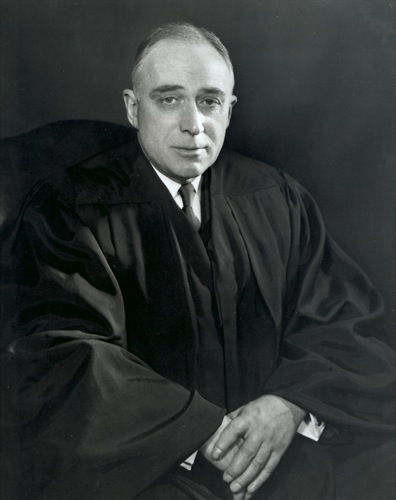
Historical · Supreme Court of the United States
John Marshall Harlan
Former justice
Former Associate Justice · Supreme Court of the United States · 1955–1971 · Appointed by Dwight D Eisenhower
John Marshall Harlan served as an Associate Justice of the Supreme Court of the United States (1955–1971) was appointed by Dwight D Eisenhower. The page below collects sourced biographical facts, the appointment record, and provenance for Harlan.
FJC ID: 1381831
Key facts
- Full name
- John Marshall Harlan
- Court
- Supreme Court of the United States
- Role
- Associate Justice
- Status
- Former justice
- Seat
- SCT1005
- Appointed by
- Dwight D Eisenhower
- Appointment
- Senate-confirmed
- Confirmed
- 1955-03-16
- Supreme Court service
- 1955–1971
- Took seat
- 1955
- Born
- 1899
- Died
- 1971
- Dataset version
- 1.20260711
Appointment & service record
Associate Justice of the Supreme Court of the United States · 1955–1971
- Seat
- SCT1005
- Appointing president
- Dwight D Eisenhower
- Appointment
- Senate-confirmed
- Confirmed
- March 16, 1955
Seat, appointing president, appointment type, confirmation date, and service dates are drawn from the Federal Judicial Center Biographical Directory and the Supreme Court's own members roster.[1][2][3]
Sources
- [1]https://www.fjc.gov/node/1381831fjc · retrieved 2026-06-16
- [2]https://www.supremecourt.gov/about/members_text.aspxsupremecourt.gov · retrieved 2026-06-16
- [3]https://www.fjc.gov/history/judges/biographical-directory-article-iii-federal-judges-exportfjc-directory · retrieved 2026-06-16
Biographical narrative
951 words · sourced from the Wikipedia REST extract
John Marshall Harlan (May 20, 1899 – December 29, 1971) was an American lawyer and jurist who served as an associate justice of the United States Supreme Court from 1955 until his retirement in 1971. He is commonly referred to as John Marshall Harlan II to distinguish him from his grandfather, a former associate justice who served on the Court from 1877 to 1911.
Early life and legal career
John Marshall Harlan was born on May 20, 1899, in Chicago. His parents were John Maynard Harlan, a lawyer and politician, and Elizabeth Flagg; he grew up with three sisters. The Harlan family had a long tradition of public service: his grandfather had been an associate justice of the Supreme Court, while other relatives held prominent legal and governmental positions. Among them was his uncle James S. Harlan, who served as attorney general of Puerto Rico and later chaired the Interstate Commerce Commission; his great‑grandfather James Harlan was a congressman in the 1830s; and his forebear George Harlan had been one of Delaware’s governors in the seventeenth century.
During his youth, Harlan attended The Latin School of Chicago before enrolling at two boarding schools located in the Toronto area—Upper Canada College and Appleby College. After completing his secondary education at Appleby, he returned to the United States and entered Princeton University in 1916. While a student there, he was a member of the Ivy Club, served as an editor for *The Daily Princetonian*, and held the position of class president during both his junior and senior years. He graduated from Princeton in 1920 with an Artium Baccalaureus degree.
Shortly after graduation, Harlan received a Rhodes Scholarship that enabled him to study jurisprudence at Balliol College, Oxford. He spent three years at Oxford before returning to the United States in 1923. Upon his return, he joined the prestigious law firm of Root, Clark, Buckner & Howland (which later became Dewey & LeBoeuf) while simultaneously pursuing legal studies at New York Law School. He earned a Bachelor of Laws in 1924 and was admitted to the bar in 1925.
From 1925 to 1927, Harlan served as Assistant United States Attorney for the Southern District of New York, where he headed the district’s Prohibition unit and prosecuted former U.S. Attorney General Harry M. Daugherty. In 1928, he was appointed Special Assistant Attorney General of New York, a role that involved investigating a scandal related to sewer construction in Queens; during this investigation he brought charges against Queens borough president Maurice E. Connolly.
In 1930 Harlan returned to his former law firm and became a partner the following year. After the death of senior partner Emory Buckner, Harlan emerged as the leading trial lawyer at the firm. His practice encompassed a range of significant cases: he defended the estate of Ella Wendel in a dispute over her substantial charitable bequest; he handled corporate matters such as *Randall v. Bailey*, which dealt with state law interpretations concerning corporate dividends; and in 1940 he represented the New York Board of Higher Education in an unsuccessful effort to retain Bertrand Russell on the faculty of City College of New York.
In 1954, Harlan was appointed to the United States Court of Appeals for the Second Circuit. A year later, President Dwight D. Eisenhower nominated him to the U.S. Supreme Court following the death of Justice Robert H. Jackson. He became the first Rhodes Scholar to sit on the Supreme Court.
Supreme Court tenure
Harlan’s judicial career culminated when President Dwight D. Eisenhower nominated him to the United States Supreme Court on March 16, 1955. The Senate confirmed his appointment and he took his seat as an associate justice in 1955, occupying seat SCT1005. He served on the Court until September 23, 1971, when he retired due to serious illness. Three months later, on December 29, 1971, he died from spinal cancer. His seat was subsequently filled by William Rehnquist, appointed by President Richard Nixon.
During his tenure on the Supreme Court, Harlan participated in a wide array of cases that reflected the evolving legal landscape of the 1950s and 1960s. He served as a member of the court during a period that is often referred to as the Warren Court, although he was frequently described as belonging to its conservative wing.
Jurisprudence and legacy
Harlan’s judicial philosophy emphasized a restrained role for the judiciary. He argued that the Supreme Court should not become a general haven for reform movements, preferring instead to limit its intervention in matters better suited to other branches of government. This perspective manifested in his frequent adherence to precedent; he was more reluctant than many of his colleagues to overturn existing legislation or established legal doctrines.
In constitutional interpretation, Harlan’s views were nuanced. He strongly disagreed with the doctrine of incorporation, which held that the provisions of the federal Bill of Rights applied to state governments as well as the federal government. At the same time, he supported a broad reading of the Fourteenth Amendment’s Due Process Clause, contending that it protected a wide array of rights not explicitly enumerated in the Constitution. This combination of positions placed him at an interesting intersection between a limited view of judicial power and a willingness to recognize individual liberties under due process.
Harlan’s legacy on the Court is characterized by his consistent application of conservative principles within the broader context of the era’s evolving jurisprudence. His opinions reflected a careful balance between respect for established legal frameworks and recognition of individual liberties under the Due Process Clause. After his retirement, his replacement by William Rehnquist marked a continuation of the Court’s engagement with complex constitutional questions that would shape American law in subsequent decades.
Sources & provenance
Every quantitative or attributable claim above carries a per-section [N] marker that resolves to the corresponding URL below. Each entry records the upstream provider, the canonical URL, and the timestamp at which the underlying source was retrieved.
Key facts
- https://www.fjc.gov/node/1381831fjc · retrieved 2026-06-16
- https://www.supremecourt.gov/about/members_text.aspxsupremecourt.gov · retrieved 2026-06-16
- https://www.fjc.gov/history/judges/biographical-directory-article-iii-federal-judges-exportfjc-directory · retrieved 2026-06-16
Biographical narrative
- https://en.wikipedia.org/wiki/John_Marshall_Harlan_IIWikipedia · retrieved 2026-06-16
Explore the federal judiciary
Fewer than 120 people have served on the Supreme Court of the United States in its history. Browse the full roster of current and former justices, or explore how the appointed federal judiciary fits into the federal government.