
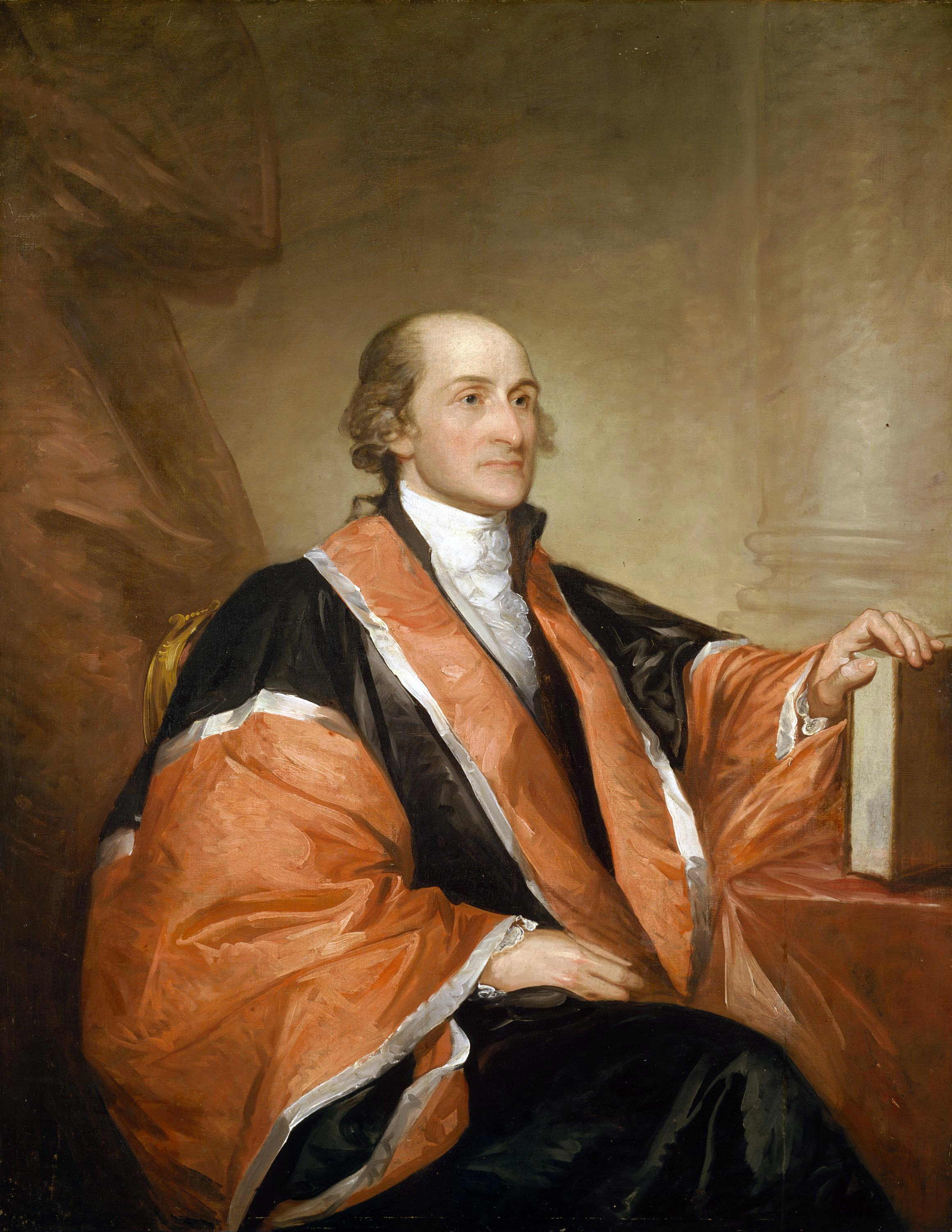
Historical · Supreme Court of the United States
John Jay
Former justice
Former Chief Justice · Supreme Court of the United States · 1789–1795 · Appointed by George Washington
John Jay served as the Chief Justice of the Supreme Court of the United States (1789–1795) was appointed by George Washington. The page below collects sourced biographical facts, the appointment record, and provenance for Jay.
FJC ID: 1382771
Key facts
- Full name
- John Jay
- Court
- Supreme Court of the United States
- Role
- Chief Justice
- Status
- Former justice
- Seat
- SCT0101
- Appointed by
- George Washington
- Appointment
- Senate-confirmed
- Confirmed
- 1789-09-26
- Supreme Court service
- 1789–1795
- Took seat
- 1789
- Born
- 1745
- Died
- 1829
- Dataset version
- 1.20260711
Appointment & service record
Chief Justice of the United States · 1789–1795
- Seat
- SCT0101
- Appointing president
- George Washington
- Appointment
- Senate-confirmed
- Confirmed
- September 26, 1789
Seat, appointing president, appointment type, confirmation date, and service dates are drawn from the Federal Judicial Center Biographical Directory and the Supreme Court's own members roster.[1][2][3]
Sources
- [1]https://www.fjc.gov/node/1382771fjc · retrieved 2026-06-16
- [2]https://www.supremecourt.gov/about/members_text.aspxsupremecourt.gov · retrieved 2026-06-16
- [3]https://www.fjc.gov/history/judges/biographical-directory-article-iii-federal-judges-exportfjc-directory · retrieved 2026-06-16
Biographical narrative
838 words · sourced from the Wikipedia REST extract
John Jay was a prominent American statesman and lawyer who played a foundational role in the early republic. He served as the first Chief Justice of the United States Supreme Court from 1789 to 1795, later became the second governor of New York, and held key diplomatic positions during and after the Revolutionary War. His career spanned law, politics, and foreign affairs, and he was a co‑author of the influential Federalist Papers that helped shape the interpretation of the Constitution.
Early life and legal career
John Jay entered the world on December 12, 1745, in New York City, into a family of merchants with French Huguenot and Dutch ancestry. His father, Peter Jay, had established a prosperous trading business before retiring after a smallpox outbreak that left two siblings blind. The Jays were well connected within New York’s civic circles; his mother, Mary Van Cortlandt, descended from the prominent Van Cortlandt family, whose members served as mayors and judges in colonial New York.
Jay received his early education at home under his mother's guidance before attending a school run by Anglican priest Pierre Stoupe in New Rochelle. He returned to Rye for further schooling with tutors George Murray and others, and at the age of fourteen he entered King’s College (later Columbia University) in 1760. While there he cultivated friendships that would prove influential later, including one with Robert Livingston. After graduating in 1764, Jay studied law under Benjamin Kissam, a respected attorney and political figure; among Kissam’s students were other notable figures such as Lindley Murray.
Admitted to the New York bar in 1768, Jay established a legal practice that he expanded into his own office by 1771. His early career was marked by active participation in colonial resistance to British policies. He joined the New York Committee of Correspondence in 1774 and served as its secretary, becoming one of the first public officials to organize opposition to the Intolerable Acts. As a delegate to the First Continental Congress, he signed the Continental Association, and later, as a member of the Second Continental Congress, he served as its president.
During the Revolutionary War, Jay’s diplomatic talents were recognized. From 1779 to 1782 he was appointed ambassador to Spain, where he secured financial assistance for the fledgling United States. He also negotiated the Treaty of Paris, in which Britain formally acknowledged American independence. After the war, Jay served as Secretary of Foreign Affairs under the Articles of Confederation government and briefly held the position of interim Secretary of State.
Jay’s legal expertise and political acumen were further demonstrated through his contributions to the Federalist Papers. He authored five of the eighty‑five essays that argued for the ratification of the Constitution and clarified its intended structure and powers.
Supreme Court tenure
President George Washington appointed John Jay as the first Chief Justice of the United States Supreme Court on September 26, 1789. Confirmed by the Senate, he occupied seat SCT0101 and served from 1789 until 1795. During his six‑year term, the court handled a modest docket; it decided only four cases, reflecting the nascent state of federal judicial activity at the time.
While serving as chief justice, Jay also negotiated the controversial Jay Treaty with Britain in 1794, an agreement that sought to resolve lingering disputes from the Revolutionary War and secure American trade interests. The treaty was met with mixed reactions domestically but represented a significant diplomatic effort during his tenure on the bench.
Jay’s political profile extended beyond the judiciary. He received electoral votes in several of the first presidential elections; however, he never pursued a campaign for the presidency. After Washington’s administration, Jay declined to return to the Supreme Court when President John Adams sought his reappointment. Instead, he retired from federal service and returned to private life on his farm in Westchester County.
Jurisprudence and legacy
John Jay’s time as Chief Justice was characterized by a cautious approach to judicial authority. With only a handful of cases before the court, his opinions helped lay foundational principles for the interpretation of the Constitution, though specific holdings are not detailed here. His leadership established procedural norms and underscored the importance of an independent judiciary in the new republic.
Beyond the bench, Jay’s legacy is marked by his diplomatic achievements and state governance. As governor of New York from 1795 to 1801, he enacted gradual emancipation legislation that advanced the cause of ending slavery within the state, even as he himself owned a small number of slaves until 1800. His tenure in this role reflected a commitment to balancing progressive reforms with the prevailing social realities of the era.
Jay’s contributions to American law and politics have earned him recognition as one of the Founding Fathers. He was instrumental in shaping early federal institutions, negotiating critical treaties, and guiding the Supreme Court through its formative years. His career exemplifies the multifaceted responsibilities undertaken by leaders during the establishment of the United States, leaving a lasting imprint on both the judiciary and the nation’s diplomatic history.
Sources & provenance
Every quantitative or attributable claim above carries a per-section [N] marker that resolves to the corresponding URL below. Each entry records the upstream provider, the canonical URL, and the timestamp at which the underlying source was retrieved.
Key facts
- https://www.fjc.gov/node/1382771fjc · retrieved 2026-06-16
- https://www.supremecourt.gov/about/members_text.aspxsupremecourt.gov · retrieved 2026-06-16
- https://www.fjc.gov/history/judges/biographical-directory-article-iii-federal-judges-exportfjc-directory · retrieved 2026-06-16
Biographical narrative
- https://en.wikipedia.org/wiki/John_JayWikipedia · retrieved 2026-06-16
Explore the federal judiciary
Fewer than 120 people have served on the Supreme Court of the United States in its history. Browse the full roster of current and former justices, or explore how the appointed federal judiciary fits into the federal government.