
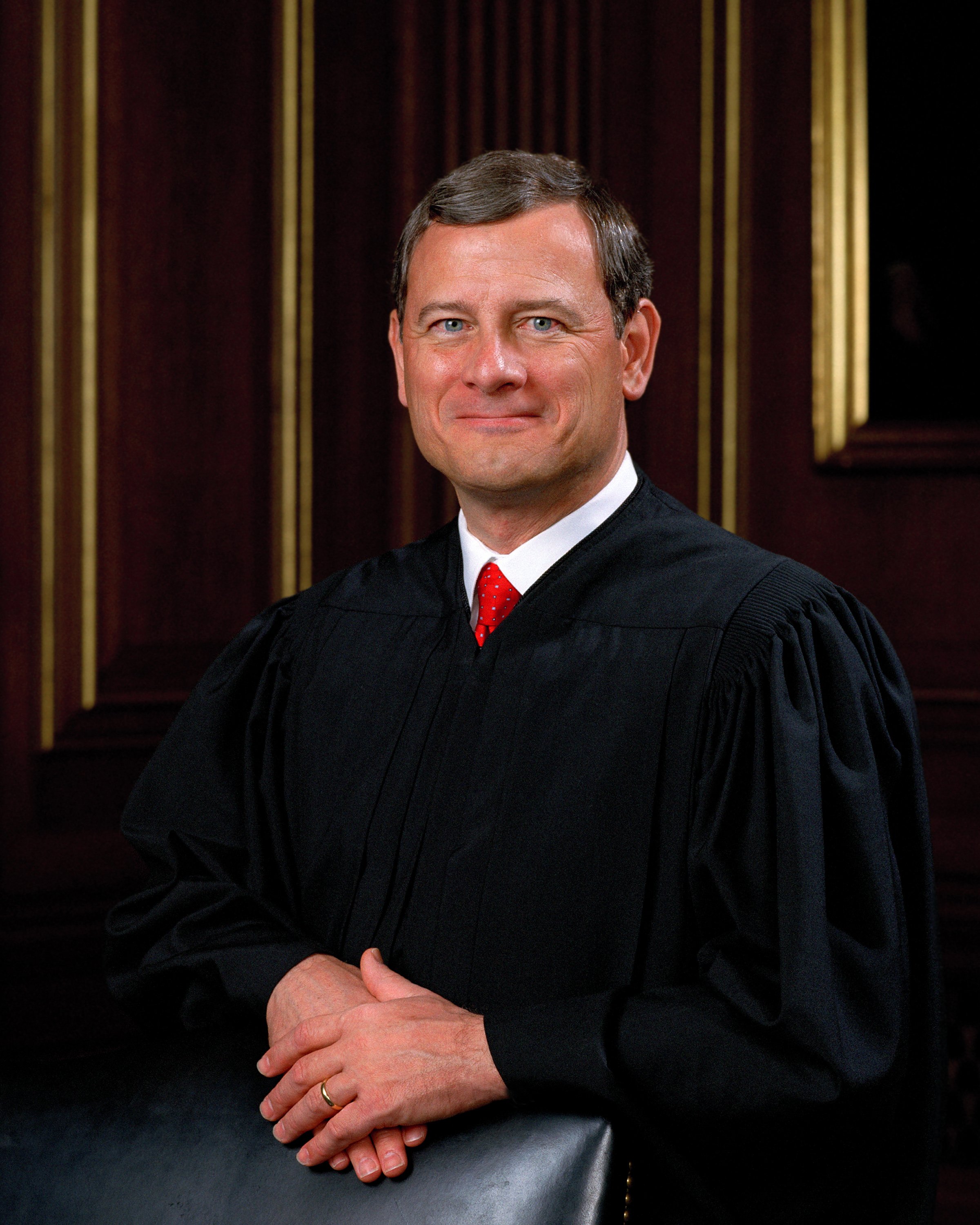
Currently serving · Supreme Court of the United States
John Glover Roberts Jr.
Currently serving
Chief Justice · Supreme Court of the United States · 2005–present · Appointed by George W Bush
John Glover Roberts Jr. serves as the Chief Justice of the Supreme Court of the United States (2005–present) was appointed by George W Bush. The page below collects sourced biographical facts, the appointment record, and provenance for Jr..
FJC ID: 1391841
Key facts
- Full name
- John Glover Roberts Jr.
- Court
- Supreme Court of the United States
- Role
- Chief Justice
- Status
- Currently serving
- Seat
- SCT0117
- Appointed by
- George W Bush
- Appointment
- Senate-confirmed
- Confirmed
- 2005-09-29
- Supreme Court service
- 2005–present
- Took seat
- 2005
- Born
- —
- Died
- —
- Dataset version
- 1.20260711
Appointment & service record
Chief Justice of the United States · 2005–present
- Seat
- SCT0117
- Appointing president
- George W Bush
- Appointment
- Senate-confirmed
- Confirmed
- September 29, 2005
Seat, appointing president, appointment type, confirmation date, and service dates are drawn from the Federal Judicial Center Biographical Directory and the Supreme Court's own members roster.[1][2][3]
Sources
- [1]https://www.fjc.gov/node/1391841fjc · retrieved 2026-06-16
- [2]https://www.supremecourt.gov/about/members_text.aspxsupremecourt.gov · retrieved 2026-06-16
- [3]https://www.fjc.gov/history/judges/biographical-directory-article-iii-federal-judges-exportfjc-directory · retrieved 2026-06-16
Biographical narrative
940 words · sourced from the Wikipedia REST extract
John Glover Roberts Jr., born in 1955, is an American jurist who has served as the seventeenth Chief Justice of the United States Supreme Court since 2005. A product of rigorous academic training and extensive experience on both sides of the bench, Roberts has become one of the most influential figures in contemporary American jurisprudence. His tenure on the Court has been marked by a combination of institutional stewardship, a moderate conservative judicial philosophy, and a record of authorship of several landmark majority opinions that have shaped the legal landscape of the nation.
Early life and legal career
Roberts entered the world on January 27, 1955, in Buffalo, New York. Raised in a devout Catholic family, he spent his formative years in Northwest Indiana after his family relocated there when he was ten. The early environment fostered a disciplined work ethic; Roberts attended La Lumiere School, a rigorous Catholic boarding institution where he excelled academically and athletically, ultimately graduating as class valedictorian.
He pursued higher education at Harvard College, initially intending to become a historian. There, he distinguished himself through scholarly achievements, earning summa cum laude honors in history and membership in Phi Beta Kappa. His intellectual curiosity extended beyond the classroom; Roberts engaged with contemporary political thought and developed an interest in legal advocacy. He subsequently enrolled at Harvard Law School, where his academic performance placed him among the top students of his cohort. During law school, he served as managing editor of the Harvard Law Review, a role that underscored his leadership abilities and editorial acumen.
After obtaining his Juris Doctor magna cum laude in 1979, Roberts embarked on a legal career that combined clerkships, government service, private practice, and appellate advocacy. He first clerked for Judge Henry Friendly of the United States Court of Appeals for the Second Circuit, followed by a clerkship with Justice William H. Rehnquist of the Supreme Court. These experiences provided him with an intimate view of judicial decision‑making at the highest levels.
Roberts then served in the Department of Justice from 1989 to 1993, holding positions during the administrations of Presidents Ronald Reagan and George H. W. Bush. His tenure in federal service was complemented by a partnership at a private law firm, where he cultivated a leading appellate practice. Over his career, Roberts argued 39 cases before the Supreme Court, gaining recognition for his persuasive advocacy and deep understanding of constitutional issues.
In 1992, President George H. W. Bush nominated Roberts to the United States Court of Appeals for the District of Columbia Circuit; however, the Senate did not hold a confirmation vote. Two years later, in 2003, President George W. Bush appointed him to that same appellate court, where he served until his elevation to the Supreme Court.
Supreme Court tenure
Roberts was nominated by President George W. Bush—who is affiliated with the Republican Party—to fill the vacancy left by Justice Sandra Day O'Connor on the United States Supreme Court in 2005. The nomination was initially for an associate justice seat, but following the death of Chief Justice William H. Rehnquist, Roberts was instead appointed as chief justice. He was confirmed by a Senate vote of 78–22 and took office on September 29, 2005, at the age of 50. This made him the youngest chief justice since John Marshall.
As chief justice, Roberts has presided over numerous significant cases that have defined contemporary constitutional law. His majority opinions include decisions in National Federation of Independent Business v. Sebelius—where he upheld key provisions of the Affordable Care Act; Shelby County v. Holder—where he limited the scope of the Voting Rights Act of 1965; Trump v. Hawaii—expanding presidential authority over immigration; Carpenter v. United States—addressing digital privacy concerns; Students for Fair Admissions v. Harvard—overturning race‑based admission practices; and Trump v. United States—clarifying limits on presidential immunity from criminal prosecution. In addition to these opinions, Roberts served as the presiding judge during President Donald Trump's first impeachment trial.
Roberts’ leadership style has been described as institutionalist; he emphasizes the Court’s role within the broader framework of American governance. He is often regarded as a swing vote in closely divided cases, and his decisions have contributed to an ideological shift toward conservative jurisprudence on the high court. Throughout his tenure, Roberts has authored numerous opinions that reflect a careful balance between adherence to precedent and responsiveness to evolving legal questions.
Jurisprudence and legacy
John Glover Roberts Jr.’s judicial philosophy is frequently characterized as moderate conservative, with a strong focus on institutional integrity. He approaches cases with an emphasis on the Court’s role in maintaining stability within the American constitutional system. His opinions often reflect a careful consideration of precedent, statutory interpretation, and the practical implications of legal rulings.
Roberts’ record includes a significant number of majority opinions that have addressed critical issues such as healthcare regulation, voting rights, executive power, privacy, higher education admissions, and presidential accountability. These decisions demonstrate his willingness to engage with complex policy questions while maintaining a commitment to constitutional principles. His leadership during high‑profile proceedings, including the impeachment trial of a sitting president, further underscores his role in upholding the rule of law.
The legacy of Roberts’ tenure is still unfolding, but it is evident that he has played a pivotal role in shaping contemporary American jurisprudence. By authoring key opinions and guiding the Court through periods of significant political and social change, he has contributed to an evolving legal landscape that balances tradition with modern challenges. His influence extends beyond individual cases; his stewardship of the Supreme Court’s institutional framework continues to impact how justice is administered at the highest level in the United States.
Sources & provenance
Every quantitative or attributable claim above carries a per-section [N] marker that resolves to the corresponding URL below. Each entry records the upstream provider, the canonical URL, and the timestamp at which the underlying source was retrieved.
Key facts
- https://www.fjc.gov/node/1391841fjc · retrieved 2026-06-16
- https://www.supremecourt.gov/about/members_text.aspxsupremecourt.gov · retrieved 2026-06-16
- https://www.fjc.gov/history/judges/biographical-directory-article-iii-federal-judges-exportfjc-directory · retrieved 2026-06-16
Biographical narrative
- https://en.wikipedia.org/wiki/John_RobertsWikipedia · retrieved 2026-06-16
Explore the federal judiciary
Fewer than 120 people have served on the Supreme Court of the United States in its history. Browse the full roster of current and former justices, or explore how the appointed federal judiciary fits into the federal government.