
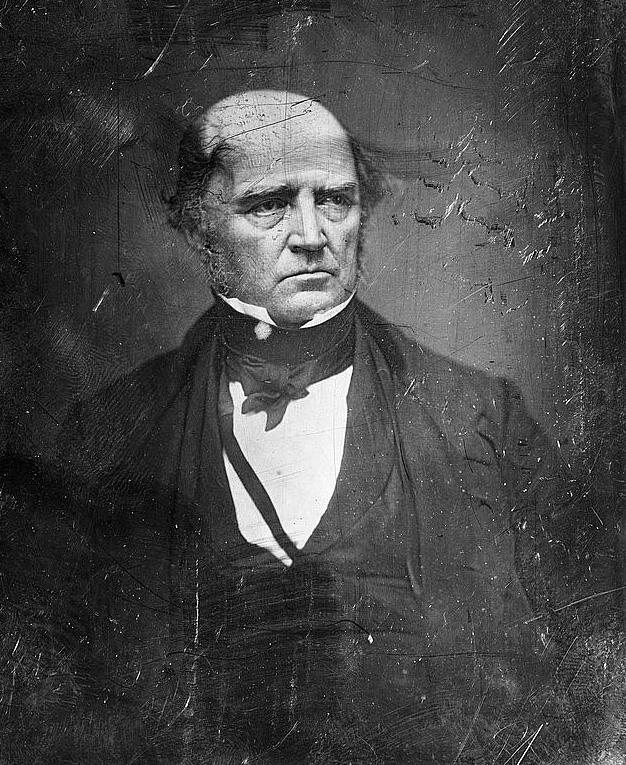
Historical · Supreme Court of the United States
Levi Woodbury
Former justice
Former Associate Justice · Supreme Court of the United States · 1846–1851 · Appointed by James K Polk
Levi Woodbury served as an Associate Justice of the Supreme Court of the United States (1846–1851) was appointed by James K Polk. The page below collects sourced biographical facts, the appointment record, and provenance for Woodbury.
FJC ID: 1390061
Key facts
- Full name
- Levi Woodbury
- Court
- Supreme Court of the United States
- Role
- Associate Justice
- Status
- Former justice
- Seat
- SCT0303
- Appointed by
- James K Polk
- Appointment
- Senate-confirmed
- Confirmed
- 1846-01-03
- Supreme Court service
- 1846–1851
- Took seat
- 1846
- Born
- 1789
- Died
- 1851
- Dataset version
- 1.20260711
Appointment & service record
Associate Justice of the Supreme Court of the United States · 1846–1851
- Seat
- SCT0303
- Appointing president
- James K Polk
- Appointment
- Senate-confirmed
- Confirmed
- January 3, 1846
Seat, appointing president, appointment type, confirmation date, and service dates are drawn from the Federal Judicial Center Biographical Directory and the Supreme Court's own members roster.[1][2][3]
Sources
- [1]https://www.fjc.gov/node/1390061fjc · retrieved 2026-06-16
- [2]https://www.supremecourt.gov/about/members_text.aspxsupremecourt.gov · retrieved 2026-06-16
- [3]https://www.fjc.gov/history/judges/biographical-directory-article-iii-federal-judges-exportfjc-directory · retrieved 2026-06-16
Biographical narrative
924 words · sourced from the Wikipedia REST extract
Levi Woodbury was a prominent American jurist and public servant whose career spanned the early decades of the nineteenth century. Born in rural New Hampshire, he pursued legal studies at Dartmouth College and the Tapping Reeve Law School before establishing a practice that would launch him into state politics. Over more than forty years he held a succession of elected and appointed offices—including governor of his home state, United States senator, cabinet secretary under Presidents Andrew Jackson and Martin Van Buren, and finally associate justice of the Supreme Court—before his death in 1851.
Early life and legal career
Levi Woodbury entered the world on December 22, 1789, in the small community of Francestown, New Hampshire. He received his early schooling at Atkinson Academy before matriculating at Dartmouth College, where he graduated in 1809 as a member of Phi Beta Kappa. Seeking formal legal training, Woodbury attended the Tapping Reeve Law School in Litchfield, Connecticut—a pioneering institution that would later be recognized for producing several federal judges. After completing his studies, he read law under established practitioners and was admitted to the New Hampshire bar in 1812.
Woodbury returned to Francestown to establish a private practice that lasted until 1816. During this period he became involved in local political affairs, notably authoring the Hillsborough Resolves, which defended federal policy during the War of 1812. His advocacy drew attention and led to his appointment as clerk of the New Hampshire State Senate for the 1816–17 session.
In 1817 Woodbury was elevated to the state's highest court, serving on the Superior Court of Judicature (later known as the New Hampshire Supreme Court) until 1823. His judicial experience at the state level positioned him for executive office when he was elected governor in 1823. Although his single term was marked by attempts to bridge partisan divides, it did not result in lasting policy achievements.
After stepping down as governor, Woodbury returned to legislative service, serving as Speaker of the New Hampshire House of Representatives in 1825. His growing reputation for legal acumen and political moderation led to his election to the United States Senate from New Hampshire in 1825, a seat he held until 1831. During that tenure he chaired the Senate Commerce Committee and was noted for his support of policies aligned with the emerging Jacksonian Democratic movement.
Woodbury’s federal career continued when President Andrew Jackson appointed him Secretary of the Navy in 1831, a position he occupied until 1834. He then served as Secretary of the Treasury under both Jackson and Martin Van Buren from 1834 to 1841, during which time he advocated for an independent treasury system and hard‑money fiscal policy. After a brief return to the Senate in 1841–45, Woodbury’s long record of public service culminated in his appointment to the Supreme Court.
Supreme Court tenure
President James K. Polk nominated Woodbury to fill the vacancy left by Justice Joseph Story on December 23, 1845. The United States Senate confirmed the nomination on January 3, 1846, and Woodbury was sworn into office shortly thereafter. He served as an associate justice of the Supreme Court from 1846 until his death in 1851.
During his tenure on the bench, Woodbury authored opinions that addressed a range of constitutional questions. His writings touched upon the Contract Clause, issues related to slavery, the political question doctrine, and the Commerce Clause. While specific case names are not provided here, his contributions helped shape the Court’s approach to these enduring legal themes.
Woodbury’s service on the Supreme Court was marked by his status as the first justice who had attended a formal law school—a milestone that underscored the evolving professionalization of the judiciary in the United States. He remained on the bench until his passing on September 4, 1851, closing a career that spanned nearly four decades of public service.
Jurisprudence and legacy
Levi Woodbury’s legacy is multifaceted, reflecting his roles as lawyer, legislator, cabinet secretary, and judge. His early legal education at Dartmouth and the Tapping Reeve Law School positioned him among the first generation of American jurists to receive formal academic training in law, a development that would influence subsequent generations of federal judges.
In the political arena, Woodbury’s alignment with the Jacksonian Democratic movement is evident through his support for an independent treasury system and hard‑money policies. His tenure as Secretary of the Treasury coincided with significant economic upheaval, including the Panic of 1837; although the long‑term effects of that crisis are complex, Woodbury’s advocacy contributed to the eventual establishment of a more secure federal financial framework.
Woodbury also demonstrated a willingness to engage in national politics beyond his appointed roles. In 1848 he was considered as a potential presidential candidate at the Democratic National Convention, reflecting the esteem in which he was held by contemporaries. While he did not secure the nomination, this episode illustrates the breadth of his influence within the political landscape of his time.
On the Supreme Court, Woodbury’s opinions on constitutional matters—particularly those involving commerce, contracts, and slavery—played a part in shaping mid‑nineteenth‑century jurisprudence. His approach to the political question doctrine helped delineate the boundaries between judicial review and executive authority, a theme that would resonate throughout American legal history.
Overall, Levi Woodbury’s career exemplifies the trajectory of an early nineteenth‑century public servant who bridged state and federal responsibilities while contributing to the development of both national policy and constitutional law. His service across multiple branches of government—legislative, executive, and judicial—highlights a period in American history when individuals often moved fluidly between roles to shape the young nation’s institutions.
Sources & provenance
Every quantitative or attributable claim above carries a per-section [N] marker that resolves to the corresponding URL below. Each entry records the upstream provider, the canonical URL, and the timestamp at which the underlying source was retrieved.
Key facts
- https://www.fjc.gov/node/1390061fjc · retrieved 2026-06-16
- https://www.supremecourt.gov/about/members_text.aspxsupremecourt.gov · retrieved 2026-06-16
- https://www.fjc.gov/history/judges/biographical-directory-article-iii-federal-judges-exportfjc-directory · retrieved 2026-06-16
Biographical narrative
- https://en.wikipedia.org/wiki/Levi_WoodburyWikipedia · retrieved 2026-06-16
Explore the federal judiciary
Fewer than 120 people have served on the Supreme Court of the United States in its history. Browse the full roster of current and former justices, or explore how the appointed federal judiciary fits into the federal government.