
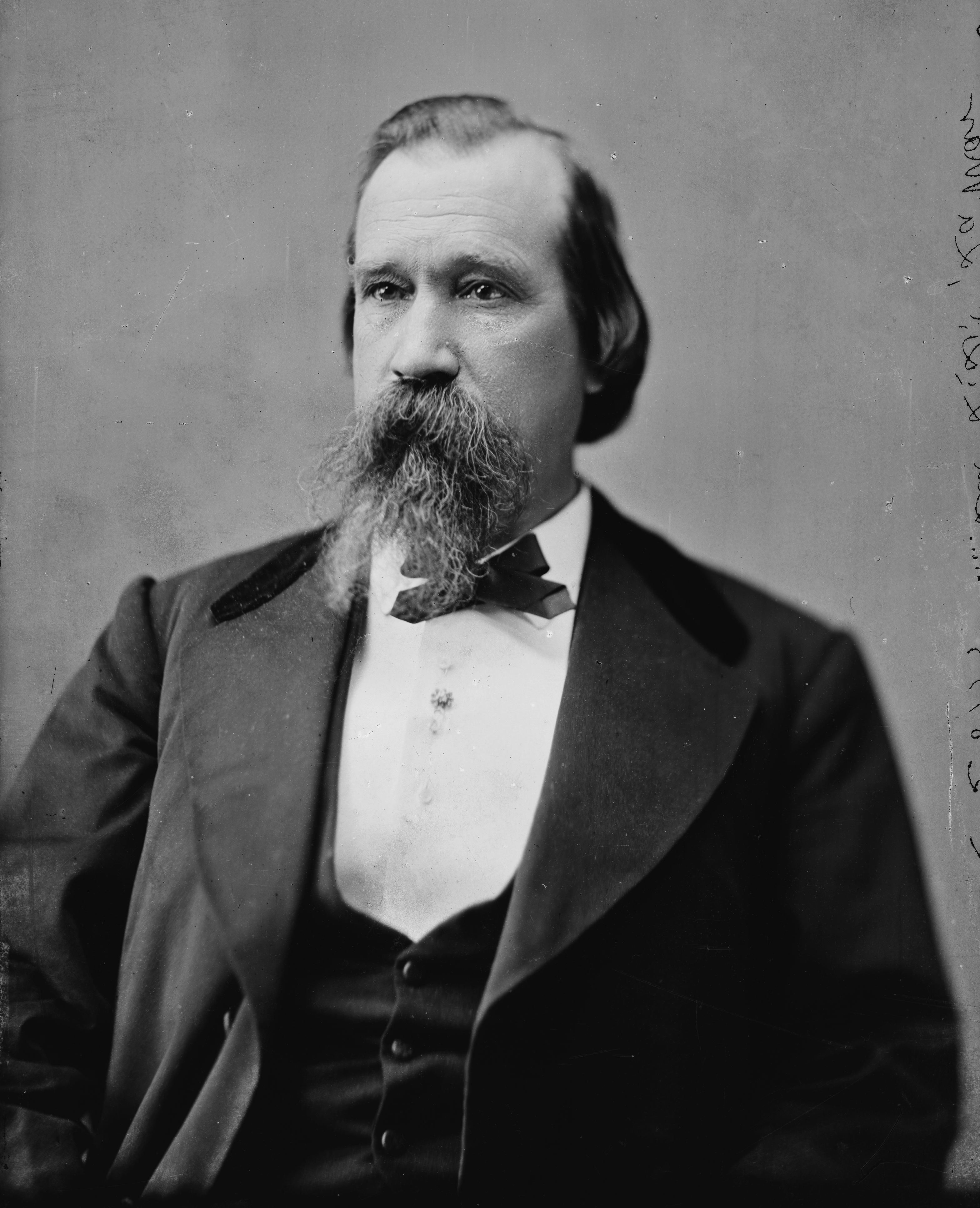
Historical · Supreme Court of the United States
Lucius Quintus Cincinnatus Lamar
Former justice
Former Associate Justice · Supreme Court of the United States · 1888–1893 · Appointed by Grover Cleveland
Lucius Quintus Cincinnatus Lamar served as an Associate Justice of the Supreme Court of the United States (1888–1893) was appointed by Grover Cleveland. The page below collects sourced biographical facts, the appointment record, and provenance for Lamar.
FJC ID: 1383581
Key facts
- Full name
- Lucius Quintus Cincinnatus Lamar
- Court
- Supreme Court of the United States
- Role
- Associate Justice
- Status
- Former justice
- Seat
- SCT0407
- Appointed by
- Grover Cleveland
- Appointment
- Senate-confirmed
- Confirmed
- 1888-01-16
- Supreme Court service
- 1888–1893
- Took seat
- 1888
- Born
- 1825
- Died
- 1893
- Dataset version
- 1.20260711
Appointment & service record
Associate Justice of the Supreme Court of the United States · 1888–1893
- Seat
- SCT0407
- Appointing president
- Grover Cleveland
- Appointment
- Senate-confirmed
- Confirmed
- January 16, 1888
Seat, appointing president, appointment type, confirmation date, and service dates are drawn from the Federal Judicial Center Biographical Directory and the Supreme Court's own members roster.[1][2][3]
Sources
- [1]https://www.fjc.gov/node/1383581fjc · retrieved 2026-06-16
- [2]https://www.supremecourt.gov/about/members_text.aspxsupremecourt.gov · retrieved 2026-06-16
- [3]https://www.fjc.gov/history/judges/biographical-directory-article-iii-federal-judges-exportfjc-directory · retrieved 2026-06-16
Biographical narrative
949 words · sourced from the Wikipedia REST extract
Lucius Quintus Cincinnatus Lamar served as an associate justice on the United States Supreme Court from 1888 until his death in 1893. Born into a prominent Southern family, he pursued a career that spanned law, politics, military service, and diplomacy before ascending to the nation's highest court. His appointment marked the first time a former Confederate official had joined the Supreme Court since the Civil War, reflecting the gradual reintegration of Southern leaders into federal institutions during the late nineteenth century.
Early life and legal career
Lamar was born on September 17, 1825, near Eatonton in Putnam County, Georgia. His family owned a large plantation known as “Fairfield,” where he spent his childhood. The death of his father when Lamar was nine left an indelible impression on him; contemporary accounts suggested the loss stemmed from mental illness or severe digestive disease. Despite this early hardship, Lamar continued his education in local schools before enrolling at the Manual Labor School in Covington, Georgia, in 1837. When that institution merged with Emory College in 1840, he remained in Oxford to complete his studies, graduating in 1845.
During his time at Emory, Lamar met Virginia Longstreet, daughter of the college’s president, Augustus Baldwin Longstreet. The couple married in July 1847 and had four children: L.Q.C. Lamar III, Virginia, Sarah, and Frances. Virginia died on December 29, 1884, from a lung disease that had afflicted her for several years.
After graduation, Lamar studied law under his uncle’s guidance in Vienna, Georgia, and was admitted to the Georgia bar in 1847. He established a private practice in Covington before relocating to Oxford, Mississippi, in 1849, where he continued his legal work and served as an assistant professor of mathematics at the University of Mississippi.
Lamar’s early political career began in Georgia, where he represented Newton County in the state Democratic convention in 1847 and again in 1849. He later moved to Mississippi, where he became involved with the Southern Rights Party, advocating for proslavery positions that remained consistent throughout his life. In 1850, he was licensed to practice law in Mississippi and entered the university’s faculty.
In the federal census of 1850, Lamar owned fourteen slaves near Oxford; a decade later, he held thirty-one enslaved individuals in Lafayette County. His political engagement deepened when he addressed a county convention on slavery in May 1850 and helped organize a local branch of the Southern Rights Party in March 1851. He campaigned for Jefferson Davis during the gubernatorial election and participated in public debates with Unionist opponents.
Lamar was elected to the United States House of Representatives in 1856, serving until January 1861. During this period he helped draft Mississippi’s Ordinance of Secession. With the outbreak of the Civil War, he raised the 19th Mississippi Infantry Regiment and served on the staff of his wife's cousin, General James Longstreet. In 1862, Confederate President Jefferson Davis appointed him Special Confederate Commissioner to Russia.
Following the war, Lamar returned to academia as a professor at the University of Mississippi and took part in several state constitutional conventions. He was elected again to the U.S. House in 1873, becoming the first Mississippi Democrat to return to Congress after Reconstruction. His tenure in the House lasted until 1877, when he moved to the Senate, where he served from 1877 to 1885. Lamar opposed Reconstruction policies and voting rights for African Americans during his legislative career.
In 1885, President Grover Cleveland (Democratic) appointed Lamar as Secretary of the Interior. He held this cabinet position until 1888, when he was nominated by Cleveland to serve on the Supreme Court.
Supreme Court tenure
Lamar’s nomination to the United States Supreme Court was confirmed by the Senate on January 16, 1888. He occupied seat SCT0407 and served as an associate justice for five years until his death on January 23, 1893. His appointment made him the first Southerner to join the Court since the Civil War, a milestone that reflected the broader national effort to reconcile former Confederate leaders with federal authority.
During his tenure, Lamar participated in the deliberations and decisions of the Court. While specific opinions authored by him are not detailed here, he contributed to the body’s collective judgments on matters presented during this period. His service concluded when he passed away while still holding office, marking the end of a brief but historically significant judicial career.
Jurisprudence and legacy
Lamar’s time on the Supreme Court was relatively short; nevertheless, his presence represented a symbolic bridge between the post‑Civil War South and the federal judiciary. The fact that he had served as a Confederate officer, a U.S. legislator, and a cabinet secretary before joining the Court illustrates the complex pathways through which former Confederates were reintegrated into national institutions during the late nineteenth century.
Although detailed records of his judicial philosophy are not provided here, Lamar’s earlier positions—particularly his opposition to Reconstruction and African‑American voting rights—suggest that he brought to the bench a perspective shaped by his Southern upbringing and political experiences. His tenure coincided with a period when the Court addressed issues related to civil rights, federal authority, and economic development; as an associate justice, he would have weighed in on these matters alongside his colleagues.
Lamar’s legacy is thus twofold: first, as a figure who navigated multiple roles—lawyer, legislator, diplomat, cabinet secretary, and judge—within the shifting political landscape of nineteenth‑century America; second, as a symbol of the gradual restoration of Southern participation in federal governance after the Civil War. His death in 1893 ended a career that spanned both the Confederacy and the United States Supreme Court, leaving a record of service that continues to be referenced by scholars studying the era’s legal and political history.
Sources & provenance
Every quantitative or attributable claim above carries a per-section [N] marker that resolves to the corresponding URL below. Each entry records the upstream provider, the canonical URL, and the timestamp at which the underlying source was retrieved.
Key facts
- https://www.fjc.gov/node/1383581fjc · retrieved 2026-06-16
- https://www.supremecourt.gov/about/members_text.aspxsupremecourt.gov · retrieved 2026-06-16
- https://www.fjc.gov/history/judges/biographical-directory-article-iii-federal-judges-exportfjc-directory · retrieved 2026-06-16
Biographical narrative
- https://en.wikipedia.org/wiki/Lucius_Quintus_Cincinnatus_LamarWikipedia · retrieved 2026-06-16
Explore the federal judiciary
Fewer than 120 people have served on the Supreme Court of the United States in its history. Browse the full roster of current and former justices, or explore how the appointed federal judiciary fits into the federal government.