
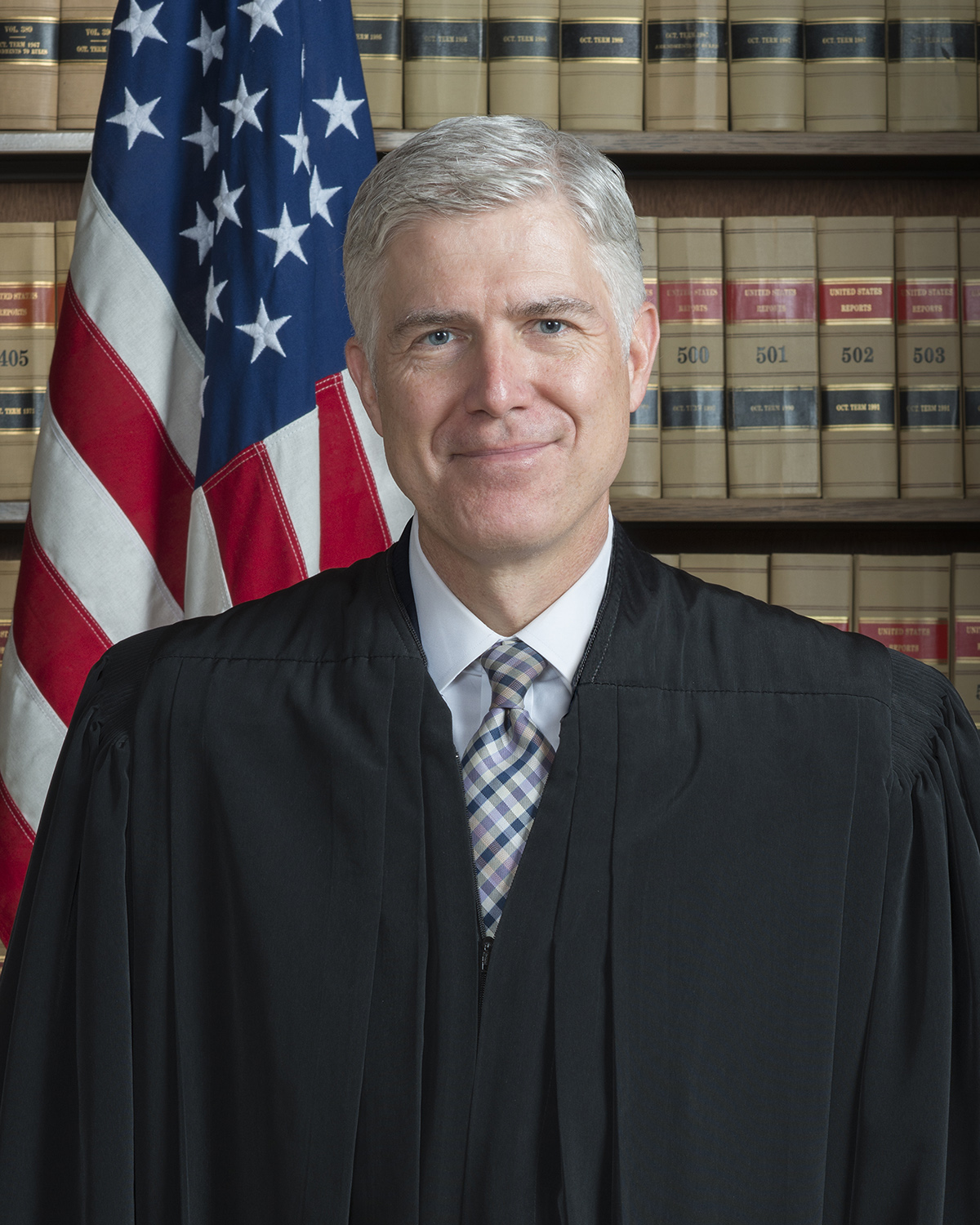
Currently serving · Supreme Court of the United States
Neil M. Gorsuch
Currently serving
Associate Justice · Supreme Court of the United States · 2017–present · Appointed by Donald Trump
Neil M. Gorsuch serves as an Associate Justice of the Supreme Court of the United States (2017–present) was appointed by Donald Trump. The page below collects sourced biographical facts, the appointment record, and provenance for Gorsuch.
FJC ID: 1392461
Key facts
- Full name
- Neil M. Gorsuch
- Court
- Supreme Court of the United States
- Role
- Associate Justice
- Status
- Currently serving
- Seat
- SCT1008
- Appointed by
- Donald Trump
- Appointment
- Senate-confirmed
- Confirmed
- 2017-04-07
- Supreme Court service
- 2017–present
- Took seat
- 2017
- Born
- —
- Died
- —
- Dataset version
- 1.20260711
Appointment & service record
Associate Justice of the Supreme Court of the United States · 2017–present
- Seat
- SCT1008
- Appointing president
- Donald Trump
- Appointment
- Senate-confirmed
- Confirmed
- April 7, 2017
Seat, appointing president, appointment type, confirmation date, and service dates are drawn from the Federal Judicial Center Biographical Directory and the Supreme Court's own members roster.[1][2][3]
Sources
- [1]https://www.fjc.gov/node/1392461fjc · retrieved 2026-06-16
- [2]https://www.supremecourt.gov/about/members_text.aspxsupremecourt.gov · retrieved 2026-06-16
- [3]https://www.fjc.gov/history/judges/biographical-directory-article-iii-federal-judges-exportfjc-directory · retrieved 2026-06-16
Biographical narrative
1,003 words · sourced from the Wikipedia REST extract
Neil McGill Gorsuch is an associate justice of the Supreme Court of the United States who has served in that capacity since 2017. Born in Denver, Colorado, he pursued a distinguished academic path that included degrees from Columbia University and Harvard Law School, followed by a doctorate in jurisprudence earned as a Marshall Scholar at the University of Oxford. Prior to his appointment to the nation's highest court, Gorsuch held positions in private practice, served as principal deputy associate attorney general in the Department of Justice, and was appointed to the United States Court of Appeals for the Tenth Circuit. His judicial philosophy emphasizes textualism and originalism in statutory and constitutional interpretation, and he has been noted for his advocacy of natural law principles alongside Justice Clarence Thomas.
Early life and legal career
Neil M. Gorsuch was born on August 29, 1967, in Denver, Colorado. He grew up in a family with strong ties to the legal profession; both of his parents were attorneys who encouraged debate and civic engagement from an early age. His father, David Ronald Gorsuch, and mother, Anne Gorsuch Burford (née McGill), served as role models for his intellectual curiosity and commitment to public service.
Gorsuch received his primary education at Christ the King Roman Catholic School in Denver before moving with his family to Bethesda, Maryland, following his mother's appointment as administrator of the United States Environmental Protection Agency. He then attended Georgetown Preparatory School, a Jesuit college-preparatory institution, where he distinguished himself academically and served as student body president upon graduation in 1985.
He entered Columbia University in 1985, completing a Bachelor of Arts degree cum laude in history and politics by 1988. During his undergraduate years, Gorsuch was active in campus debate and journalism, contributing to the Columbia Daily Spectator and co‑founding the satirical publication The Fed. He also joined Phi Gamma Delta fraternity and earned induction into the Phi Beta Kappa honor society.
In 1988, Gorsuch matriculated at Harvard Law School on a Harry S. Truman Scholarship. While there, he served as an editor of the Harvard Journal of Law and Public Policy and participated in several legal aid and advocacy programs. He graduated cum laude with a Juris Doctor in 1991. Following his graduation, he was awarded a Marshall Scholarship to study at the University of Oxford, where he earned a doctorate in jurisprudence in 2004 under the supervision of legal philosopher John Finnis. His doctoral thesis explored the morality of assisted suicide.
After completing his studies, Gorsuch entered the clerkship circuit. From 1991 to 1992, he served as a law clerk for Judge David B. Sentelle on the United States Court of Appeals for the District of Columbia Circuit. He then spent a year at Oxford before returning to Washington, D.C., where he clerked for Justice Byron White from 1993 to 1994 and subsequently for Justice Anthony Kennedy during the same period. These clerkships provided him with exposure to both appellate and Supreme Court work.
From 1995 until 2005, Gorsuch practiced privately at the law firm Kellogg, Hansen, Todd, Figel & Frederick. In 2005, he transitioned to public service as principal deputy associate attorney general in the Department of Justice, a role that involved advising on complex legal matters for the federal government.
President George W. Bush nominated Gorsuch to the United States Court of Appeals for the Tenth Circuit on May 10, 2006, to fill the seat vacated by Judge David M. Ebel upon senior status. He was confirmed and began serving in that capacity in 2007, where he handled a broad array of appellate cases until his elevation to the Supreme Court.
Supreme Court tenure
President Donald J. Trump nominated Gorsuch to the Supreme Court on January 31, 2017, following the retirement of Justice Antonin Scalia. He was confirmed by the Senate and took office as an associate justice on April 10, 2017, occupying seat SCT1008. His confirmation vote tally and other procedural details are recorded in official court documents.
During his tenure on the Supreme Court, Gorsuch has written majority opinions in several landmark cases that have shaped contemporary constitutional and statutory law. Notable among these decisions are Bostock v. Clayton County, which addressed protections for employees under Title VII of the Civil Rights Act; McGirt v. Oklahoma, concerning tribal jurisdiction over criminal matters; Kennedy v. Bremerton School District, dealing with religious observance in public employment; and Ramos v. Louisiana, addressing jury verdict procedures.
In addition to his written opinions, Gorsuch has participated in numerous oral arguments and has been recognized for his rigorous analytical approach. He is the first justice on the Supreme Court who has served alongside a former clerk of his own—Justice Anthony Kennedy—highlighting the continuity within the court’s personnel history.
Jurisprudence and legacy
Gorsuch’s judicial philosophy centers on textualism in statutory interpretation, which emphasizes the ordinary meaning of legal text at the time it was enacted. He also adheres to originalism when interpreting the Constitution, seeking to understand the framers’ intent or the text’s original public meaning. These principles guide his analysis across a range of issues, from civil rights to federal power.
Alongside Justice Clarence Thomas, Gorsuch has advocated for natural law jurisprudence, which posits that certain moral principles are inherent in human nature and can inform legal reasoning. This perspective occasionally informs his views on the relationship between morality and law, especially in cases involving fundamental rights or governmental authority.
Gorsuch’s contributions to the Supreme Court have had a lasting impact on American jurisprudence. His opinions reflect a commitment to clarity of language and fidelity to constitutional text, influencing how lower courts interpret statutes and apply constitutional principles. The breadth of his work—from civil liberties to federalism—demonstrates an enduring influence on the development of U.S. law.
Through his service on both appellate and supreme courts, Gorsuch has established a reputation for meticulous scholarship and principled decision‑making. His legacy continues to shape legal discourse and informs ongoing debates about constitutional interpretation, statutory construction, and the role of judicial review in American democracy.
Sources & provenance
Every quantitative or attributable claim above carries a per-section [N] marker that resolves to the corresponding URL below. Each entry records the upstream provider, the canonical URL, and the timestamp at which the underlying source was retrieved.
Key facts
- https://www.fjc.gov/node/1392461fjc · retrieved 2026-06-16
- https://www.supremecourt.gov/about/members_text.aspxsupremecourt.gov · retrieved 2026-06-16
- https://www.fjc.gov/history/judges/biographical-directory-article-iii-federal-judges-exportfjc-directory · retrieved 2026-06-16
Biographical narrative
- https://en.wikipedia.org/wiki/Neil_GorsuchWikipedia · retrieved 2026-06-16
Explore the federal judiciary
Fewer than 120 people have served on the Supreme Court of the United States in its history. Browse the full roster of current and former justices, or explore how the appointed federal judiciary fits into the federal government.