
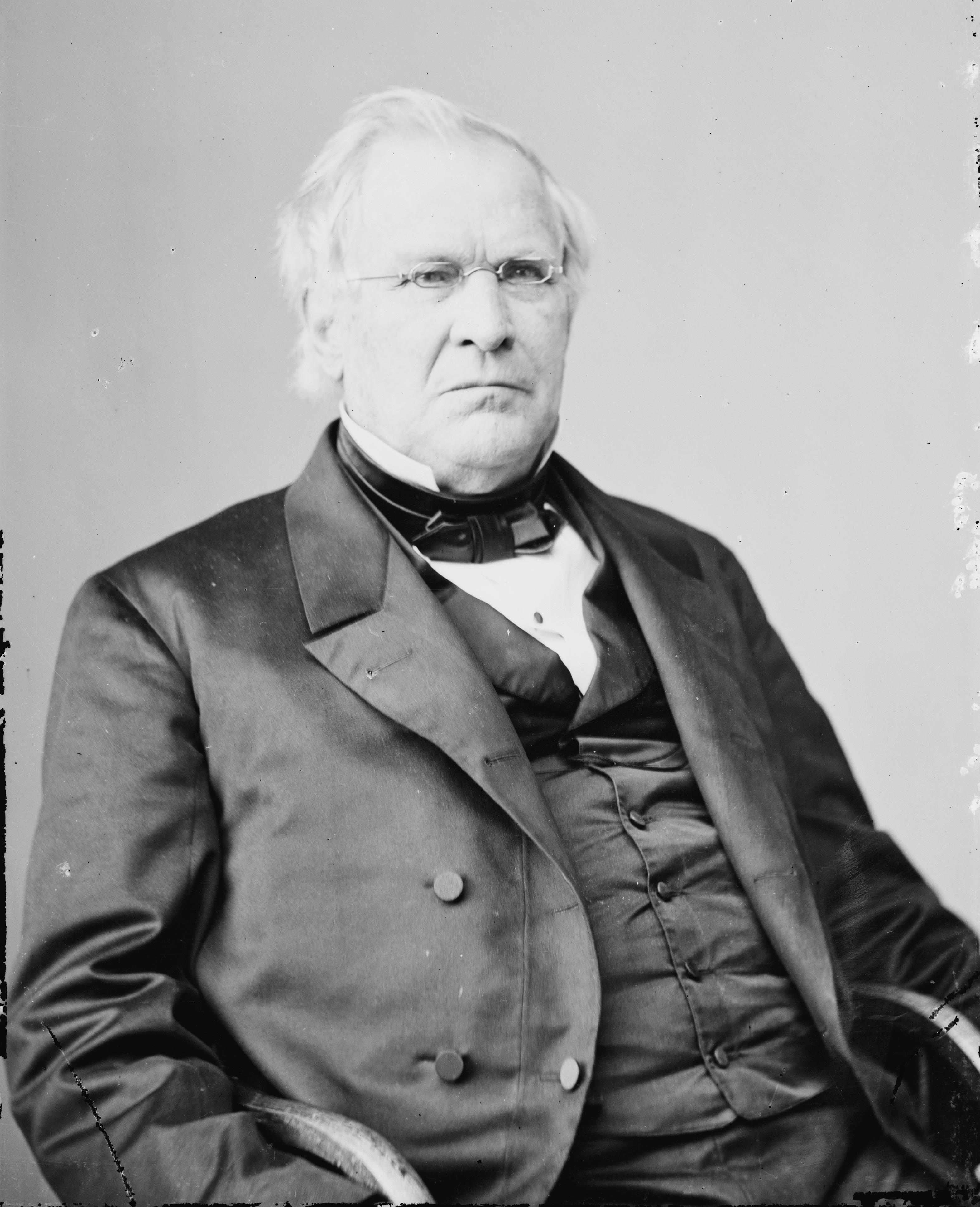
Historical · Supreme Court of the United States
Robert Cooper Grier
Former justice
Former Associate Justice · Supreme Court of the United States · 1846–1870 · Appointed by James K Polk
Robert Cooper Grier served as an Associate Justice of the Supreme Court of the United States (1846–1870) was appointed by James K Polk. The page below collects sourced biographical facts, the appointment record, and provenance for Grier.
FJC ID: 1381521
Key facts
- Full name
- Robert Cooper Grier
- Court
- Supreme Court of the United States
- Role
- Associate Justice
- Status
- Former justice
- Seat
- SCT0404
- Appointed by
- James K Polk
- Appointment
- Senate-confirmed
- Confirmed
- 1846-08-04
- Supreme Court service
- 1846–1870
- Took seat
- 1846
- Born
- 1794
- Died
- 1870
- Dataset version
- 1.20260711
Appointment & service record
Associate Justice of the Supreme Court of the United States · 1846–1870
- Seat
- SCT0404
- Appointing president
- James K Polk
- Appointment
- Senate-confirmed
- Confirmed
- August 4, 1846
Seat, appointing president, appointment type, confirmation date, and service dates are drawn from the Federal Judicial Center Biographical Directory and the Supreme Court's own members roster.[1][2][3]
Sources
- [1]https://www.fjc.gov/node/1381521fjc · retrieved 2026-06-16
- [2]https://www.supremecourt.gov/about/members_text.aspxsupremecourt.gov · retrieved 2026-06-16
- [3]https://www.fjc.gov/history/judges/biographical-directory-article-iii-federal-judges-exportfjc-directory · retrieved 2026-06-16
Biographical narrative
883 words · sourced from the Wikipedia REST extract
Robert Cooper Grier was an American jurist who served as an Associate Justice of the Supreme Court of the United States from 1846 until his death in 1870. Appointed by President James K. Polk, he occupied a seat that had remained vacant for more than two years after the death of Justice Henry Baldwin. During his tenure, Grier participated in several landmark decisions, including the Dred Scott case and the Prize Cases, and was noted for his balanced approach to federalism and commerce law.
Early life and legal career
Grier entered the world on March 5, 1794, in Cumberland County, Pennsylvania. He was the eldest of eleven children born to Elizabeth Cooper Grier and Isaac Grier, both ministers of the Presbyterian Church. His father provided a rigorous classical education at home, where Robert excelled particularly in Latin and Greek. In 1806 the family relocated to Northumberland, Pennsylvania, where Isaac managed three churches and operated a private school.
In 1811 Grier enrolled as a junior at Dickinson College, graduating just one year later in 1812. He remained on campus as an instructor before accepting a teaching position at his father’s school. While working there, he studied law under his father's guidance until the latter's death in 1815. Continuing his legal education, Grier apprenticed with Charles Hall and was admitted to the bar in 1817.
For fifteen years he practiced privately, first in Bloomsburg and then in Danville, Pennsylvania. During this period he supported his mother’s household and financed the education of ten of his siblings. Politically, he identified as a Jacksonian Democrat and backed Andrew Jackson during the latter’s presidential campaign.
In 1840, amid political maneuvering surrounding the creation of a new district court for Allegheny County, Grier was offered the judgeship. Although initially expected to decline, he accepted and moved to Pittsburgh, where he served on that bench for thirteen years. His reputation as a fair and competent judge grew during this time. In 1848 he was elected a member of the American Philosophical Society.
Supreme Court tenure
The seat vacated by Justice Henry Baldwin had remained empty since Baldwin’s death in April 1844, creating an unprecedented 841‑day vacancy—the longest in Supreme Court history. President James K. Polk, who assumed office in March 1845, sought to fill the position. After two unsuccessful nominations—first to Edward King and then to John M. Read—the president turned to Grier, recommended by four congressmen from Maryland who highlighted his willingness to uphold slave‑owner rights.
On August 3, 1846 Polk nominated Grier; the Senate confirmed him unanimously on August 4, and he was sworn in on August 10 of that year. He joined the Taney Court as a member of the so‑called “doughfaces,” a group of Northern Democrats who opposed abolitionism and supported slavery. Alongside Samuel Nelson, Grier voted in favor of the Dred Scott decision, which held that Congress lacked authority to regulate slavery in the territories and declared a portion of the Missouri Compromise unconstitutional. The decision was controversial; President‑elect James Buchanan pressured Grier to align with Southern justices, but Grier ultimately joined the majority.
Despite his pro‑slavery votes, Grier opposed the secession of the Confederate States. In 1863 he authored the majority opinion in the Prize Cases, which affirmed President Abraham Lincoln’s power to impose Union blockades on Confederate ports during the Civil War. This decision reinforced federal authority over maritime matters in wartime.
Grier also contributed to important commerce and contract cases. In the Passenger Cases of 1849, he sided with the majority that a state tax on immigrants violated Congress’s commerce power. He participated in Cooley v. Board of Wardens (1852), which sought a balance between congressional authority and state police powers. His first major opinion came in Cook v. Moffat (1847), where he ruled against a Maryland bankrupt, emphasizing that states could not impose bankruptcy laws on parties outside their jurisdiction without violating stare decisis. In Richmond, Fredericksburg and Potomac Railroad Company v. Louisa Railroad Company (1852) he addressed the interplay between state charters and contractual rights.
Grier served on the Court until his death on September 25, 1870, completing nearly a quarter‑century of judicial service.
Jurisprudence and legacy
Justice Grier’s jurisprudence reflected a careful balance between federal authority and states’ rights. He was known for his respect for precedent; in Cook v. Moffat he cautioned against departing from established decisions without compelling reason, underscoring the importance of stare decisis. His opinions on commerce law often navigated the tension between state regulation and federal oversight, as seen in the Passenger Cases and Cooley.
His participation in the Dred Scott decision placed him among those who upheld slavery’s legality within U.S. territories, a stance that would later be repudiated by subsequent Supreme Court rulings. Yet his opposition to secession and his support for Lincoln’s wartime measures demonstrate a willingness to prioritize national unity over sectional interests.
Grier’s legacy is intertwined with the broader narrative of the Taney Court, which grappled with issues of slavery, federalism, and civil rights during a period of intense national division. His long tenure provided continuity on the bench through tumultuous years that included the Civil War and its aftermath. While not as celebrated as some of his contemporaries, Grier’s contributions to commercial law, contract interpretation, and wartime jurisprudence remain part of the Court’s historical record.
Sources & provenance
Every quantitative or attributable claim above carries a per-section [N] marker that resolves to the corresponding URL below. Each entry records the upstream provider, the canonical URL, and the timestamp at which the underlying source was retrieved.
Key facts
- https://www.fjc.gov/node/1381521fjc · retrieved 2026-06-16
- https://www.supremecourt.gov/about/members_text.aspxsupremecourt.gov · retrieved 2026-06-16
- https://www.fjc.gov/history/judges/biographical-directory-article-iii-federal-judges-exportfjc-directory · retrieved 2026-06-16
Biographical narrative
- https://en.wikipedia.org/wiki/Robert_Cooper_GrierWikipedia · retrieved 2026-06-16
Explore the federal judiciary
Fewer than 120 people have served on the Supreme Court of the United States in its history. Browse the full roster of current and former justices, or explore how the appointed federal judiciary fits into the federal government.