
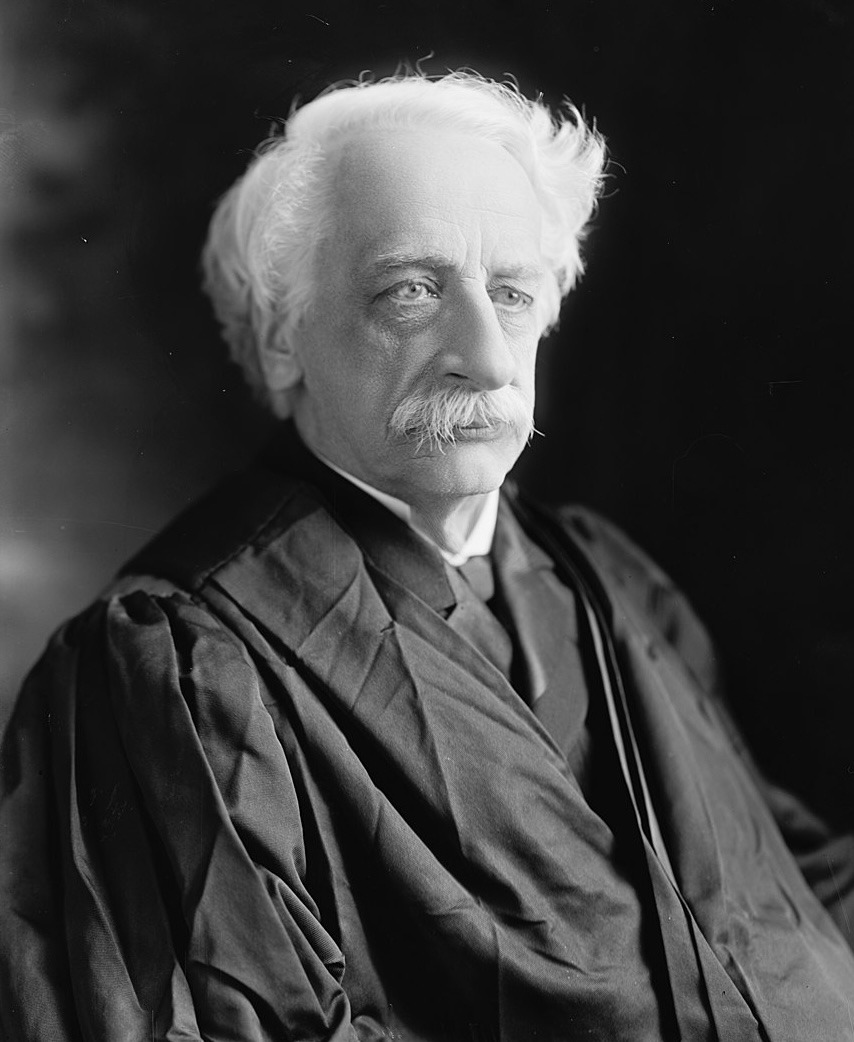
Historical · Supreme Court of the United States
Rufus Wheeler Peckham
Former justice
Former Associate Justice · Supreme Court of the United States · 1895–1909 · Appointed by Grover Cleveland
Rufus Wheeler Peckham served as an Associate Justice of the Supreme Court of the United States (1895–1909) was appointed by Grover Cleveland. The page below collects sourced biographical facts, the appointment record, and provenance for Peckham.
FJC ID: 1386206
Key facts
- Full name
- Rufus Wheeler Peckham
- Court
- Supreme Court of the United States
- Role
- Associate Justice
- Status
- Former justice
- Seat
- SCT0409
- Appointed by
- Grover Cleveland
- Appointment
- Senate-confirmed
- Confirmed
- 1895-12-09
- Supreme Court service
- 1895–1909
- Took seat
- 1895
- Born
- 1838
- Died
- 1909
- Dataset version
- 1.20260711
Appointment & service record
Associate Justice of the Supreme Court of the United States · 1895–1909
- Seat
- SCT0409
- Appointing president
- Grover Cleveland
- Appointment
- Senate-confirmed
- Confirmed
- December 9, 1895
Seat, appointing president, appointment type, confirmation date, and service dates are drawn from the Federal Judicial Center Biographical Directory and the Supreme Court's own members roster.[1][2][3]
Sources
- [1]https://www.fjc.gov/node/1386206fjc · retrieved 2026-06-16
- [2]https://www.supremecourt.gov/about/members_text.aspxsupremecourt.gov · retrieved 2026-06-16
- [3]https://www.fjc.gov/history/judges/biographical-directory-article-iii-federal-judges-exportfjc-directory · retrieved 2026-06-16
Biographical narrative
807 words · sourced from the Wikipedia REST extract
Rufus Wheeler Peckham served as an Associate Justice of the United States Supreme Court for fourteen years, from 1895 until his death in 1909. Appointed by President Grover Cleveland and confirmed by a Republican‑controlled Senate, he was the last justice seated under a Democratic president while the Senate held a Republican majority. His tenure is noted for its strong use of substantive due process to strike down regulations on business and property, as well as for landmark opinions that shaped early twentieth‑century constitutional law.
Early life and legal career
Peckham entered the world in Albany, New York, on November 8, 1838. He was the son of Rufus Wheeler Peckham, a lawyer and judge who would later serve as a U.S. Representative, and Isabella Adeline Lacey. The loss of his mother when he was nine years old marked an early personal hardship. After completing his education at The Albany Academy, Peckham pursued law by studying in his father’s office, ultimately gaining admission to the New York bar in 1859.
For a decade he practiced privately before being elected as district attorney for the city of Albany, a position he held from 1869 to 1872. Afterward he returned to private practice and also served as legal counsel for the City of Albany. His judicial career began with his election as a trial judge on the New York Supreme Court in 1883. Three years later, in 1886, he was elected to the state’s highest court, the New York Court of Appeals. While serving there, Peckham also contributed to legal education as a member of the board of trustees for Albany Law School.
Peckham remained active within Democratic circles at the local level and represented New York as a delegate to the 1876 Democratic National Convention. His professional network extended into the business world; he was known to have close ties with prominent industrialists such as J. Pierpont Morgan, Cornelius Vanderbilt, and John D. Rockefeller.
Supreme Court tenure
President Grover Cleveland nominated Peckham to fill the vacancy left by the death of Associate Justice Howell Edmunds Jackson in 1895. The Senate confirmed his appointment on December 9, 1895, and he was sworn into office on January 6, 1896. He served as an associate justice until his passing on October 24, 1909.
During his time on the Court, Peckham authored a substantial body of opinions—over three hundred in total—and dissented only nine times. His jurisprudence is often described as embodying laissez‑faire constitutionalism, reflecting a preference for minimal governmental interference in economic matters. A hallmark of this approach was his reliance on substantive due process to invalidate regulations that he viewed as infringing upon the freedom of contract.
One of Peckham’s most celebrated opinions was the majority decision in *Lochner v. New York* (1905), where he struck down a state law limiting bakers’ working hours to sixty per week, holding it contrary to an individual’s right to freely negotiate contracts. In that same opinion, however, he upheld other workplace regulations concerning bakery facilities that he deemed justified limitations on contractual freedom.
Peckham also expanded the scope of the Sherman Antitrust Act, interpreting it as prohibiting all restraints of trade rather than limiting its reach only to those already barred by common‑law principles. His stance on civil rights was more complex; while he joined the majority in *Plessy v. Ferguson* (1896) upholding segregationist statutes, he was comparatively sympathetic toward Chinese litigants in various immigration cases.
A significant contribution of his tenure came with the 1908 decision in *Ex parte Young*, which established that federal courts could issue injunctions against state officials to prevent enforcement of invalid state laws—a principle that remains a cornerstone of federal judicial power over state actions.
Jurisprudence and legacy
Peckham’s influence on American constitutional law is multifaceted. His advocacy for substantive due process reinforced the Court’s willingness to scrutinize economic regulations, thereby shaping the trajectory of labor and business jurisprudence in the early twentieth century. The *Lochner* decision, in particular, became a touchstone for debates over the balance between individual liberty and governmental regulation.
His expansive reading of the Sherman Antitrust Act contributed to a broader understanding of antitrust enforcement, setting precedents that would guide future interpretations of trade restraints. In civil rights matters, his record reflects both adherence to prevailing legal doctrines—such as in *Plessy*—and moments of progressive judgment, notably in immigration contexts.
Peckham’s death from cardiovascular disease on October 24, 1909, at the age of seventy, marked the end of a significant era for the Supreme Court. He was interred in Albany Rural Cemetery in Menands, New York, where he would later be joined by his wife, Harriette Maria Arnold.
His legacy remains that of a jurist who navigated the complex interplay between economic liberty and governmental authority, leaving an indelible mark on the development of substantive due process, antitrust law, and federal judicial power.
Sources & provenance
Every quantitative or attributable claim above carries a per-section [N] marker that resolves to the corresponding URL below. Each entry records the upstream provider, the canonical URL, and the timestamp at which the underlying source was retrieved.
Key facts
- https://www.fjc.gov/node/1386206fjc · retrieved 2026-06-16
- https://www.supremecourt.gov/about/members_text.aspxsupremecourt.gov · retrieved 2026-06-16
- https://www.fjc.gov/history/judges/biographical-directory-article-iii-federal-judges-exportfjc-directory · retrieved 2026-06-16
Biographical narrative
- https://en.wikipedia.org/wiki/Rufus_W._PeckhamWikipedia · retrieved 2026-06-16
Explore the federal judiciary
Fewer than 120 people have served on the Supreme Court of the United States in its history. Browse the full roster of current and former justices, or explore how the appointed federal judiciary fits into the federal government.